Colin Sheridan: Take your point? Supporters' championship takes deserve radio platform
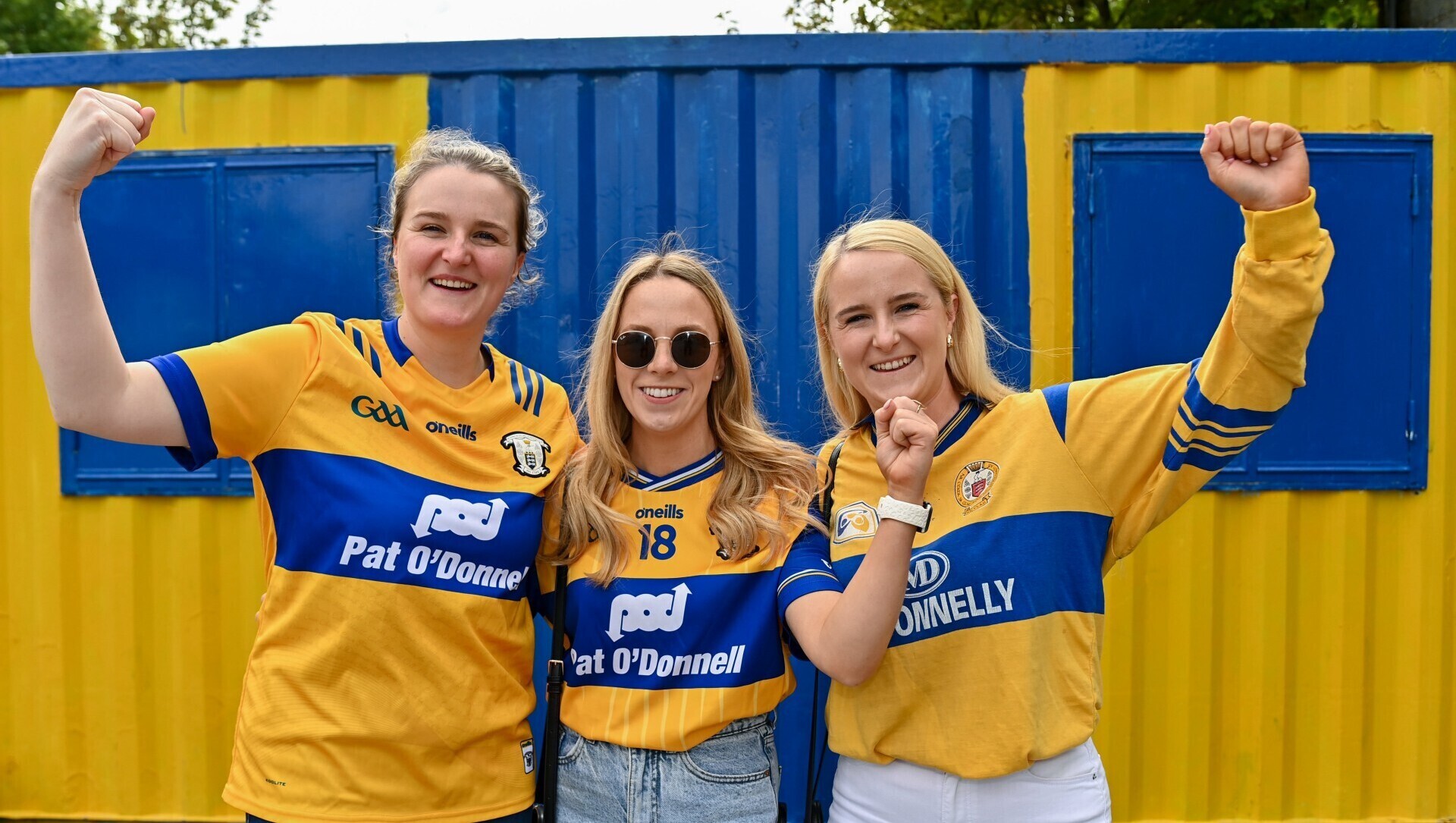
TRUE COLOURS: Clare supporters, from left, Claire McDonnell, Lorna Crowe and Louise McDonnell, from Ruan, before the game against Limerick on Sunday. Pic: Tom Beary/Sportsfile

There is a silence that settles over Ireland on an early summer Sunday evening. It is not the peaceful, reflective kind, but the frustrated, unsatisfied hum of a country that has more to say than it has been given time to say it. By six o’clock-seven, if we are lucky - RTÉ Radio has wrapped up its GAA championship coverage. The matches are analysed in a hurry before the Angelus is respectfully observed, and then… that’s it. Curtains. Meanwhile, thousands upon thousands of supporters are only beginning the long crawl home: inching out of Portlaoise and Ennis, parked somewhere outside Roscommon town with the engine idling and the blood still boiling.
And boiling it is.
Because if Monaghan’s victory over Derry this weekend proved anything it is that the championship is not a neat, self-contained product that fits into a tidy broadcast window. It is messy and emotional. It lingers. It nags at you somewhere between the toll plaza and the first Supermac’s stop. It demands expression and oxygen. And right now, radio -- both RTÉ and Newstalk -- are missing an open goal the size of Croke Park by failing to give that expression a proper outlet.
This is not a complicated idea. In fact, it is so obvious it feels faintly ridiculous to have to spell it out: a Sunday evening GAA phone-in show. Not highlights nor polite analysis. Not another panel of former players agreeing with each other in increasingly creative ways. A proper, unfiltered, gloriously chaotic phone-in. The sporting equivalent of letting the kettle finally scream.
Think about the audience. Tens of thousands of people, every Sunday, sitting in cars, stuck in traffic, phones within arm’s reach, minds racing. They have just watched their county win, lose, or implode in ways that will sustain conversation for a week. At present, that conversation migrates almost instantly to group chats, to X, to the digital ether where outrage burns hot and dies quickly.
Radio should be catching that. Instead, it waves politely as it drives past. We already know the appetite exists, because we have seen what happens when a phone-in show captures the public mood. Liveline has, for years, turned everyday irritations, cultural flashpoints and moments of national fixation into compulsive listening. It does not tidy things up. It lets them breathe, argue, spiral and occasionally combust.
Imagine that energy turned toward a championship weekend. Imagine the volume, the colour, the sheer catharsis of a nation reacting in real time to Roscommon hammering Mayo or Jack McCarron’s sideline ball. Why is that not on air?
Newstalk, in particular, is leaving something on the table here. The absence of live commentary does not exclude it from the conversatio -- it practically invites reinvention. If anything, it frees them to lean into personality, immediacy and reaction. There is no rule that says you must have called the match to talk about it. In fact, sometimes a bit of distance sharpens the edge.
And what an edge it could have.
Picture the format. Two hosts, not necessarily ex-players, and preferably not both anyway. One with journalistic sharpness, one with a bit of mischief. They set the agenda lightly before getting the hell out of the way.
You would have the lad calling from the hard shoulder outside Clones, convinced his county has been betrayed by a “three-year plan” that has somehow entered its seventh year. The lady in a packed car outside Thurles, calmly dismantling a referee’s performance with the forensic detail of the state pathologist. You would have the occasional philosopher-poet, the accidental comedian, the man who rings in not entirely sure what his point is but determined to make it anyway.
And yes, you would have nonsense. Glorious, essential nonsense. Complaints about the size of a full-back’s backside. Observations about a manager whose arms seem to be expanding in real time on the sideline. The sort of commentary that will never make it onto a highlights package but tells you everything about how people actually experience the game.
This is not a flaw. It is the point.
There is a tendency in sports broadcasting to tidy everything up, to sand down the rough edges until all that remains is a presentable, sponsor-friendly version of events. But the GAA, at its core, resists that treatment. It is tribal, local, deeply felt. It deserves a space where that energy is not just acknowledged but embraced.
And crucially, it deserves to exist somewhere other than online. Because that is where all of this goes now. Straight from the car seat to the phone screen. Into timelines and threads and comment sections that scatter the conversation into a thousand separate corners. The noise is there, but the shared experience is diluted.
A Sunday evening phone-in would pull it back together again. It would extend the life of the weekend’s action. It would turn passive listeners into participants. It would make those long drives home feel shorter-not because the traffic has eased, but because the silence has been replaced with something far more satisfying: being part of it.
And from a broadcaster’s point of view, it is as close to a no-brainer as you will find. The audience is there. The content is there. The infrastructure is already in place. What is required is not invention but recognition.
Recognition that the GAA championship does not end at the final whistle. Recognition that analysis is only one part of the story. Recognition that sometimes, what people want most is simply to be heard.
Because right now, the Sunday Game is too short, and the unspoken rants are too long. So let them have their place.
Give them a number to call, a host to challenge, a moment to vent. Let the arguments run, let the humour bubble up, let the contradictions sit side by side. Trust that, in all its messy, passionate glory, it will work.
There are louder footballers than Antoine Griezmann. Brighter ones, too. Players who arrive with a fanfare, who demand attention, who bend games to their will in ways that make the rest of the pitch feel incidental. Griezmann has never quite been that. And yet, on a damp Tuesday night in a UEFA Champions League semi-final against an Arsenal team intent on killing everything creative, he was -- once again -- the best player on the pitch. His man-of-the-match display for Atlético Madrid was a reminder of something we have perhaps been too quick to forget: brilliance does not always arrive wrapped in ego. Sometimes it drifts, finds space, links play, presses intelligently, and leaves a game subtly but completely altered. Grace is an overused word in football. With Griezmann, it fits. There is a lightness to how he moves, a willingness to do the unglamorous work, a sense that he understands the rhythm of a match better than most. He is not just playing in it-he is adjusting it, quietly, constantly.
It was not always this certain. His move to FC Barcelona, all €120 million of it, felt like a wrong turn. The hair changed, the narrative shifted, and for a while he looked like another talent who had mistaken scale for substance. A player slightly lost in the glare. But great players, the real ones, find their way back.
With France, he became a world champion and the team's composer. With Atlético, he became something more enduring: a reference point, a chameleon, a player capable of being whatever the game required. Goalscorer, creator, worker, leader-often all within the same passage of play.
Now, with a move to MLS on the horizon, there is a sense of something winding down. This time, there will be now grand farewell tour. Just a quiet transition, fitting for a player who - after a rocky start - eventually chose understatement over spectacle. All the more reason to pay attention. A prince of a footballer, one who makes you look twice. Not because he demands it, but because, consistently, elegantly, he earns it.
Napoleon Bonaparte is frequently credited with saying, “I’d rather have lucky generals than good ones.” On Saturday evening, Leo Cullen may have felt the exact same thing. His Leinster side were within a dropped pass of another semi-final elimination - and humiliation - but, mercifully for him, winger Gaël Dréan spilled the critical offload. Instead, Cullen, after a difficult start to the season, has guided Leinster to yet another European final. He had his pop at the media in victory, accusing them - us - of always wanting to “kick the boot into” his team. Fair enough. He knows only too well, however, that the only thing that justifies such an argument is victory in Bilbao in three weeks' time. Anything else - rightly or wrongly - will be viewed as failure.
Head injuries in sport are no longer a side issue-they are the issue. What an Oireachtas committee heard this week should end any lingering complacency: repetitive head impacts are linked to long-term brain damage and must be treated as a public health concern, not just a sporting one. For too long, sport has hidden behind its benefits -- community, fitness, identity. All true, but no longer sufficient. The science is clear, the consequences are lasting, and the burden cannot sit with sporting bodies alone.
If sport is to thrive, it must finally confront what it has spent decades ignoring -- and change.