Paul Rouse: Sport generally lurked just off-stage in the work of Brendan Behan
The sporting activity that Behan really loved was swimming – he is still remembered by people jumping into the tide out at Seapoint and the 40 Foot.
Paul Rouse: Sport generally lurked just off-stage in the work of Brendan Behan

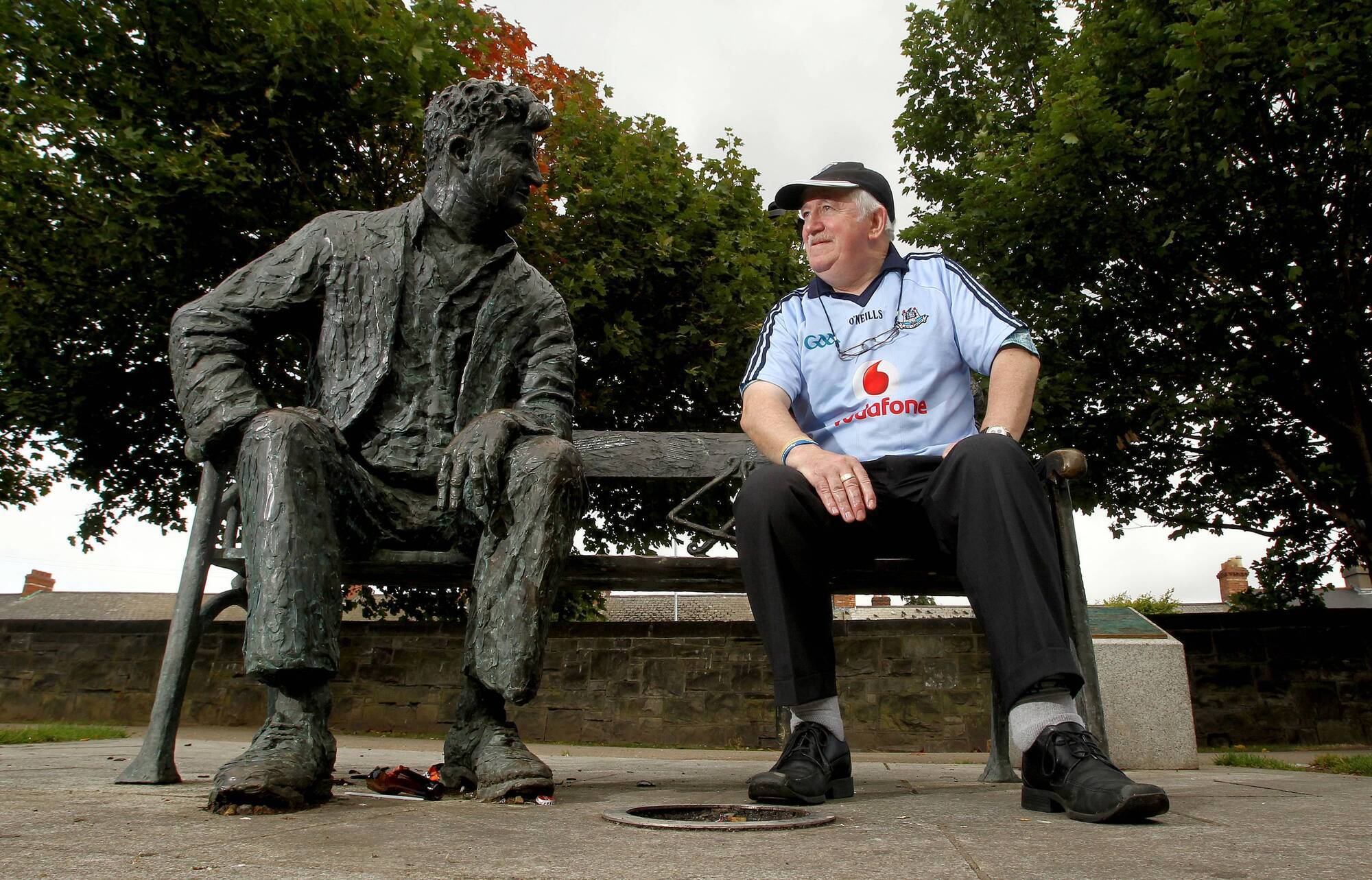
TAKE A PEW: Dublin fan Johnny Sheridan from Blanchardstown sits beside the Brendan Behan statue Pic: ©INPHO/James Crombie  

On March 20, 1964 Brendan Behan died in the Meath Hospital in Dublin. He was buried within Glasnevin cemetery after one of the biggest funerals seen in Dublin.

Behan was a complex, remarkable man. His last years were troubled. As Colbert Kearney has written, he lamented “his loss of faith in the extreme nationalism of his earlier years” and “he was fearful that exposure of his sexual interest in men would destroy his image as working-class tough guy.” At the height of his powers, though, he displayed truly unique gifts as a writer and entertainer whose linguistic virtuosity was dazzling.


His writing had been honed while imprisoned for IRA activities during World War Two (his uncle was Peadar Kearney who had written ‘The Soldier's Song’, which was adopted as the Irish national anthem). Behan wrote in Irish and in English, he wrote poems and short stories, journalism and songs, dramas and radio scripts.

His play ‘The Quare Fellow’ (about an execution in a prison) was a huge success, as was his follow-up ‘An Giall’ – written in Irish for Gael Linn and put on in 1958 to popular acclaim.

His greatest work was ‘Borstal Boy’, a novel based on his time in a borstal; it also came out in 1958, having been in the making for more than a decade. It is a work like no other in Irish literature.

By then, Behan was already drinking heavily and acting the ‘character’ around Dublin pubs. As the drink took hold, he gained a certain notoriety as a live television guest – still capable of spontaneity and wit, but also boorish and outrageous. He became a sort of celebrity and his behaviour swallowed his talent.

Ultimately, his alcoholism – poured on top of diabetes – destroyed his health, a deterioration played out in public, and led to his death at the age of just 41.

Writer Brendan Behan. Pic by Hulton Archive/Getty Images)

Behan’s life had begun in the north inner city. He was born into a family who lived on Russell Street, the stretch of road that generations of GAA supporters have walked, when they turn off the North Circular Road at Gill’s Corner and head towards the canal bridge that leans down towards the Hogan Stand.

It was from Russell Street that British soldiers starting shooting on Bloody Sunday, just over two years before Brendan Behan was born. They shot one boy off a wall and another who was sitting in a tree, both watching the game. Behan later wrote of that day and how it was remembered on the street.

He went to local primary and secondary schools before training to work as a painter, as his father had before him.

As he made his way as a writer, he wrote occasionally about sport. In a letter to The Irish Democrat when he was just 14, he wrote about how he got a kick in the neck from his religion teacher for saying that he thought Ireland could become communist. He finished the letter with the sentence – “As the Northerner said at the football final: Up Down!” This was a joke he came back to. In 1960, he flew to New York for the opening of his play The Hostage and entertained all aboard the Aer Lingus flight by singing ‘The Auld Triangle’ and slagging off what he terms a bunch of “fucking nuns” who were also on the plane.

Down had just beaten Offaly in the All-Ireland football semi-final. For those days in New York, as Dave Hannigan has written, Behan wore a red-and-black rosette with “Up Down” written on it. He knocked great fun out of explaining it to the scrum of reporters and photographers who followed him all over the city.

Actors Clive Barker, Philip Davis and Mary Larkin rehearse Brendan Behan's play, 'The Hostage', at the Theatre Royal in Stratford, London. (Photo by Michael Webb/Keystone/Getty Images)

Later, more reporters and more photographers followed him when he went to a bullfight in Mexico City. His wife Beatrice was terrified that Behan would jump the wall and join in with the bulls, as he had promised he would.

The sporting activity that Behan really loved was swimming – he is still remembered by people jumping into the tide out at Seapoint and the 40 Foot.

In Paris he swam in the piscine in the River Seine and in Los Angeles hotels he used to take the lift from his room down through the lobby wearing only his swimming togs – he thought the hotel swimming pools were the only thing to be recommended from LA.

Best of all, he described Dollymount Strand as Dublin’s Riviera.

In general, there is sport and sporting reference in a lot of what Behan wrote – but it is almost never central, instead it’s off-stage, a line or half-line to give colour or context. One man is a described as being a noted handball referee, another is a boxer, a third bets and plays cards.

In his plays, there’s a fleeting mention of an argument about football in The Quare Fellow; in The Hostage there’s a reference to a fella who played Gaelic football wearing a kilt, and a mention of rugby in Richard Cork’s Leg.

In Moving Out, there’s a scene where a barman reminisces about the great Tipperary hurlers he knew: Mick Ryan from Nenagh, Sean Roche from the Galtees, and Paddy Leahy from Boherlahan, who he said had many county medals.

There’s a lovely piece in the RTÉ radio archives – broadcast first in December 1951 – where Behan talked about hurling. He recalled going to hurling matches as a child. Those were days – in the 1930s – when the O’Toole’s Club from Seville Place played club matches in Croke Park. He also slipped into big matches, All-Ireland Finals, and collected broken hurls to play with on the street outside afterwards. He said he once played with a broken stick that had been thrown away by the great Kilkenny hurler, Lory Meagher.

The thing is though, for Behan, Croke Park was not really about watching the games. It was also a chance to make a few pounds. He said: “We’d go up to a countryman in a car and say to him: ‘Mister, give us a few makes and I’ll mind the valves of your tyres. Sometimes they were decent enough, but sometimes they’d say, ‘Go on out of that, my valves can look after themselves’. He’d know all about that after the match when he’d want to drive back to Mayo or wherever he’d come from.” 

He said the only Gaelic footballer he really knew of was the Kerryman John Joe Sheehy of Tralee. Sheehy was a four-time All-Ireland senior football winner in the 1920s, twice as captain. He was also an ardent Republican who had fought in the War of Independence. When Sheehy went on an American tours with the Kerry team in 1927 and 1931, he used the opportunity – according to Prof. Marie Coleman of Queen’s University Belfast – “to smuggle Thompson sub-machine guns into Ireland for the IRA, hidden in the players’ kit”. In 1941 Sheehy was arrested and interned in the Curragh for two years. In other words, at that time, his politics aligned with those of Brendan Behan.

Not with his sporting interests, however. Behan said: “We never played Gaelic and knew nothing about it.” 

Like many people from the streets around Croke Park, his game was soccer rather than Gaelic football or hurling. He was an Irish nationalist, but he saw no need to demonstrate that nationalism through his sporting choices.

The soccer he loved most of all was played by local teams – his team, he said, was NCR AFC – North Circular Road Association Football Club. He followed that team all over the city to cheer them on against other local Dublin clubs in Windy Arbour or the Fifteen Acres.

The team sometimes went further afield. Behan wrote a very funny article about a trip with the team to Newry where NCR AFC played the Ancient Order of Hibernians Football Club for a set of medals. The Newry players were too strong – or as Brendan Behan put it: “They were all over our crowd in everything except dirt.” He said that in an attempt to win, NCR AFC tried “every manner of lowness, but to no avail” and eventually lost 2-0.

Away from the North Circular Road, he knew the names and nicknames of the League of Ireland stars, as well as the stars of English soccer. He could recite their names like a poem.

In the summer of 1961, he was in the Polo Grounds in New York to see a Shamrock Rovers XI – filled with the stars of the League of Ireland – play an Israeli team in an international competition that was run across several weeks.

He began to fail fairly quickly after that, but to the end there was some sport. In the last proper surviving letter that he wrote shortly before he died, he wrote about swimming. He had been given a poem by the young daughter of the doctor that was treating him.

He replied: "Suzanne, a chara. I was delighted and complimented, as a writer, to receive a copy of your poem, 'The Sea'. Your mention of the shark reminds me of Hollywood. Everyone there has a swimming-pool and you might wonder why, when they have the whole beautiful Pacific Ocean stretching along the coast for one thousand miles. The answer is the shark, who every year kills a couple of hundred people. Here 'the sharks lying among the weeds' don't stay among their weeds, but swim straight into the beach attacking and savaging anything or any person that comes in their way."

*Paul Rouse is professor of history at University College Dublin

More in this section

Sport

Newsletter

Latest news from the world of sport, along with the best in opinion from our outstanding team of sports writers. and reporters

Cookie Policy Privacy Policy Brand Safety FAQ Help Contact Us Terms and Conditions

© Examiner Echo Group Limited