Would Mourinho have cancelled the sixties?
Larry Ryan offers some thoughts on the football week.

Would Mourinho have cancelled the sixties?

Larry Ryan offers some thoughts on the football week.

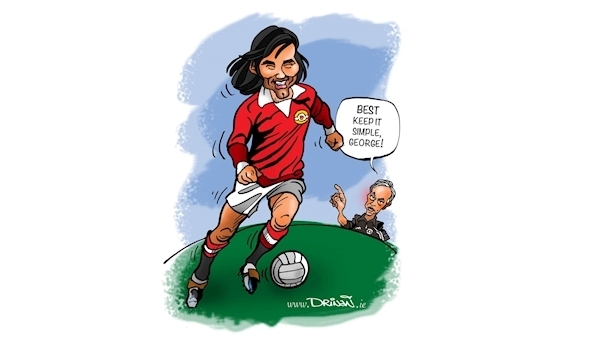
Would George have been Jose’s Best man?

They do like to attach a wider significance to their existence in Manchester. There’s a touch of the Corkness about them in that sense.

The technology age, labour-saving devices. TV and transistors, a man on the moon, feminist ideas, anti-war protests, England winning the World Cup, sex, mass consumerism — Michael Parkinson, in his new George Best memoir, links it all to Manchester’s place at the cultural heart of Britain and considers Bestie the physical incarnation of the era’s “heady optimism”.

In this week’s BT Sport documentary Too Good To Go Down, a drama screened after the comedy with Arsenal, John Cooper Clarke flips the coin: “State of emergency, three-day week, miner strikes, the IRA, a sense of panic that was palpable, and relegation at Old Trafford.”

The show wasn’t slow to labour the modern parallels in the story of United’s 1974 drop: “A major club trying to find their feet after the departure of a legendary manager… sound familiar?”

Even if United are now too big to go down, as much as too good.

It’s tempting to wonder how latter-day Jose Mourinho would have handled a distracted Bestie post-1968.

For that matter, how would he have handled the young Best who Matt Busby sent from the room during pre-match tactical team talks?

Would Jose have set him free or drilled him in blocking passing channels while bombarding him with conspiracy theories and scorning his finishing?

Might he even have broken George before he ever got started? And cancelled the sixties.

Final piece of the puzzle

Jose couldn’t have broken David de Gea now too, could he?

Square ball the new backpass?

Sead Kolasinac’s Old Trafford howler was a relic of an almost defunct genre: The poorly-weighted backpass — that reliable punchline of so many Football League goals round-ups over the decades.

Tentative little stabs backwards that coax keepers out into wild fresh-air swipes or ‘unceremonious’ penalty concessions, followed by morose displays of recrimination on all sides.

As the outhouses at the back grow ever more comfortable with the proverbial ‘ball at their feet’, we don’t see so many of them any more. Even Kolasinac’s botch-job hardly qualifies as a backpass, more second-touch-a-tackle clumsiness.

The gaffe du jour now, as defenders grow too comfortable with the ball at their feet, seems to be the over-confident, intercepted square ball, a fresh spate delivered to the Premier League this week.

Progress, of sorts.

Bookies blow final whistle?

If the score on the screen was the great TV innovation that accompanied the arrival of the Premier League, it’s a small miracle it was never joined permanently by odds on the final score, given how embedded gambling had become in football.

That looks further away than ever now.

Last week, we noted here that baseball and the other American sports are falling into bed with gambling companies just as sport this side of the pond considers untangling from this embrace.

Then word arrived Thursday that UK bookmakers have volunteered a ‘whistle to whistle’ ban on TV betting ads during all sport except horse racing.

It seems unlikely this was entirely a pang of conscience from the industry, given its efforts to delay a UK cap on fixed-odds betting terminals. More likely it’s a smart bet on a PR move before the plug was pulled anyway.

Bookies spend five times more on internet advertising than TV, according to analysts, not to mind what they fork out on disseminating banter online, so they will likely reach their targets somehow.

But Marc Etches, the chief executive of GambleAware had warned of a “tipping point in terms of the relationship between professional sports and gambling.

“We have a generation of fans who believe you have to bet on football to enjoy it and that is disturbing and concerning.”

So it’s a welcome end, for now at least, to Ray Winstone directing us ‘ave a go on that”.

Tackling the great British bloodlust

It was David Hill, an Australian, who first put the score on the screen at Sky Sports. He then moved to America and brought it with him to Fox, where not all gridiron enthusiasts were impressed.

“You’re a foreigner, and you’re fooling with football. We’ll have to kill you,” read one letter.

Back in England, Jurgen Klopp has taken on the role of foreign fool messing with the fundamentals, a job once carried out enthusiastically by Arsene Wenger. Annoyed by a leg fracture for Joe Gomez at Turf Moor, Klopp represented the heavy hand of European regulation by attempting to deny England the fundamental human right to lunge.

Needless to say, Burnley boss Sean Dyche — like the many patriots in places like Stoke and Blackburn and Bolton who once fought French rule — stood firm against Johnny Foreigner.

“I don’t think there’s many fans in this country that want to see tackling go out of the game.”

Second legless

At the time of writing the European project is suffering a fundamental blow, with America looking certain to reclaim the Mosconi Cup. Down to generous pockets maybe, or not enough vice-captains.

So there may be a certain vulnerability there when Boris Johnson steams in, taking his inspiration from football: “We may be 1-0 down at this stage of the negotiation with the EU, but we can still win 2-0.”

Gilesy zoning out?

Before the bookies gave up on TV odds, TV gave up on The Panel, as if they too were keen to get in ahead of some apocalypse that would have taken this institution off our screens anyway.

They hardly bother with a panel any more now on RTÉ, repairing to Facebook a few minutes after Champions League games, before anybody has told us what is fundamentally wrong with Manchester United.

Instead, we must rely on Eamon Dunphy’s podcast, The Stand, where Eamo and Gilesy and Chippy reconvene most weeks for this very purpose.

It is good to have the band back together, playing the greatest hits, even if there was a bum note this week when Gilesy warned Mauricio Pochettino he will need a much deeper squad if Tottenham are, as they say, to compete on all fronts.

Surely it’s not his displacement from the telly that has Gilesy forget all his old convictions about the evils of squad rotation and his certainty there’s no such thing as tiredness.

If he suddenly finds some merit in zonal marking at corners, we can begin to fear for his moral courage.

Living in the moment

Rory Smith in the New York Times perhaps best summed up the blissful honeymoon period Unai Emery has bought himself.

“Not every game seems like a referendum on the future.”

There’s an enormous sense of well-being around the Arsenal now, post the bitter divisiveness of a referendum campaign, where anything positive that happens can be a sign of progress and any lapse is just in-tray business yet to be attended to.

Searching for good news stories from the Old Trafford pantomime, it was the Manchester United Twitter account that posted a shot of the crowd following Jesse Lingard’s equaliser with the message “not a cellphone in sight, just people living in the moment”.

But it is Arsenal finally living in the here and now.

Dirty protest

How would Harry Kane have reacted had a goal like Alex Lacazette’s at Old Trafford been taken off him? Taken it to CAS? Gone on hunger strike?

Who’s the biggest Twerk?

All of football should gyrate in support of Ballon d’Or winner

Read More:

Who is the English game’s best ever twerker? Big Cas, in his pomp, made fine use of his arse, Mark Hughes would not be found wanting in that area.

But Kenny Dalglish’s magnificent posterior work was a cut above.

More in this section

Sport

Newsletter

Sign up to our daily sports bulletin, delivered straight to your inbox at 5pm. Subscribers also receive an exclusive email from our sports desk editors every Friday evening looking forward to the weekend's sporting action.

Cookie Policy Privacy Policy Brand Safety FAQ Help Contact Us Terms and Conditions

© Examiner Echo Group Limited