Tommy Martin: In football, a child is not a child but a transfer asset
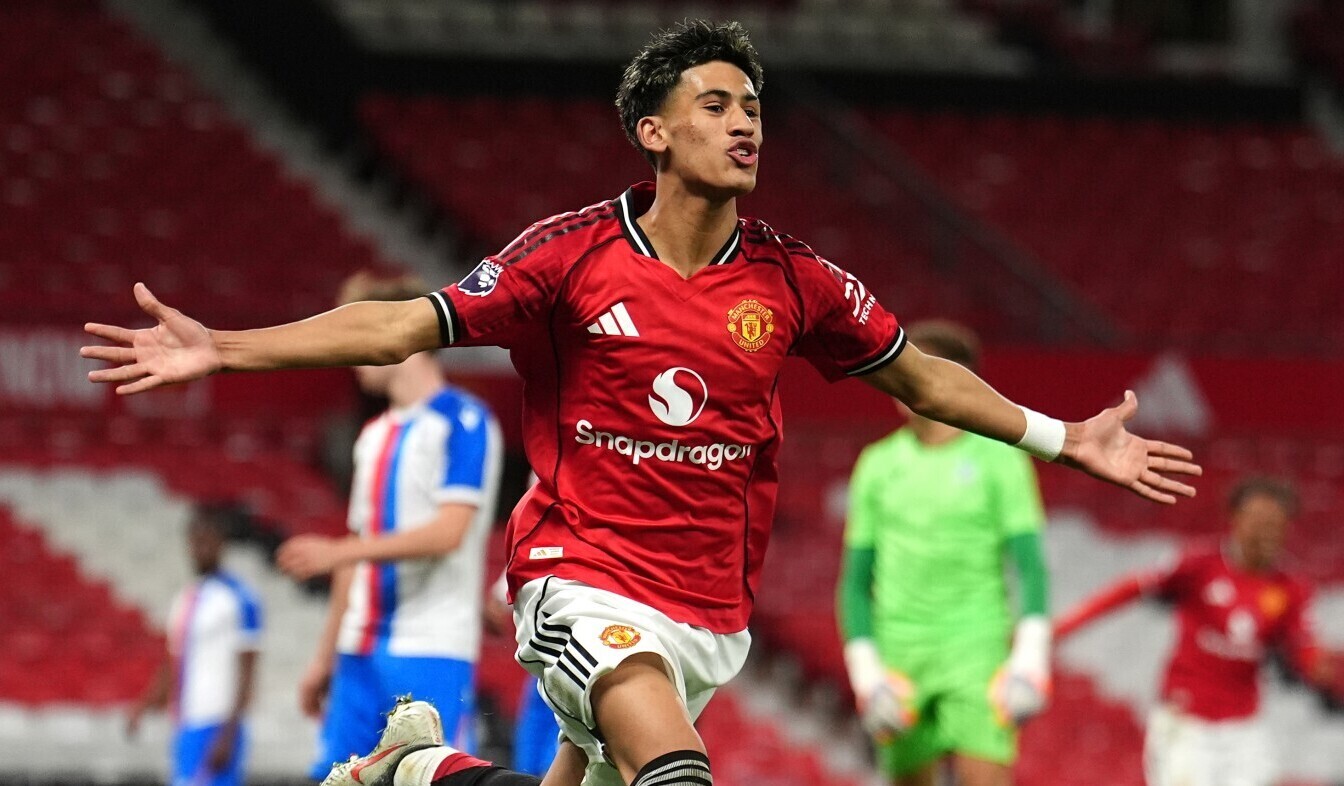
The fact that JJ Gabriel is a child is key to this story and yet seems strangely tangential. Pic: Martin Rickett/PA Wire.
When is a child not a child? When he’s a 15-year-old football prodigy.
Then he’s a pint-sized messiah, YouTube sensation, unicorn investment stock, font of endless possibility and, in the case of this week’s turn of events for Manchester United’s JJ Gabriel, ungrateful turncoat.
Football craves the exciting young prospect and the headlines generated by young Gabriel this week prove that. His achievements in the game amount to a stellar season playing up in the United under 18s, piles of goal compilation videos and even more whispered intimations of impending greatness.
And yet the news that he formally requested that United cancel his registration became a big story, another melodramatic arc in the overwrought Old Trafford soap opera. It seems that Gabriel’s people, specifically his father and agent, the twice-capped former Republic of Ireland international Joe O’Cearuill, have lost faith that United are the right club for their charge and have decided to take his talents elsewhere.
Read More
It was reported that the Gabriel camp were livid that he wasn’t included in United’s squad for their opening Champions League fixture against Sabah of Azerbaijan last Thursday. They reckoned he should have made his much-anticipated senior debut in the game, expected to be the easiest of United’s Champions League run.
The fact that JJ Gabriel is a child is key to this story and yet seems strangely tangential. United have stressed their efforts to protect the kid, reports citing concerns about the physicality of senior football. He is not old enough to even sign a scholarship contract. Meanwhile on the other side, you have a dad pushing their prodigious boy to be the best that he can be. A club versus parent impasse typical at any level of the game.
But this is professional football and all that is essentially window dressing. Gabriel is an asset and his decisions are career moves, with financial consequences running into millions for the parties involved. A player (or, at least, his representatives) goes into a strop because of gametime. Real Madrid and Barcelona are circling. Repeat, this is a child.
Where do you go with all this? Blundering United drop the ball again? Helicopter parenting taken to a new level? Football’s first-class child trafficking ring in the open air?
Some of the briefing against the Gabriel camp has focused on the pushy parent angle, with O’Cearuill’s credentials as a feisty advocate for his son being detailed. Most reports suggest O’Cearuill changed his son’s name so it would be more marketable. However, a report in said the change was “in recognition of his and his wife’s religious beliefs and because his given name carried little meaning to him.” There’s a whole lot of briefing going on here.
On one hand you think United might be well shot of the kid and his dad and the whole shebang. For all their fall from grace, it’s still Manchester United, and they shouldn’t be dancing around on eggshells because a 15-year-old doesn’t get his game in the Champions League.
On the other hand, it is Manchester United, the modern version, and this week’s hapless defeat to Brighton in the Carabao Cup only added to the sense that this might not be the place an ambitious parent would want to deposit their precious cargo. In childcare terms, their recent travails would classify Manchester United in Mrs Doubtfire category, shrieking in the kitchen with wig askew and prosthetic breasts on fire.

But are we even asking the right question here?
In the same week that the destiny of one child star became a talking point before he had even played a competitive first team game, the career of a former one reached its sad endgame. Some of the coverage of Gabriel’s Old Trafford ultimatum drew connections to Raheem Sterling, a cautionary tale of how the spectacular rewards professional football gifts to its talented youngsters can eventually spoil.
Sterling pleaded guilty this week to dangerous driving after he was arrested in May when driving his Lamborghini on a motorway while inhaling nitrous oxide balloons.
How did it come to this for Sterling, aged just 31 and currently without a club despite being an England international as recently as 2022? Some have blamed the bleak circumstances of his spell at Chelsea, which ended with him exiled from the first team squad and forced to train separately in the evenings when the other players had left. He has been unattached since an unsuccessful short-term spell at Feyenoord last season.
But Sterling’s decline from four-time Premier League winner to his hard shoulder nadir seems deeper than decisions made in football. Like Gabriel, he was a 15-year-old sensation, snapped up at that age by Liverpool from QPR’s academy, and the subject of excited fan talk based on starring performances in the FA Youth Cup. First team football and England caps followed before, like Gabriel, though at the much older age of 20, he downed tools and forced a move to Manchester City.
If Gabriel’s career achievements turn out half as good as Sterling’s, he’ll be doing well. Those Premier League titles with City, 82 England caps and an MBE for services to racial equality in sport. It is only speculation to wonder what went wrong and to look at a boy whose father was murdered in his birth country of Jamaica when he was just two years old, who was taken out of mainstream education and put in special school for three years because of behavioural problems, who was told by a teacher: “If you carry on the way you’re going, by the time you’re 17 you’ll either be playing for England or you’ll be in prison.”
Maybe football saved Sterling but maybe the fame and fortune and British tabloid opprobrium he endured as a rich, young black man was a different kind of sentence. “You know, when you see someone on TV and go, ‘I don’t like him’,” Sterling once said when explaining why he attracted so much criticism. “Some people have that face, and I’ve got it.”
Maybe the question to ask about young JJ Gabriel is whether anyone should be talking about him at all. Should a child be the subject of back-and-forth briefings and breathless transfer talk? Is it right that someone who is not old enough for a paper round should be getting the Fabrizio Romano treatment? Do children belong anywhere near the avaricious and ruthless world of professional football?
Even to ask these questions goes against the time-honoured truths of professional soccer, where youngsters are fed into the machine at the first sign of potential. Matt Busby’s phrase “If you are good enough, you are old enough” has been the rule for decades. Youth development is a mass production enterprise and the fruits are picked as soon as they ripen.
But never before have the rewards been so great and the pressures so heavy. The scale of wealth and profile the game now offers has a warping effect on even developed minds, never mind what it does to the youngest who enter its highest echelons, especially those, like Sterling, whose structures outside of the game are less than ideal.
Kids are recruited to professional academy feeder systems when barely out of nappies. Parents are gripped by the promise of untold riches. Few make it through to even Gabriel’s age but those that do must live with the reality that, for all the rewards on offer, they live in a world where a child does not get to be a child. We used to send children up chimneys and down coalmines. Someday we might wonder why we sent them into professional football.