Colin Sheridan: After 9/11, a home run gave grieving New York a moment of escape
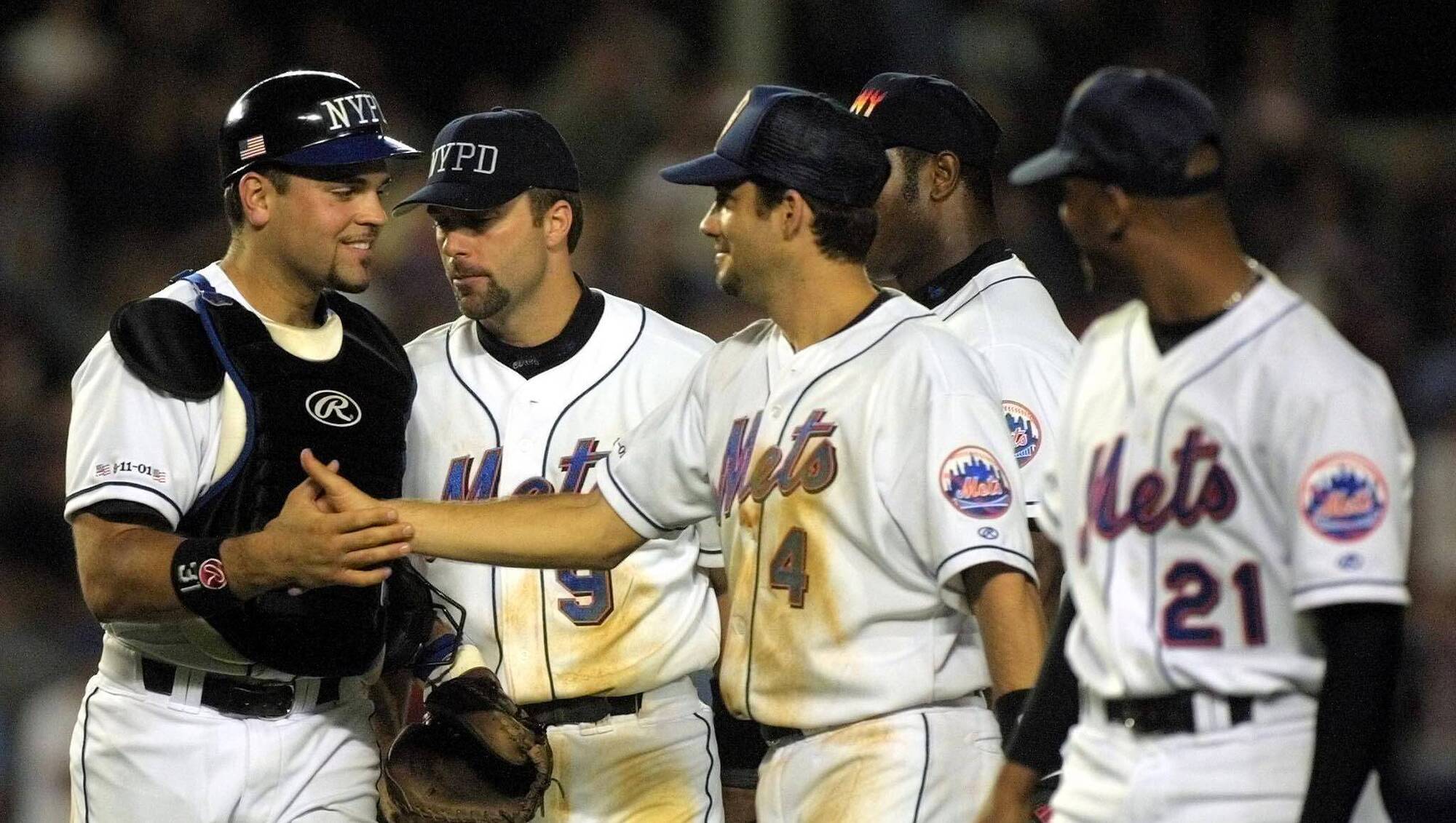
Ten days after 9/11, the New York Mets' Mike Piazza hit a baseball into the night and, for a few seconds at least, sport mattered again. Pic: MATT CAMPBELL/AFP via Getty Images

Twenty-five years ago this week, Michael Jordan was coming back. At least, that was the headline news for a couple of hours. On September 10, 2001, the sporting world was consumed by reports that Jordan, three years after his last shot for the Chicago Bulls had won a sixth NBA championship, was preparing another return. This time, aged 38, it would be with the Washington Wizards.
By 9am the following morning, nobody cared. It is difficult now to reconstruct the sporting landscape into which the first plane flew into the North Tower at 8.46am. The US Open had finished at Flushing Meadows two days earlier. The NFL season was days old. Baseball was bouncing along toward the playoffs. The Ryder Cup was little more than a fortnight away at The Belfry.
Within hours, almost all of it had become irrelevant. Major League Baseball stopped. The NFL postponed its next round of games. The Ryder Cup was eventually pushed back an entire year. Pádraig Harrington, already selected for Europe, understood why.
“The Ryder Cup is a big event,” he said. “But when you compare it with what happened in America last week, then it is not the most important thing in the world.”
Read More
For perhaps the only time in its existence, the arms race that is the elite sports industry was confronted simultaneously with the knowledge of its own complete insignificance. But sport wasn't merely watching September 11 happen. Its people were inside it.
The Los Angeles Kings lost two members of their organisation, Garnet “Ace” Bailey and Mark Bavis, aboard United Airlines Flight 175. Rugby player Mark Bingham was aboard Flight 93. Former Boston College lacrosse player Welles Crowther, the 24-year-old who became known as “the man in the red bandana”, repeatedly returned into the South Tower to help others escape before he was killed.
And a few miles north, another sporting community was discovering that the distance between the great events of history and a Sunday afternoon match could be terribly short. Gaelic Park in the Bronx has been one of the great outposts of Irish sporting life for generations. Families went there to watch football and hurling, but also to meet other Irish people, find work, make friends and construct something resembling home.
Four men deeply connected to New York GAA died on September 11: Damian Meehan, Denis McHugh, Brendan Dolan and Kieran Gorman. Meehan had grown up in Inwood in northern Manhattan, one of seven sons in a family for whom Sundays meant Gaelic Park. He played full-back as a youngster, later represented Donegal New York and the New York senior football team, and worked on the 92nd floor of the North Tower. He was 33.
McHugh belonged to another intersection of New York's Irish worlds: firefighter and Gaelic footballer. He played with Rockland GAA and the FDNY Gaelic football team. On September 11, he went to work with Ladder 13 and, like so many of his colleagues, did not come home.
There is no need to manufacture a connection between sport and what happened that morning. It was already there. What happened next is perhaps more interesting. For days, nobody quite knew when games should begin again. There was something faintly obscene about the idea of caring whether somebody hit a baseball or caught a touchdown when thousands of people had just been killed.
Then, on September 21, 41,235 people went to Shea Stadium. It was the first major professional sporting event in New York since the attacks. The Mets played the Atlanta Braves. In the bottom of the eighth inning, with New York trailing 2-1, Mike Piazza drove a Steve Karsay pitch over the centre-field wall.
The Mets won 3-2.
We should be careful with what happened next.
A home run did not heal New York. Baseball did not answer terrorism. Nor should the years of patriotic bombast subsequently wrapped around American sport - flags, flyovers, military pageantry and all the rest - be confused with what happened inside Shea Stadium that night.
Something much smaller, and perhaps more human, occurred.
For a few seconds, tens of thousands of people who had spent ten days thinking about death were allowed to care desperately about a ball the size of their fist disappearing over a wall.
That is one of sport's strange privileges. Most of the time, none of it matters. We spend our lives pretending otherwise. We become furious about referees and transfers and team selections. We allow the movement of a ball to ruin weekends and occasionally entire summers. We construct enormous emotional architectures around games whose consequences, viewed rationally, are almost nonexistent.
Then something happens which actually matters, and the illusion collapses. Twenty-five years ago, Michael Jordan was coming back. Ten days later, Mike Piazza hit a baseball into the New York night and, for a few seconds at least, sport mattered again.
Perhaps the fact that it didn't really matter in the time in between was precisely the point.
There are golfers with higher world rankings than Leona Maguire. Golfers with more titles, greater profiles and considerably more noise surrounding them. Put her in a Solheim Cup, though, and there are very few you would rather have. On Saturday, Maguire and Germany's Esther Henseleit defeated Jennifer Kupcho and Rose Zhang to deliver another European point at Bernardus in the Netherlands. More significantly, it was Maguire's 10th Solheim Cup victory in just her 14th match. Nobody has reached 10 quicker. The previous record was 15 matches, jointly held by Nelly Korda and Dottie Pepper.
Going into Sunday's singles against Lauren Coughlin, Maguire's extraordinary Solheim record stood at 10 wins, three halves and just one defeat That is some return for a player currently ranked 80th in the world and who required a captain's pick to make Anna Nordqvist's European team
But perhaps we should no longer be surprised. Maguire spent 135 weeks as the world's number one amateur before making the difficult transition into professional golf. She has since won twice on the LPGA Tour, but the Solheim Cup has revealed something else about her: an extraordinary aptitude for matchplay and for those moments when golf stops being an entirely individual pursuit.
Amid another weekend when much of Irish golf's attention has understandably been trained elsewhere, Maguire's achievement deserves its own tip of the cap. The Solheim Cup is one of women's sport's great events, and Maguire has not merely participated in it. Across four appearances, she has become one of its defining competitors. Rankings fluctuate. Form comes and goes. Careers inevitably have peaks and troughs. Fourteen Solheim Cup matches provide another measurement altogether. Ten wins. Three halves. One defeat. Whatever happened against Coughlin on Sunday, that is already an extraordinary Irish sporting record.
If ever a weekend captured the beauty and beast of sport, Eddie Dunbar just lived it. On Friday, the Cork cyclist produced one of the year's most affecting Irish sporting moments, winning Stage 19 of the Vuelta a España atop Peñas Blancas after an injury-ravaged season. Dunbar had been hit by a scooter in Monaco in March, breaking his ankle and spending three months off the bike. His disbelief and emotion afterwards made a third Vuelta stage victory perhaps his sweetest. Then, barely 24 hours later, came the cruelty. Dunbar crashed on Saturday, fractured his collarbone and was forced to abandon the race. From the summit to the ambulance in a day: professional cycling distilled to its essence. The consolation is that Friday cannot be taken from him. Hopefully, this next recovery will not take too long.
“Arsenal wear them down” may become the most frequently written words of this Premier League season. Sunderland discovered why on Saturday. They competed, threatened, won a penalty and gave the champions as good as they got for long periods. They lost 2-0. That increasingly feels like Arsenal's brazen modus operandi. They don't necessarily overwhelm opponents. They absorb them. David Raya saves the penalty, Bruno Guimarães scores two minutes later, Bukayo Saka finishes things in stoppage time. Four games. Four wins. Twelve points. Perhaps this is what champions look like once they know they're champions.