Colin Sheridan: Billionaires own the teams we love but it doesn't buy them moral authority
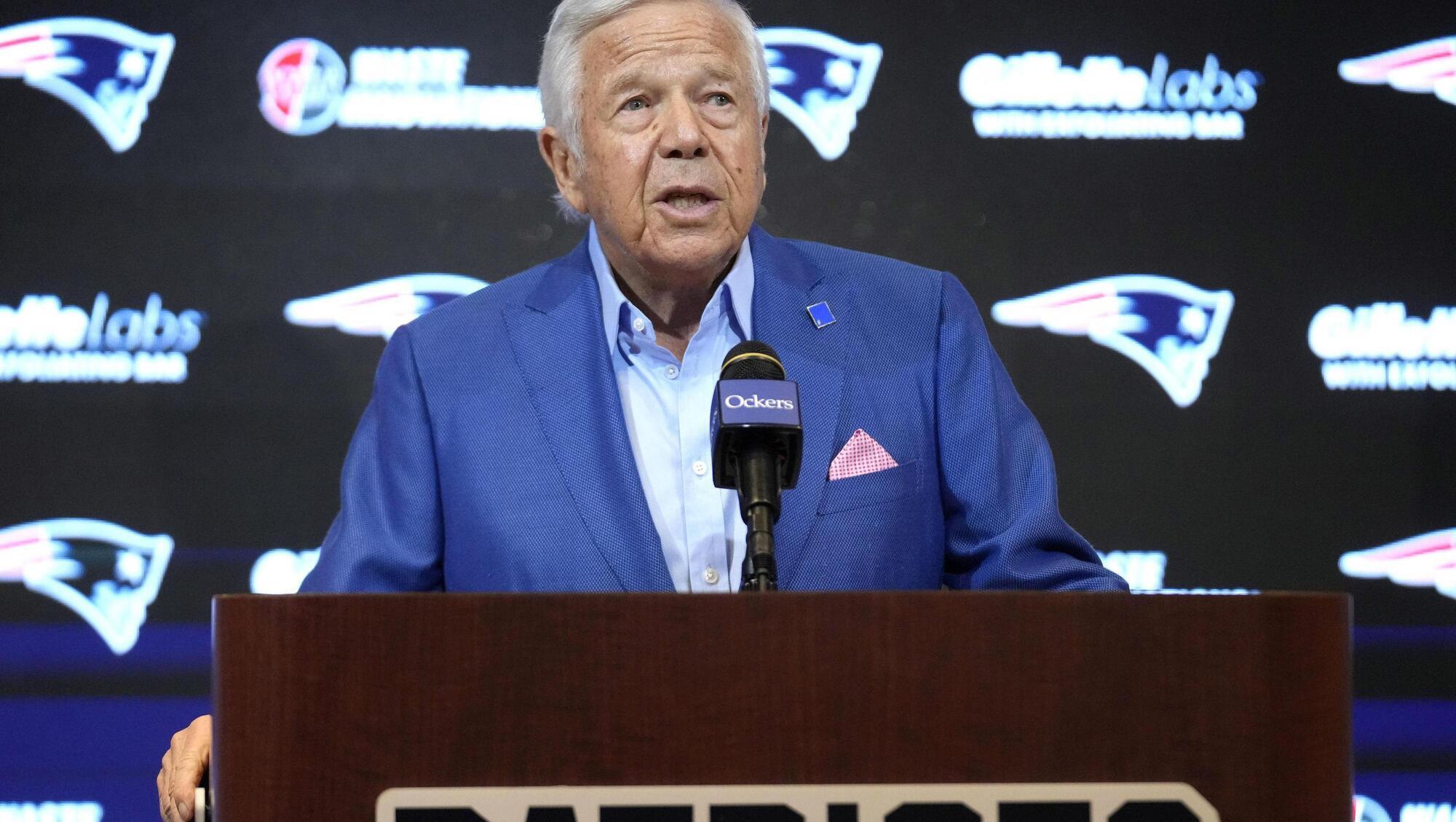
PATRIOT GAMES: New England Patriots team owner Robert Kraft. pIC: AP Photo/Steven Senne

Robert Kraft’s intervention in Ed Sheeran’s American tour caused consternation, largely because people remain strangely surprised when a billionaire team owner behaves like a billionaire team owner. Kraft, who owns the New England Patriots and Gillette Stadium, objected to Macklemore appearing there after the rapper condemned Israel’s genocidal actions in Gaza during earlier performances. The venue and promoter removed him from the tour.
Kraft did not take politics out of Gillette Stadium. He established that only the owner’s politics were guaranteed admission. Those politics are hardly obscure. Kraft is a longstanding supporter of Israel and Benjamin Netanyahu personally presented him with the Genesis Prize in Jerusalem in 2019. Accepting it, Kraft said that, after his family, nothing inspired greater passion in him than Israel and his Jewish identity.
As we should all now know, Netanyahu is now subject to an International Criminal Court arrest warrant alleging war crimes and crimes against humanity. Kraft’s political relationships and personal friendships are plainly relevant when he uses ownership of a stadium to determine who may speak inside it. He is of course entitled to his convictions. Billionaire ownership simply supplied the power to convert them into somebody else’s silence.
He has experienced uncomfortable scrutiny himself. In 2019, then aged 78, Kraft was charged with two counts of soliciting prostitution following visits to a Florida massage parlour. He pleaded not guilty and the charges were dropped after secretly recorded video evidence was ruled inadmissible. Kraft nevertheless apologised publicly for hurting and disappointing those around him. Perhaps none of us should demand moral perfection from the man who owns our football team. But nor must we pretend that purchasing one confers it.

Consider Jim Ratcliffe, the Monaco-based tax exile invited to restore the soul of Manchester United. Ratcliffe has overseen hundreds of redundancies, reduced staff benefits, increased ticket prices and replaced free hot meals in the Old Trafford staff canteen with fruit. Non-playing staff at Carrington were offered soup and bread. Nothing restores a working-class football institution like a billionaire checking whether Betty from accounts really needs a hot lunch.
Ratcliffe has also complained that Britain had been “colonised by immigrants.” This week, after he again criticised immigration welfare and taxation - probably from Monaco - Manchester United’s Muslim Supporters’ Club called for his resignation.
The workers lose their jobs, supporters pay more and a billionaire tax exile lectures Britain on sacrifice. This is apparently what football calls transformation.
Ratcliffe is merely the latest entry in an established tradition. Donald Sterling owned the Los Angeles Clippers for 33 years before a recording emerged of him objecting to his partner associating publicly with Black people and asking her not to bring them to Clippers games. Sterling had somehow become extremely wealthy in a league built largely upon Black labour, culture and support while objecting to Black people appearing in his arena. The NBA banned him for life, fined him $2.5m and forced the sale of the team. It had tolerated his ownership for three decades before discovering its moral threshold once the recording became impossible to ignore.
Ownership does more than produce embarrassing statements. It establishes the boundaries of acceptable dissent.
Colin Kaepernick knelt during the American anthem to protest against police brutality and racial injustice. He became a free agent in 2017 and never played in the NFL again. The league denied his allegation that owners had colluded against him and eventually settled his grievance confidentially. Depositions nevertheless revealed Miami Dolphins owner Stephen Ross saying he had supported the protests until Donald Trump intervened. Dallas Cowboys owner Jerry Jones testified that Trump told him: “You can’t win this one.” Years later, after George Floyd’s murder, the NFL embraced the language of Black Lives Matter and admitted that it should have listened to its Black players. It neglected to mention the unemployed quarterback who had forced it to hear them.
Sport welcomes most dissent eventually, provided the dissenter has first been removed and the slogan has passed safely through marketing.
The NBA discovered its own limits when Houston Rockets executive Daryl Morey tweeted support for Hong Kong’s democracy movement in 2019. Chinese broadcasters stopped showing games and sponsors withdrew. The league scrambled, while LeBron James complained that Morey had not considered the consequences of his words.
Human rights remained important. They had simply encountered an enormous broadcasting market.
Irish sport is not exempt from this bargain. The Irish Open presented its perfect form: we loved the golf, we loved Doonbeg and - mostly - we loved Shane Lowry.
And then there was Donald Trump.
Lowry supplied the on-course alchemy, the crowd supplied the emotion and Trump supplied the deed to the property. He arrived by helicopter, interrupted play and inserted himself into photographs whose affection belonged entirely to somebody else.
This is why billionaires purchase sporting institutions. They cannot manufacture history, belonging or communal love. They can, however, buy the ground beneath them and wait for some of the warmth to transfer.
The GAA should not imagine itself immune. The more frequently “growing the game” means pursuing larger commercial partnerships, the fewer potential benefactors it can afford to offend. Around 800 current and former players previously asked it to reconsider its Allianz relationship over the company’s financial connections to Israel. The sponsorship endured.
Dancing with the devil becomes easier once the devil sponsors the league.
Supporters do not select these people. Newcastle fans did not choose Saudi Arabia, Manchester United fans did not choose the Glazers and golfers enjoying Lowry’s victory did not endorse Trump. Our love for a sporting institution should never be mistaken for approval of the person who bought it.
But sport keeps welcoming men whose money has insulated them from consequences, then expressing astonishment when they behave as though consequences are for other people.
Billionaires do not buy our teams because they love sport more than we do. They buy them because we already love the teams - and they know there is money, power and absolution in owning the things the rest of us cannot abandon.
The Premier League’s investigation into Manchester City began in 2018. The club was charged in February 2023 with more than 100 alleged breaches of the competition’s financial rules. An independent commission began hearing the case two years ago this week. Still, there is no verdict. City strenuously deny wrongdoing and are entitled to a process that examines properly the enormous volume of evidence involved. But procedural fairness cannot require everyone else to pretend that time is irrelevant. Players move, managers leave and seasons disappear into history. Trophies are lifted, prize money distributed and qualification places decided. Rival clubs make financial and sporting decisions within a competition whose recent history could theoretically be rewritten whenever this “natural conclusion”, as Premier League chief executive Richard Masters describes it, finally arrives. That is the fundamental weakness in football’s attempt to regulate itself. Justice in sport must not merely be accurate. It must arrive while it can still mean something. Any eventual outcome now presents a problem. A severe punishment would raise questions about everything that happened while the case remained unresolved. A modest sanction would appear absurd after an investigation lasting eight years. An exoneration would leave City having spent much of their period of dominance under a cloud they could never definitively remove. The case is often discussed as a referendum on City. Increasingly, it is a referendum on the Premier League. A competition that markets itself as the most dynamic in world sport has created a regulatory system apparently incapable of moving at anything resembling sporting speed. The matches continue, the table changes and another champion is crowned. But when allegations this serious remain unresolved for this long, delay does not sit apart from justice. Delay becomes the failure itself.
World Rugby’s decision to trial a smaller ball in the women’s game may have been conceived as progress, but its implementation feels more like another decision made about female athletes rather than with them. The new ball is 3% smaller, but Ireland hooker Cliodhna Moloney-MacDonald says players received little time to adapt. She fears its different flight could complicate line-outs and kicking, while requiring clubs to purchase separate equipment. Women’s sport need not replicate the men’s game unquestioningly. Evidence-based adaptation can be valuable. But innovation without proper consultation is merely imposition wearing progressive clothes. The players’ verdict must matter more than the experiment’s marketing.
Darragh McElhinney’s 13:22 at the World Road Running Championships removed four seconds from an Irish 5km record that had stood since 2012. Yet its greater significance lies in how unsurprising such performances are becoming. McElhinney joins an extraordinary cohort including Andrew Coscoran, Sarah Healy, Sophie O’Sullivan, Cathal Doyle and national marathon record-holder Peter Lynch. Irish distance and middle-distance running no longer depends upon the arrival of one exceptional athlete every generation. Records are falling because expectations have risen. International competition is no longer somewhere Irish runners travel hoping to belong. Increasingly, they arrive expecting to compete. The occasional miracle has become a sustainable culture.