There may be trouble ahead
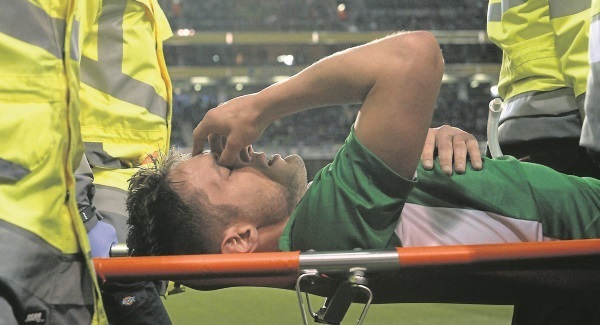
Kevin Doyle’s retirement brought in its wake a flood of warm appreciation for a hugely popular player, along with some rumination in the sports pages about the risks of potential long-term damage associated with concussion and heading of the ball.
But, in the way of these things, it took an intervention from Roy Keane to propel the subject onto the airwaves and chat shows.
Questioned at an Ireland press conference in Abbotstown on Tuesday, Keane said at one point: “If you’re worried about the physical side of any sport, you’re wary of it, then play chess.” And with the extraction of that one soundbite gaining traction, the story took on the trappings of a controversy, Keane coming in for a fair amount of flak for alleged old school, hard man insensitivity.
In fact, what he had to say in full about Doyle’s retirement was more nuanced and considered than that.
“It’s sad, but he’s made the right decision, no doubt,” he’d begun.
“He’s had an excellent career and seems a real, decent guy. He’s 34, he’s had a decent innings, and hopefully he’s picked the right time to retire. As everyone else has been saying, your health is your wealth.”
Pressed for his thoughts on the potentially concussive effects of heading and related issues, he went on: “I’m sure there is (more research needed to be done), that’s ongoing. But if you’re worried about the physical side of any sport, you’re wary of it, then play chess. It’s part of the game, whether it be hurling, football, American football, the rugby lads, it’s part of the game. When you cross that line, there is an element of risk involved.”
The line about playing chess might have been dry enough to stick in a few throats but it’s quite the leap for Keane’s critics to go from there to inferring that his comments betrayed an indifference to, or underestimation of, the seriousness of possible links between playing football and long-term damage to the brain.
This was the troubling association which had been explicitly referenced by Kevin Doyle in the statement announcing his retirement.
“This year it has been clear to me that heading the ball was becoming problematic and causing me to have repeated headaches,” he said.
“Two concussions this season and numerous others over the years have made this more concerning. After consulting the experts in this field, it has been decided that to avoid the possibility of these symptoms becoming more serious and permanent, I will be hanging my boots up for good.”
While we can all only hope that Doyle has made his decision in good time to prevent any further problems, one can’t help wondering if the fact that he finished his playing career in the United States, as opposed to in Britain, is a key reason why he found experts in the field who were ready to advise such decisive action.
The States has long been proactive on this issue, with heading banned for children aged 10 and under and, for those aged 11 to 13, limited to 30 minutes per week.
In England, the footballing authorities have, belatedly, announced plans to commission new research, largely in response to campaigning which gained intensity after a coroner found that the symptoms of early onset dementia from which West Brom and England striker Jeff Astle was suffering when he died, age 59, in 2002, had been caused by heading heavy footballs throughout his career in the 1960s and 70s.
Jeff Astle’s daughter Dawn said this week that she was shocked but not surprised by Kevin Doyle’s announcement.
“They keep saying that it was the old leather footballs that did the damage and Dad said when it was wet it was like heading a bag of bricks,” she said. “It was heavy but it was slow. It certainly didn’t come with the velocity of a modern ball...I’ve always believed that the problem is still there.”
Not everyone agrees. Last year, Jan Erkstrand, Professor of Sports Medicine at Linkoping University in Sweden and the Lead Expert in Uefa’s Elite Club Injury Study, spoke at a sports medicine conference in Dublin and, when I interviewed him afterwards, he had clearly yet to be convinced that heading might be linked to degenerative brain disease.
“Football is the biggest sport in the world and if that was the case you would have seen tons former of football players with brain problems,” he told me. “It would be an epidemic. It isn’t. The fact is the problem with head injuries is normally from a clash of heads or an elbow or something like that. Heading is not a problem for the trained footballer because they focus on the ball – they are trained how to head it - and we’ve not seen any studies showing heading by footballers, who really are footballers, has any later effects. It’s not like in boxing or something.”
That view may change with further research but, in the meantime, only the most foolishly irresponsible would dispute the importance of concussion protocols being applied to the maximum whenever a player suffers a blow to the head. This is when medical opinion should automatically and without question override all other considerations.
“The doctor has to be the one who decides,” Jan Erkstrand emphasised.
“There is no way the manager should have a say. It’s purely a medical thing. Because if you break that rule there is a big risk for later.” In the bigger picture, it’s not hard to imagine that the restrictions on heading the ball already in place for children playing football in America will, before very long, be replicated on this side of the Atlantic. But pending the emergence (and acceptance) of definitive proof of a link to long-term brain damage, the day when heading is outlawed in the adult game still seems a very long way off, if it ever dawns at all.
Kevin Doyle’s retirement will certainly have helped concentrate minds on the matter but I suspect that, as things stand, the vast majority of those who currently play the game as they know and love it, will continue to do so in the belief that the rewards outweigh the risks.
Listen to the latest Irish Examiner PaperTalk podcast:
Or to get the latest episode automatically, you can SUBSCRIBE ON iTUNES