New Euro 2016 rules could see referees send players off before the match even starts
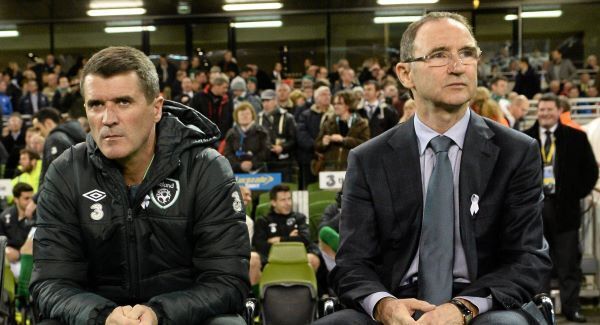
Roy Keane, that’s who.
Well, sort of.
Although, not really.
But, hey, did I get your attention or what?
And, actually, there is a connection between Ireland’s Assistant Manager and a raft of changes in the rules of the game which are being debated this very weekend in Cardiff and which could see a number of them ratified in time for application at the European Championship finals this summer.
One innovation will permit referees to send players off for pre-match fights, something which was not permissible until now since the existing laws were drawn up long before it became the norm for teams to line-up beside each other in the tunnel.
Former Premier League referee, David Elleray was charged with drawing up recommendations for the rule changes which are expected to get the green light from the International Football Association Board — the body charged with overseeing the rules of the game.
In a recent interview, Elleray cited the famous 2005 row in the tunnel between Roy Keane and Patrick Vieira as an example of an incident which, even if it had come to blows being exchanged, would still not have allowed the referee on the day to send the players off.
But, from Euro 2016 on, it’s envisioned the ref will be able to impose the ultimate sanction for what is deemed a red card offence, from the moment he has conducted his pre-match inspection.
Happily, however, this won’t mean games kicking off with 10 v 10, or worse.
Instead, the plan is to allow managers to deploy a substitute from the off but, by doing so, they would in effect suffer the penalty of being reduced to just two substitutions over the course of the actual game. (Speaking of subs, another proposal up for discussion is a fourth substitution be allowed in extra-time).
Another change in the rules will be evident with, literally, the very first kick of Euro 2016 — no longer will the ball have to move forward from the centre-spot.
It’s a tiny change on one level yet one that will alter the football habits of a life-time.
Instead of the usual practice of the little tap forward and then the pass back, from this summer on the ball will be allowed to travel in any direction at the kick-off, just so long as it moves.
These proposed changes, and others — including introducing the “sin bin” to football— arise out of what David Elleray has described as “a comprehensive review” of the laws of the game which has seen the existing, archaic 22,000-word rule book almost halved to around 12,000 words.
“We have tried to use much clearer language,” he said. “We tried to avoid a lot of unnecessary repetition and we tried to make it up to date.”
While many of the recommended changes are expected to be rubber-stamped today, IFAB — a body which, for historical reasons, is composed of four ‘home nations’ members, including one from the IFA in Belfast, and four FIFA representatives — has already found itself at odds with UEFA over how to deal with the so-called ‘triple punishment’ conundrum.
While there is almost unanimous agreement across the game that the current sanction of penalty, sending off and suspension for a player who deliberately prevents a goal-scoring opportunity is simply draconian, UEFA’s proposal the red card be replaced by a yellow card (for non-dangerous fouls) has already been rejected by IFAB who are expected, instead, to do away with the automatic suspension.
Patrick Nelson, chief executive of the IFA, has said: “There is a will to move rapidly on this matter.”
A much slower train coming, however, is the introduction of the video ref but, for those of us in the appliance of science corner, it’s at least encouraging to note that IFAB are expected to approve trials of the technology in a bid to finally get to grips with issues such as contentious goals, penalties, red cards and cases of mistaken identity.
This column could bore for Ireland — and, indeed, frequently has — on the absurd anomaly whereby the armchair supporter, sitting perhaps thousands of miles away from the action, has instant access to a commonplace technology which is still denied the one person on the spot who is empowered by football’s highest authorities to make the right decision — which, as we know, quite often turns out to be wrong one.
And for those who fear that the mere appearance of the video ref will cause massive disruption to the flow of the game, I make no apologies for referring once again to the ‘Hand Of Gaul’ goal and my cast-iron contention in the time it took an apoplectic Shay Given to chase Martin Hansson halfway ‘round the Stade de France, a video ref would have been able to sit back with a glass of wine and tapas and watch a veritable box-set of enlightening replays of that notorious goal.
In a promising departure from the conservatism on this issue Sepp Blatter and Michel Platini, new FIFA boss Gianni Infantino stated earlier this week that he hopes that video experimentation can begin “sooner rather than later” but, unlike goal-line technology — which we now know will be in place for the Champions and Europa league finals as well as Euro 2016 — there is bound to be much apocalyptic debate on the subject before the video ref finally gets to make his, her or even its international debut, perhaps at the earliest at Euro 2020 but more likely at World Cup 2022.
But, thankfully, even this slowest of trains seems to be finally ready to at least leave the station. Writing in the magazine’s latest issue, World Soccer’s authoritative Keir Radnedge notes that several national federations have already expressed an interest in playing the role of guinea pig.
“The FA may propose next season’s FA Cup but the Premier League may be more ambitious, particularly with the Bundesliga having thrown its hat into the ring,” he observes.
“The Germans, left behind in the rush to domestic goal-line technology, have no wish to be seen playing catch-up again.”
Nice to see that, however much the face of the game might change, the ancient rivalries remain.