Paul Rouse: Saudis betting big on video games a sign of sporting times
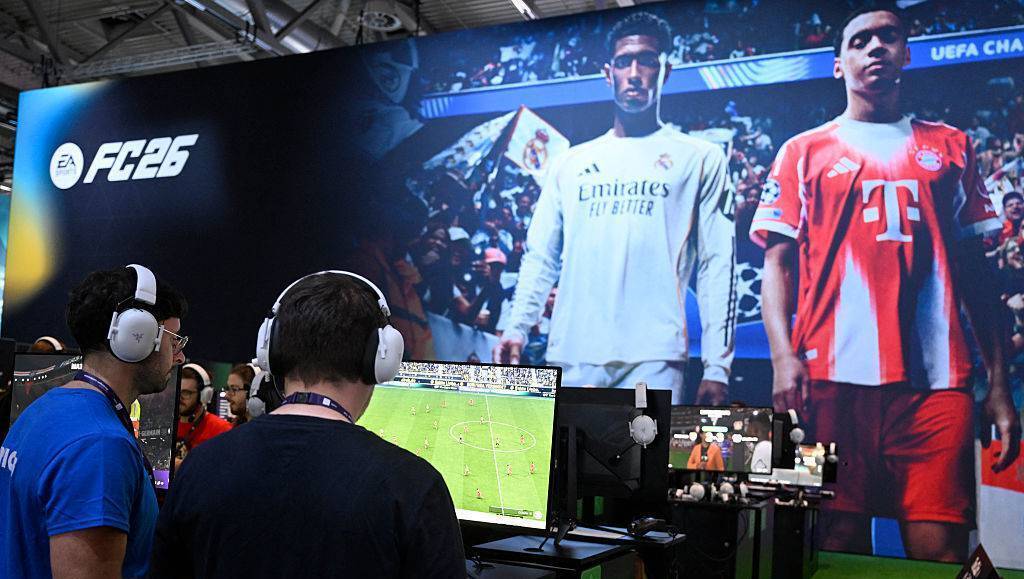
Electronic Arts (EA), the maker of some of the most successful video games across the past 50 years, was bought by an extraordinary group of investors for $55 billion. Pic: INA FASSBENDER/AFP via Getty Images
Modern sport has always offered ways for a global elite to indulge itself. From the 19th century, this elite hunted, golfed, played polo and sailed in competition with itself.
The truly rich never lost.
This shared interest in sport has been remade in the 21st century to fit the digital age. The new elite now unite to buy up as much of sport as they can. This extends from the biggest field games to the world of online gaming.
This month Electronic Arts (EA), the maker of some of the most successful video games across the past 50 years, was bought by an extraordinary group of investors for $55 billion. These investors are led by Saudi Arabia’s Public Investment Fund (PIF) and by Affinity Partners, a private equity company run by Donald Trump’s son-in-law Jared Kushner. Silver Lake private equity group is also involved, while about $20 billion of loans came from JP Morgan bank.
World history is filled with accommodations between seeming incompatibles, not least when there is money to be made. And so in this instance the New Yorkers and the Saudis – regardless of any previous inconvenient history which can be dismissed as irrelevant – just get on with reshaping the world to allow them hoover more and more cash for each other.
The Saudis are the majority stakeholders. They now own games such as Madden NFL, The Sims and Battlefield, as well as EA Sports FC (which was called Fifa until 2023), games which have dominated many childhoods – and helped those childhoods stretch long into adulthood.
When news of the impending purchase first broke, many gamers were opposed. They did not wish their world to be owned by the Saudis. Their views proved irrelevant.
It is mistakenly presumed that all of this Saudi engagement is sports washing (the attempt to use sports as a form of propaganda to direct attention away from a country’s human rights abuses or other scandals). It is much more than that: it is about diversification of the Saudi economy through growing the sports events industry and tourism as the Age of Oil comes to an end.
The hundreds of millions of dollars that are available in its Public Investment Fund offers it the scope to diversify in ways that include the personal interests of its leading figures, among them being sport.
Whatever about motivation, the outcome of the involvement of Saudi Arabia in sport is also a complicated story; it is not one of linear growth or gathering success.
Having been upstaged by Abu Dhabi winning the Champions League at Manchester City, Saudi Arabia sought to make up lost ground through the purchase of Newcastle United and, more particularly, the dramatic expansion of the Saudi Arabian league. Both have made progress, but remain dwarfed by competitors.
Against that, it was awarded the right to host the 2034 Fifa World Cup. It is a regrettable truth that every decision made under the leadership of Gianni Infantino stands open to question. He remains a lickspittle whose megalomania and toxic relationship with power (its pursuit, its use, its monetisation) has destroyed Fifa’s credibility even in respect of the fair application of the basic rules of play.
It remains to be seen how Saudi Arabia manages the delivery of the 2034 World Cup. This is particularly the case because of the new context in which the competition will be played.
The impact of Trump’s disastrous and losing war in Iran is redrawing the Middle East and it is not apparent where power will lie when current hostilities end. What is clear is that the security previously guaranteed by America is finished; it is difficult to say how it will be restored and who will benefit.
The war had an immediate impact on sport in the region. One of the sporting events to be cancelled was the Saudi Arabian Grand Prix. The country has invested heavily in Formula 1, which is the fastest growing major sport in the world in respect of global media coverage. It poured money into the McLaren team and its Grand Prix is staged at Jeddah at a newly built track.
The greatest failure came in golf, where Saudi Arabia’s vast investment in a breakaway golf league ended with a statement released in late April this year: “Public Investment Fund (PIF) has made the decision to fund LIV Golf only for the remainder of the 2026 season. The substantial investment required by LIV Golf over a longer term is no longer consistent with the current phase of PIF’s investment strategy. This decision has been made in light of PIF’s investment priorities and current macro dynamics.”
It should be noted that the estimated spend by the Saudis on LIV golf over the past five years has been around $5 billion.
Further down in that April statement came a sentence which set the scene for the ongoing investment in video gaming: “Public Investment Fund remains committed to deploying capital internationally in line with its investment strategy, including its substantial current and future investments in various sports as a priority sector.”
With so much of life now lived online and mediated by screens, the bet on the purchase of EA Sports is that artificial intelligence will reduce production expenses for games and will also help drive an entertainment boom.
There are many competitors in the market, however. The PIF has already invested in some of those, but none to anything like the scale of the purchase of EA.
The accelerating change in cultural behaviour, the way the internet facilitates fads which rise and fall with unprecedented speed, means that this is far from a sure bet.
Indeed, the only certainty is that, whether this investment succeeds or fails, the men who are in charge will all be absolutely fine.