Looking after No 1: Durcan will come back stronger
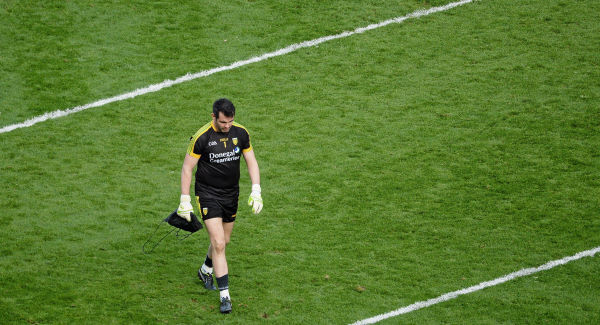

I know a list of things that have to be said but which will mean nothing to him. At half past three last Sunday he was this year’s All Star goalie in waiting. At five o’clock, he was still that. This year he came to the summer looking fitter than he has ever looked, looking more commanding than he has ever looked and operating a kick-out strategy which put him within touching distance of the greatest kick-out operator that Gaelic football has seen, Stephen Cluxton. One of Paul Durcan’s kick-outs last Sunday, when he angled a ball out to a yellow jersey on the angle between the 21 and the sideline was a fantastic kick.
Every goalie hits a reef now and then. Even my friend Stephen Cluxton has had the odd haunting moment in that goal beneath the hill. It’s the same goal where Donaghy stole two goals against Alan Quirke back in 2007.
I still wake up in cold sweats thinking of the goal Martin Comerford out past me in the All-Ireland final of 2003. Seán Óg coming in on Comerford’s right-hand side. I know Comerford’s body language. He is trying to shoot the ball across me. The shot getting squeezed off, it takes a deflection and a bounce, and the ball sailing into the goal on my near side with what looked to me like the urgent pace of a hot air balloon on a calm day. Torture.
That is goalkeeping.
I heard Paul Durcan interviewed on Newstalk after the Dublin game. He had enjoyed a great game and I was hugely impressed listening to his openness and confidence as he spoke about his year and his trips to and from Dublin and the work he does. Ten years into his inter-county career, he was speaking like a man in his prime.
Donegal people will do well to remember that Dublin game actually. In Dublin, I hear a lot of people saying that if only Diarmuid Connolly had put his goal chance away, things would have been different for Dublin. I don’t know if you can isolate a moment in any game and say that if that moment had been different, everything afterward would have worked this way or that. The point is though that Connolly is maybe the best finisher in the country. When he took that ball the traffic around him meant he had a narrow enough avenue to goal. Durcan came off his line perfectly. With the speed Connolly was travelling, and the movement around him, the last thing he needed was a six foot five wall of Donegal man blocking out the light.
The angle we view games at on the telly give the impression of there being more space than there really is when you are down on the field There was no room or no time for a bit of trickery from Connolly. Connolly did the right thing, he hit it low when Durcan, a very big man, might have been expecting him to blast the ball between head and chest height. Durcan made the save. He won’t have been going around Donegal after that crowing that without that save, Donegal would have lost. He shouldn’t be thinking this week that without his mistake, Donegal would have won. But he will be.
I noticed Paul got off the pitch pretty quickly when the whistle blew. In 2003, after Martin Comerford scored, I wanted first that we would recover and win, second that we might grab a draw, third that if we were to lose, it should preferably not be by three points, not by the width of the goal that went past me. We lost by three points. So did Donegal. I got off the field and out the gap as quickly as Paul Durcan did. It’s not a time when you want well intentioned people coming up and slapping you in the back and telling you not to worry. You don’t want a Kilkenny man or a Kerry man standing over you before he gets his winners’ medal telling you that you’ll have better days. You want to go somewhere and shut the world out.
Now put yourself in Paul Durcan’s position. This summer and last Sunday, part of his excellence was in the set-ups from kick-outs. Kerry decided to drop back and give up worrying about the short kick-outs after a while because Donegal were executing them so well. Durcan was making guys materialise out of nowhere to take the ball and start movements.
When it came to that fraught moments in the second half, a lot of things were going on. The pitch ahead of the keeper was half in shade and half-bathed in bright sunlight. When you are playing a game as Donegal do, the opposition players watch the goalie like poker players at a high stakes table looking for the “tell” from a rival player. A goalie can betray in his body language if he is going to belt the ball as far down the field as he can, but anything cleverer than that not only can he give nothing away in his run up but he has to keep some options for himself. He has to be able to change course at the last second.
On Sunday as he moved toward kicking the ball, the peripheral vision on Durcan’s left side was flooded and diffused with sunlight. On his right it was shady. Both teams were wearing green and yellow and in the millisecond, Paul had to sweep his eye to the left, with the light coming into play I am sure he just never saw Donaghy’s movement until the last moment, when he went to connect, saw the danger, stuttered and made it worse.
Until that moment he had a lovely system in place. He was finding players on the edge of the D and if they looked likely to get mugged, he was adapting and sticking it out further over the heads. But in that moment in the second half, a lot of random variables just came together and undid Paul Durcan.
Eleven years later, anytime I see Comerford’s goal from 2003 on some flashback thing on TV, and I imagine the entire country is stopping whatever it’s doing to have a laugh at me. It still makes my blood run cold. It was into the next year when Donal O’Grady said something to me half casually (but intended, knowing the man) about how would anybody save that ball with the deflection etc that I started to get my confidence back. For a long time, I felt guilt when I looked at my teammates. Felt I had let them down. I felt I’d lost the right to speak up in the dressing room. O’Grady’s absolution put my mind at ease in the end.
Paul Durcan finished out the game last week on autopilot, doing all the things he has trained himself to do. The mechanism kicked in. No point saying anything else to a brother in goalkeeping but the winter will be slow but he has reached such a level of excellence and confidence in his keeping and game management that he will be better than ever next year.
All-Ireland finals are crazy places for goalkeepers to walk into. I thought last week oddly enough that Paul Durcan was playing without fear and Brian Kelly at the other end was a lad playing in his first All-Ireland final and hoping to get through it. The first one is often like that. It controls you, not the other way around.
The great thing for Brian Kelly is that he is a young keeper and he has survived that first tightrope experience. He can grow from here. Being a young lad playing behind guys like Marc Ó Sé and Aidan O’Mahony can be both reassuring and inhibiting. In Kerry speak, you needs some carraigs to be bossing those lads around. Twenty four years old and an All-Ireland medal in the drawer. If he seals that place down for another 10 or 12 years, he’s in Hall of Fame territory.
Tomorrow in Croke Park two more goalies walk out onto the stage. Eoin Murphy and Darren Gleeson got through the last day in one piece but the nature of goalkeeping is that survival one day means nothing a few weeks later. Goalies grow in yearly or two yearly increments. They mature later and play on later.
Tomorrow the dial is set back to zero for both of them. Maybe both men will finish the game in the plus side. Maybe both of them will wind up with minus numbers and dark emotions to deal with. You can be a winning All-Ireland goalie but still be a bit shaken by the experience if you know that your colleagues dug you out of a deep hole.
The drawn game was so deeply and absorbingly tactical that there is hardly any point in attempting to predict the match ups which will be dreamed of by men who have watched the replays over and over and over again.
Kilkenny’s position depends on whether Brian Cody is a glass half full or a glass half empty man. Kilkenny either have a lot of guys who just didn’t perform the last day or they have more room for improvement than Tipp have. If the glass is half-empty, who does he turn to with confidence? It was odd to see but the impact of the changes Cody made from the bench the last day wasn’t inspiring. But these are guys you can never write off.
For Tipp can they get any better? Will Callanan score with such ease and economy this time around. Will Noel McGrath have another day where he scores four from play and hardly gets a mention, so amazing have the forwards around him been? Does Lar have another purple patch in him like the last day?
What remains the same is the business of the goalkeepers. Clock set at zero. Job to control as many of the variables in front of them as is possible. That’s the same and so is the responsibility of the referee. Like anybody else, a referee will be prone to human error. He needs to control things in a large and confident way though, with the authority and game management of a great goalkeeper.
Barry Kelly pulled that off the last day and he gave us a game which was tough and intense and breathtaking.
Tomorrow everything is reset to zero. At some stage a simple twist of fate might decide the outcome in the middle of all the fury and beauty. I hope the victim isn’t wearing No. 1 on his back…
@donalogc