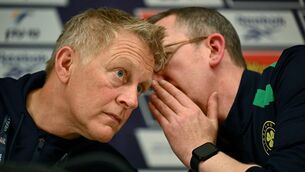
O’Neill could have been ‘Chosen One’

But that was all of 12 years ago, when Ferguson indicated he would step down at the end of the 2001/2 season. O’Neill was widely believed to be a frontrunner to succeed Ferguson at the time but when the United manager had a change of heart and decided to extend his tenure at Old Trafford, the question of the succession was put to bed for more than a decade.
Now, with the picture radically altered, it’s David Moyes who finds himself in what has rapidly become the most unenviable job in football, while Martin O’Neill continues to get to grips with the international game as manager of the Republic of Ireland.
Recently in Tralee, Radio Kerry’s Weeshie Fogarty – a self-confessed “Manchester United follower since pre-Munich” – asked O’Neill if he’d like to have managed the club and if he’d ever been approached about the position.
“You’re going back into ifs, buts and maybes,” O’Neill replied. “I was thoroughly enjoying myself at Celtic at the time when there was the possibility of Sir Alex Ferguson leaving the football club. I think he’d announced it way back years and years ago that he might be leaving. Loads of name were bandied around. I was having the time of my life at Celtic. And Celtic are a really, really fantastic club.
Speaking before the Manchester derby, O’Neill went on: “Those things are gone now. Alex has obviously retired...It’s been a really tough season for them in every aspect. Obviously Ferguson has left a tough job for anyone to follow, certainly immediately, but I’m quite sure that David Moyes can come through.”
In light of that demoralising collapse against their noisy neighbours, O’Neill’s supportive remarks sound even more like wishful thinking and, as Roy Keane observed in Cork this week, things are set to get a whole lot worse before they get better for United, with Bayern Munich hot favourites to make chumps of the champs when they visit Old Trafford on April Fools Day.
It might not have been his intention but, in an interview adjacent to this column, O’Neill might as well have been talking about the current incarnation of United when he observes: “Not every side playing Champions League football is the quintessence of excellence. Absolutely not.”
Not that Man City, or Liverpool for that matter, are entitled to parlay their current superiority over Man U into a belief that they too belong in the elite bracket of European football. Their conspicuous absence from the Champions League shake-up is one reason, while another was provided last Sunday night in Spain by that truly sensational ‘clasico’ between Real Madrid and Barcelona, a 4-3 win for the Catalans which had just about everything: skill, passion, controversy and goals, goals, goals, the whole intoxicating brew graced by a parade of some of the biggest names in the world game – Messi, Ronaldo, Neymar, Bale, Iniesta, Xavi and whoever you’re having yourself.
The presence of both clubs in the quarter-finals, alongside the likes of Bayern, PSG, Atletico Madrid and England’s best remaining hope, Chelsea, makes for the kind of mouth-watering line-up that reinforces the increasingly popular notion of the Champions League as the benchmark for quality in European and world football.
And it’s that kind of global box-office appeal which explains why UEFA have been galvanised into taking action to shore up the profile of the international game, beginning with the unveiling last month of their new ‘week of football’ calendar.
Now comes confirmation of the opening of a new front, with the ‘League Of Nations’ – by the way, that worked well last time out, didn’t it? — which is designed, at least in part, to all but replace ye olde ‘meaningless friendly’ with something boasting a nominally competitive edge.
At what we might call the ‘Premier Division’ level of the new deal, the difference will be minimal, if only because the big guns should continue to qualify for the Euro finals through the existing route, rather than having to worry about scrapping for back door entry by securing one of the four slots which will be available via the new system, with its internal promotion/relegation and play-off structure.
The temptation to regard the whole thing as an international version of the Europa League might be strong – the idea comes, after all, from the same people who have brought us France playing friendlies in the upcoming Euros qualifying campaign – but, depending on where Ireland stand in four years’ time, we could yet find ourselves investing our main hope for qualification for Euro 2020 in the ‘League of Nations’.
And, possibly, ditto for the World Cup finals two years after that.
Of course, the much more pressing issue for Martin O’Neill now is qualification for Euro 2016.
And, as challenges go, having to live up to being Ireland’s chosen one is surely preferable, at this moment, to being in the position of the man some are calling Manchester United’s wrong one.