Green Tech Skillnet, delivering training supports for businesses seeking to sharpen their renewable skills
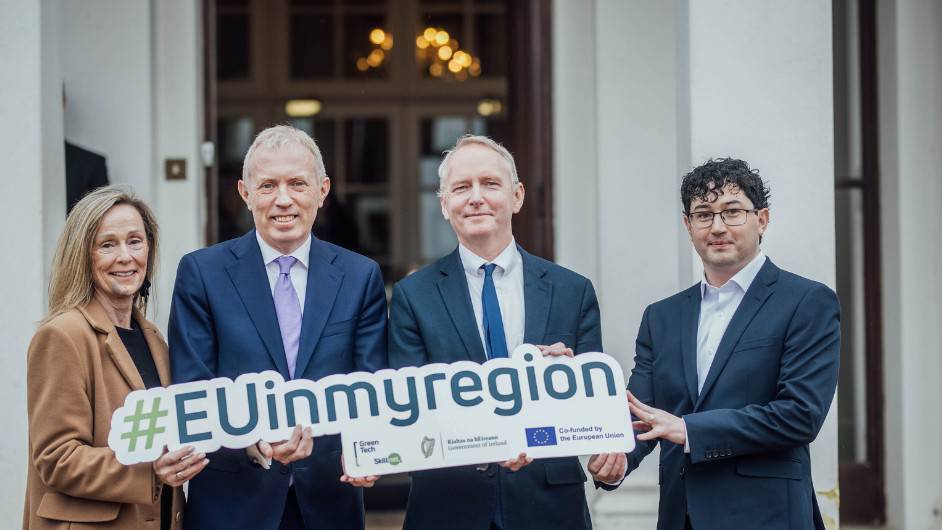
Jeanette Gill of Green Tech Skillnet; Minister of State at the Department of Climate, Energy and the Environment, Timmy Dooley; Dave Flynn of Skillnet Ireland; and Mark Ruane, network manager of Green Tech Skillnet, at the launch of the Green Tech Skillnet and UL accredited micro-credential programme in Landscape Visual Impact Assessment (LVIA), designed to address a skills gap across Ireland’s planning, environmental and renewable energy sectors.
An ambitious young developer feels that it’s now the right time to present her bold business proposal to the board of directors.
She’s proposing to build a wind farm off the west coast of Ireland and harvest the flow of ethical profitability for decades.
She needs to frame her presentation carefully because the old dogs on the board have travelled many a hard road and they are bound to pick more holes in her idea then would be found in a large lump of Swiss cheese.
The first thing she does, obviously, is to hire a consultancy and ask them to help map the wind farm supply chain all the way winding from pretty PowerPoint to shooshing turbines off the coast of Kerry. Six months and half a million euro later the consultants deliver their findings.
Executive summary: she will need to source suppliers for the turbines, foundations, cables and substations, all of which will have hundreds of their own sub-suppliers for the thousands of components needed to complete an end unit assembly.
Next, a heavyweight international construction and project management enterprise will be needed to build the farm and to control the vessel providers, the installers and the port operators that are all mission critical to a successful outcome. Then she will need to outsource production to a world-class wind farm operator, and a transmission route will also need to be commissioned.
Just as the complexity of it all is just about to about to blow her head like a force nine gale across the Blasket Islands she reads the coup de gras: ‘But they’re not your biggest problems. Skillsets. People. That’s the biggest problem that you need to solve.’
Thankfully, under the leadership of Mark Ruane, Skillnet Ireland can help her solve that problem at least. Ruane is the network manager of Green Tech Skillnet, and in collaboration with Wind Energy Ireland has developed and last year launch the ‘Offshore Wind Academy’ a national training initiative to skill, reskill and upskill Ireland’s embedded workforce a hopefully feed growing demand for trained people in the renewable energy sector.
“The Government looked at this space a few years ago and knew they needed aggressive targets,” explains Ruane. “At the time we had 4.2 GW of onshore wind capacity, and it took thirty years to get there. We had 5GW of wind ambitions by 2030, so we had eight years to do it. We have no oil and gas, and we have very little transferrable skills because we don’t have a string maritime seafaring workforce, so where is all the expertise going to come from?”
Ruane is aware of the old adage that states ‘if you want to eat an elephant, it’s best to do it one bite at a time" and the first bite was a consultation with stakeholders and industry participants to try to precisely identify the problem they were trying to solve.

“It’s a big ship to turnaround, but we keep targeting and talking to a member companies.” he continues. “Offshore wind companies in the sector and they tell the urgent needs. That's how we're targeting the skills plan, matching skill needs against provision. This informs government policy within the area and also informed the Powering Prosperity Industrial Strategy and ultimately the skills action plan at the Department of Enterprise.
“So, we immediately had a really strong baseline to work from, we understood our members needs and we targeted early-stage requirements that would be needed to deliver national offshore wind objectives. The idea of the Offshore Wind Academy is to bridge mid-career professionals into the wind industry and support for the growth of new staff or skilling up people already in the industry.”
At its launch last August, OWA codified eight modules and works closely with the universities, colleges, and other education providers to deliver the learning, all of which kicks up to an overarching seventeen recommendations to be delivered by 2030. There is also a focus on providing micro-credential training so that specifically pressing skills gaps can be filled in a more urgent manner.
Which courses are proving more popular in the initial stages of OWA?
“It's crossed the gambit,” he replies. “It takes a huge number of disciplines to build offshore winds. You've got the engineers, but you've also got the finance people, the solicitors, the asset managers. Community engagement is as a key part of developing wind farms and ensuring that you are educating the local communities on these major infrastructure projects to ensure that their concerns are settled and that will essentially lower the planning applications that are objected to and will speed up the process.
"Addressing that planning application stages is essential at this point because all of the number of projects are stuck there and we're hoping that and into the next phase of development which is installation and construction. The OWA can accelerate that.”
Ruane and has colleagues are realistic and know that their labours alone will not solve Ireland’s carbon emissions problem. Equally, they, their stakeholders and partners all know that if the elephant is eventually consumed that their bite could be a key determinant in the ‘go-no go’ for the ambitious young developer’s business proposal.
“For anyone that is interested in offshore wind workforce or getting involved in renewable energy or climate action, look at the opportunities that are available. We have a great website where you can see the range of jobs and opportunities within the sector,” says Ruane.
“There's a job there for everyone, whether you're in IT or if you like to work with your hands, if you like to talk to people, whatever it is that you do, there's something there for everyone. There's opportunity to upskill and these government initiatives are there to support you.
“It's imperative for Ireland,” he concludes. “This is a matter of energy security. It's about cost of energy. It's about our future. It's about clean planet. And if you're burning fossil fuels, it's something that's a health hazard and as someone with asthma, I know it well. I would prefer it if there were more EVs and everything is, is clean and renewable. Also, I've got two kids, so you know, it’s all about their future.”