South-East wind energy is at a pivotal juncture
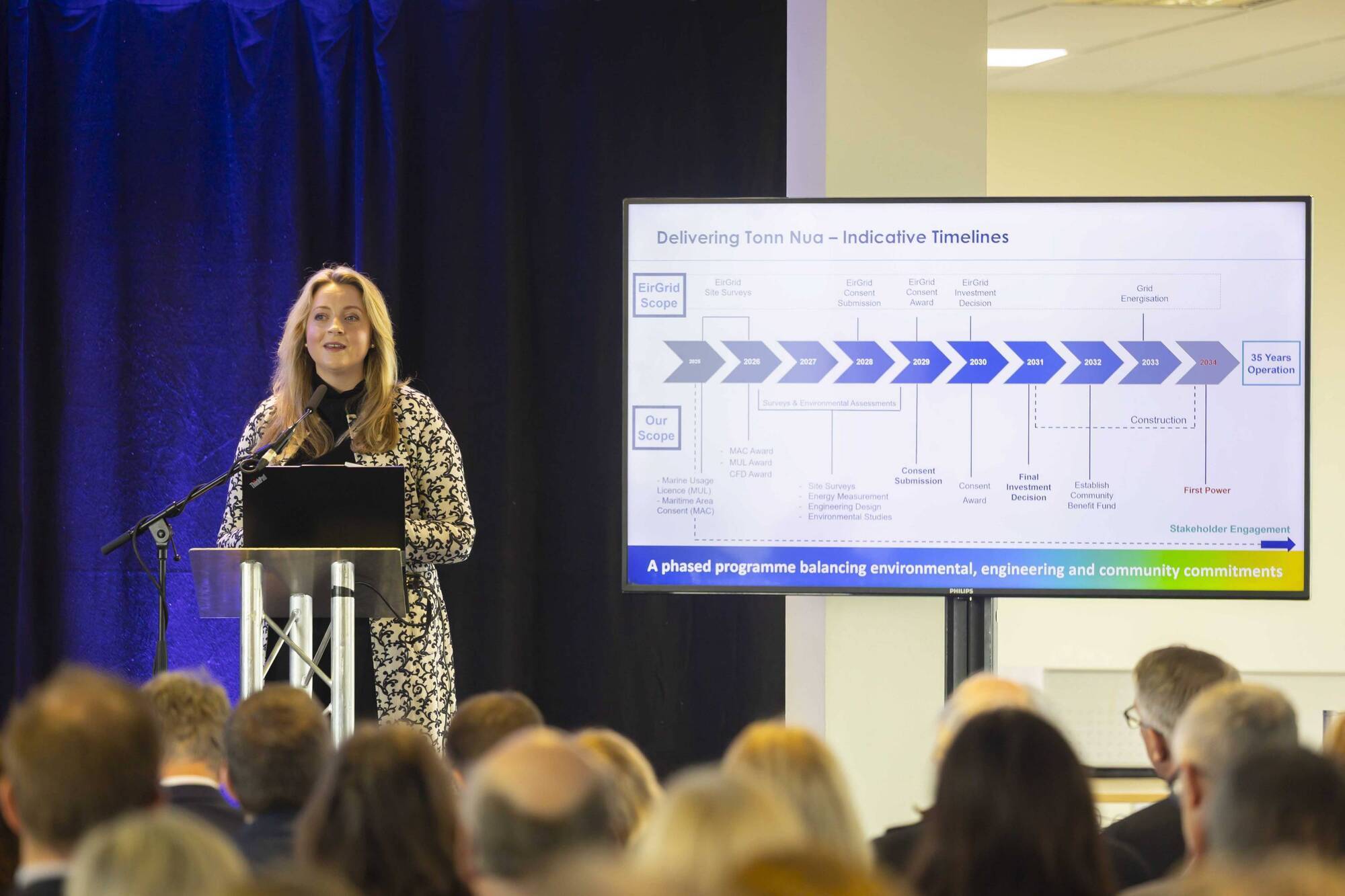
Tonn Nua project manager Moira Walsh speaking at the launch of the South East Energy Wind Partnership at the Port of Waterford. Photograph: Patrick Browne
Ireland, and in particular its South East region, stands at a pivotal juncture. As global energy systems are reshaped by decarbonisation, security concerns and the drive for sustainable growth, future prosperity will depend on building new sources of strategic economic advantage.
Offshore wind energy offers such an opportunity, vital not only for climate action and innovation, but also for economic resilience and long-term competitiveness.
Independent research commissioned by the Department of the Environment, Climate and Communications confirms the scale and immediacy of this opportunity. Studies indicate that offshore wind development could support tens of thousands of jobs nationally at peak activity, with sustained employment across construction, operations and maintenance over the lifetime of projects.
In economic terms, the sector is expected to generate substantial gross value added, with regional benefits in the South East alone running into billions of euros over time, alongside significant increases in foreign direct investment and the growth of indigenous supply chains.
Crucially, the impact extends beyond direct industry activity. Offshore wind acts as a catalyst for wider infrastructure investment, from grid development to industrial hubs, while also unlocking downstream opportunities in areas such as hydrogen production and energy-intensive manufacturing.
At community level, mandated funding mechanisms tied to offshore wind projects are projected to deliver hundreds of millions in local investment, supporting social infrastructure and regional resilience. Taken together, these factors position offshore wind not only as a cornerstone of Ireland’s climate strategy, but as a long-term economic engine capable of reshaping regional development.
The South East is ideally positioned to lead this transformation. With a growing population and a diversified economy underpinned by strengths in engineering, manufacturing, logistics and port operations, the region has the capacity to act as a gateway between Ireland and European energy markets. Its proximity to key interconnectors further reinforces its strategic importance.
The economic and community impact is expected to be significant. Under the South Coast Designated Maritime Area Plan, substantial community benefit funding will flow into the region over the coming years, strengthening social infrastructure, supporting coastal resilience and enabling the emergence of energy communities.
Central to this ambition is the Ireland South East Offshore Wind Partnership, a coalition of local authorities, enterprise agencies, industry, education providers and community stakeholders. The partnership is already embedded in national processes and is positioned to help deliver large-scale offshore wind capacity off the South East coast by 2050.
Momentum is also being driven at European level through policy frameworks such as the European Green Deal and the Renewable Energy Directive, which are accelerating project delivery, streamlining permitting and mobilising investment into offshore wind infrastructure and supply chains.
Within this broader context, infrastructure plays a supporting but essential role. In particular, the report highlights the importance of continued investment in key enabling assets, including ports, grid connectivity and transport links, to ensure that the region can fully capture the economic and operational benefits of offshore wind development.
“We were the first in Europe to build offshore energy hubs with Eddie O’Connor,” David Sinnott says, recalling the early offshore wind development off Arklow. Sinnott is the chief executive of the Port of Waterford and he is not insensitive to the subsequent gap.
The gap is not framed as technical failure. It is presented as drift. “I just think we got distracted,” he says.
Now, the conversation has returned, but in a different context. For the past three years, Sinnott has been in Waterford, previously having worked in manufacturing in Germany.
The move back to Ireland was not part of a long-term plan. “Covid came along, and I sort of realised that I actually preferred living with my wife than visiting her,” he says.
The role at Waterford followed. Ports, he argues, are widely overlooked because they function effectively. “People don’t really notice them,” he says. “If anything happens in an airport, it’s the lead item on the Six One News. Ports are completely underestimated, and I think that is solely because they work so well.”
The scale of their importance is not marginal. “Ninety percent of the global trade value moves in and out of ports,” he says.
On an island, that reliance is structural. If something goes wrong with the ports, then Ireland is compromised. Essentially, ports connect the world according to Sinnott.
That function extends directly into offshore wind. “A ship has to call into a port,” he says. “Even if it’s only a 12- or 15-kilometre journey to a wind farm, ports are going to be essential parts of that industry.”
The physical components of offshore wind are large, but the logistics extend beyond what is visible, but the towers, the blades, the foundations, will all need to be marshalled at a port.
There is also a wider supply chain. “All the cabling, all of the smaller components, all of that will have to move out on a ship, and therefore it will have to move out of a port.”
For Sinnott, this is where Ireland’s opportunity lies. “The large engineering parts won’t be made in Ireland, because we don’t have a history of that,” he says. “But why can’t some of the smaller things be made in Ireland.”
“But for that to work, we’d need a loading dock to bring them to the wind farm,” he adds.
At Waterford, that thinking has been translated into planning. “We’re currently in with An Bord Pleanála for permission to build a 250 metre renewables quay with a primary use for the renewables industry.”
The port’s role will not be in handling the largest components, often termed the white bits or the yellow bits – essentially the bits that are visible.
Instead, the focus is on what sits behind them. The analogy he uses is practical. “If you’re going to build a house, you get excited about the timber frame,” he says. “But for almost everything else, you want to buy it locally.”
The broader framework is now defined by policy. The government has designated a South Coast designated marine area plan and within that, specific areas have been identified. There are four areas where wind farms can be built, named A, B, C and D.
The scale is significant. “The area that we’re talking about could do about five gigawatts of electricity,” he says. “The country currently uses about seven or eight gigawatts.” That positioning places Waterford within a wider regional network. “Waterford is a port that is perfectly placed to support the construction, but also the operations and maintenance,” he says.
There is also an expectation of collaboration. “You have companion ports in Rosslare and Cork that can do the staging and marshalling,” he says.
Sinnott has a vision for a great constellation in the southeast. Tenders have already been established with ESB winning the permission to develop Area A. The timeline, however, is extended. “The first one will be energised in the 2034 or 2035 period, in my opinion,” he says.
The delay is structural rather than technical. “It’s the time it takes to get planning consents and the funding,” he says. “And these things cost billions.”
There is also a wider ambition. “In theory, offshore could provide all of our energy,” he says with some integration with other sources when the wind is not blowing and includes solar and battery storage.