Hydrogen, the most resilient model of energy supply?
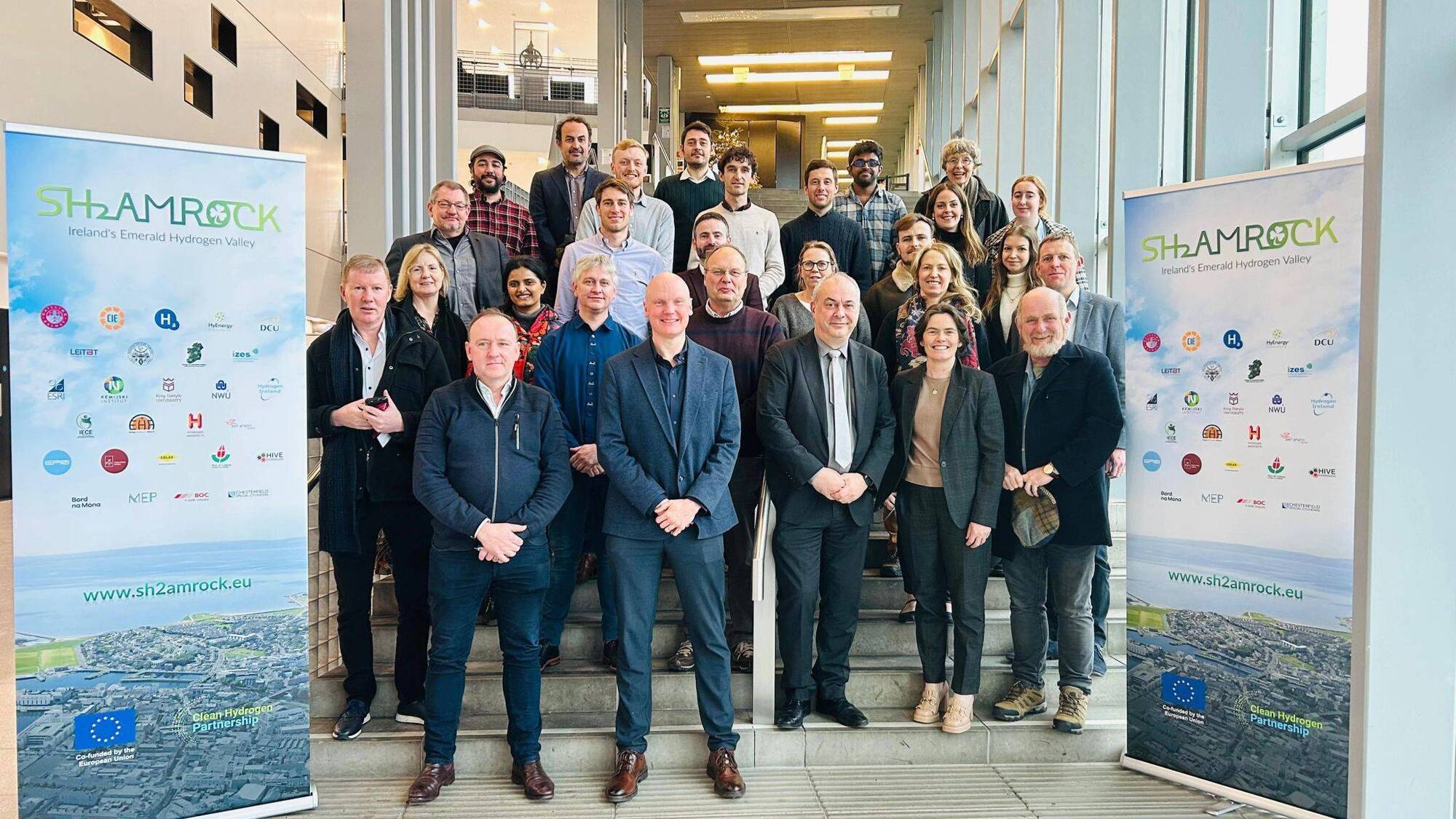
Rory Monaghan, Professor of Energy Systems Engineering at University of Galway, with supporters of SH2AMROCK, Ireland’s flagship Hydrogen Valley project.
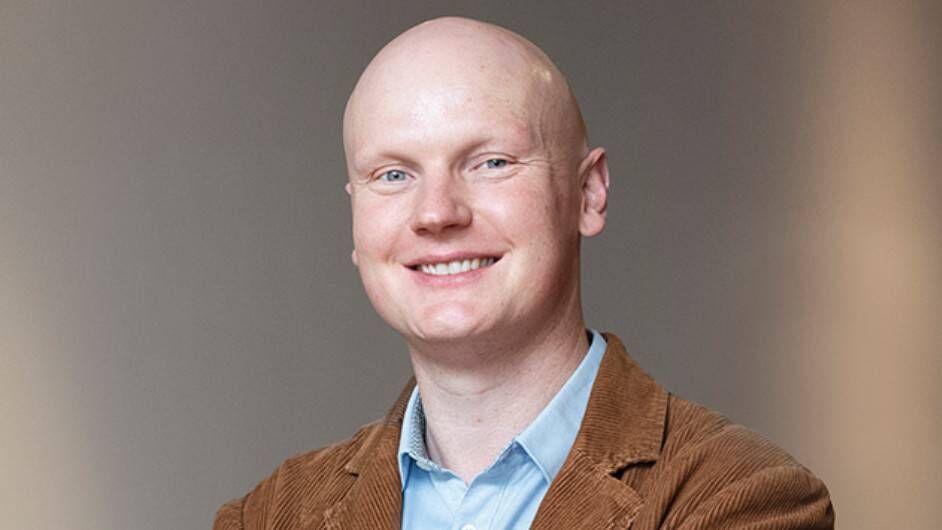
Rory Monaghan is Professor of Energy Systems Engineering at the University of Galway and a keen advocate of hydrogen. He studied the subject from first principles through to application, completing both a master’s degree and a PhD in hydrogen technologies at MIT, where he focused on its production, use and integration within energy systems.
He sees this abundant but technically demanding resource poorly matched to real-world use. “It’s everywhere, but it’s really hard to get,” he says. “What we’re trying to do is match up a demand that exists, that cannot be decarbonised by any other means, with a resource that we have in Ireland.”
That alignment underpins SH2AMROCK, Ireland’s flagship Hydrogen Valley project, where University of Galway is a central partner. The project is structured around use rather than production. Hydrogen is developed to meet defined demand across transport and industry.
“I always like to focus on the users of hydrogen,” Monaghan says. “Otherwise, it just seems like we’re producing hydrogen for the sake of it.”
The consortium reflects that approach. Public transport operators, fleet providers and industrial users are integrated into the system from the outset. CIE and Bus Éireann are examining hydrogen for intercity coaches. Fleet operators are trialling hydrogen vehicles through leasing models. Construction firms are exploring its use in high-temperature industrial processes, where electrification is not viable.
“There are aspects of the energy transition that are not suitable to electrify,” Monaghan says, pointing to heavy-duty transport and industrial heat as immediate candidates.
The model is regional but scalable. Hydrogen will be produced using renewable electricity at a wind farm in County Offaly and transported to Galway, where a cluster of demand already exists around the port. The timeline extends to 2030, with planning permission secured and detailed design underway.
Cost remains a constraint. Hydrogen is not yet competitive with fossil fuels, largely because it is entering a market where the incumbent has been supported for decades. “Fossil fuels are subsidised,” Monaghan says. “We’re not really seeing the true cost.”
Hydrogen, by contrast, is still scaling. The SH2AMROCK project has secured €8 million in European funding through the Clean Hydrogen Partnership and is expected to align with forthcoming Irish government support mechanisms.
Even with that support, the near-term economics are challenging. “In the short term, it’s an expensive source of energy,” he says. The comparison, however, is incomplete. Hydrogen is not positioned as a direct substitute for fossil fuels on price alone. Its value lies in stability and control.
Recent energy shocks have shifted that calculation. “When I’m making the case for hydrogen, I rarely need to talk about the environment anymore,” Monaghan says. “I’m making the case from an energy security perspective.”
That perspective reflects a broader reassessment across Europe. Dependence on external suppliers, previously justified by cost, has introduced systemic risk. Hydrogen offers an alternative pathway, one that is anchored in domestic renewable resources.
“It is an energy supply that we can produce ourselves,” he says.
The implication is strategic rather than technical. Hydrogen allows Ireland to use what it already has, wind, infrastructure and research capacity, to address what it does not control, imported energy and price volatility. It also extends the reach of renewables, enabling storage and use beyond the immediate generation window.
For Monaghan, that combination explains the appeal. Hydrogen is not a universal solution, but it fills a specific gap. It addresses sectors that electrification cannot reach and provides a mechanism for long-term energy storage. It also introduces a different model of supply, one based on resilience rather than cost alone.
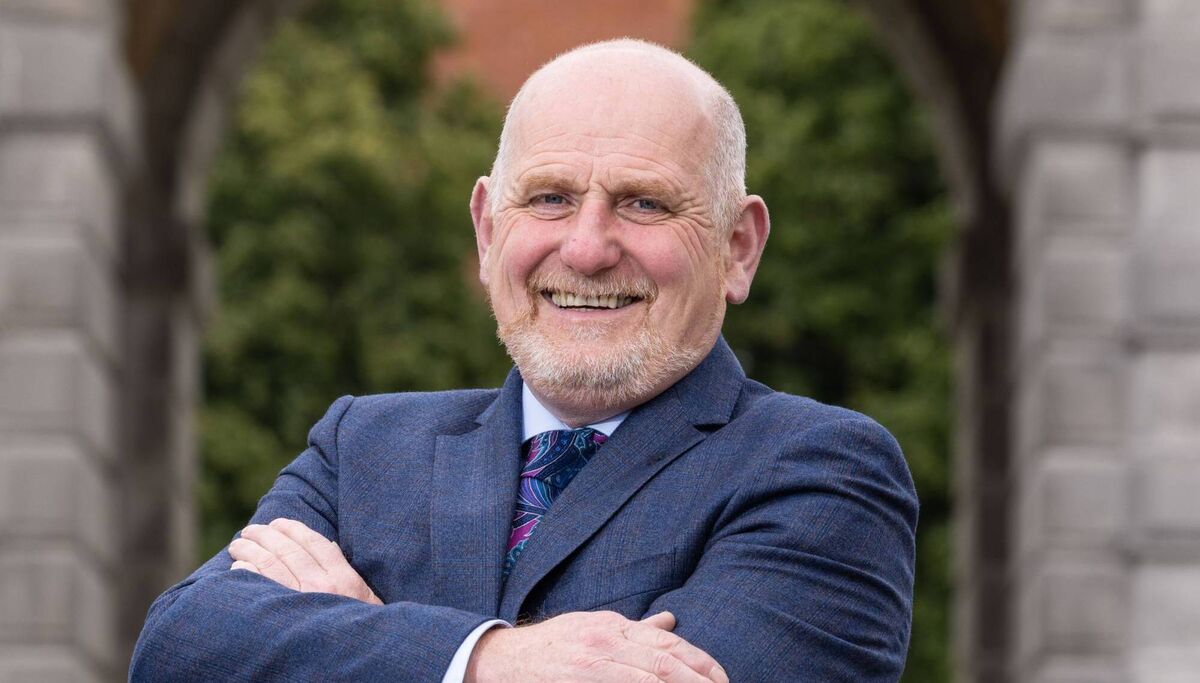
Ireland’s next phase of growth may not come from tax policy or foreign direct investment alone, but from energy. For Paul McCormack, CEO of the Hydrogen Ireland Association the shift is already underway. The question is whether Ireland moves quickly enough to lead it.
“The opportunity is there for Ireland to step forward,” he says. “The EU presidency gives us a spotlight. What we do with it is what matters.”
That six-month window, from July to December, is more than ceremonial. It is a platform. Ireland will be visible across Europe, shaping agendas and hosting conversations. McCormack sees it as a moment to reposition the country, not as a peripheral island, but as a central player in Europe’s energy future.
“We’re not an island off an island off Europe,” he says. “We can be at the centre of Europe.”
The argument rests on a combination of geography, capability and timing. Ireland has both onshore and offshore renewable resources, a growing research base and an industrial ecosystem that is already engaged in energy transition. “We have distinct strengths,” he says. “World-class onshore and offshore, engineering excellence, academic leadership and a rapidly growing innovation system.”
He describes this as Ireland 4.0, the next stage of economic development. The earlier phases were defined by agriculture, then manufacturing, then technology and services. The next phase, he argues, will be built on clean energy and the systems that support it. That includes generation, storage, distribution and the knowledge capital that underpins all three.
Knowledge capital is central to the proposition. Ireland’s universities, research institutions and industry collaborations are already active across Europe. Irish organisations are involved in more than 100 European projects linked to clean energy and hydrogen development. “The Irish industry base and academic base is much sought after,” McCormack says.
Energy security provides the context. Volatility in global markets, combined with geopolitical instability, has exposed the risks of dependence on imported fuels. Hydrogen, McCormack argues, offers a different model. It does not remove cost, but it changes the nature of it.
“It may not be cheaper than fossil fuels,” he says, “but it gives stability to the price.”
That stability matters. It enables long-term planning for industry, infrastructure and investment. It reduces exposure to external shocks. It also aligns with the broader objective of decarbonisation, allowing renewable energy to be stored and used when required.
Storage is where hydrogen becomes critical. Batteries can manage short-term fluctuations, typically over hours or days. Beyond that, their effectiveness declines. Hydrogen extends that horizon. “Batteries meet the short periods of time. Hydrogen meets the long period storage,” McCormack says.
The distinction is practical. Renewable energy is intermittent. Wind does not always blow. Solar does not always generate. The system requires a way to capture surplus energy and hold it for longer periods. Hydrogen provides that mechanism, acting as a vector that converts renewable electricity into a storable form.
It also addresses a structural weakness in Ireland’s current system. As an island, the country remains connected to external energy sources through what McCormack describes as “umbilical cords under the sea.”
Those connections carry both energy and communications. They also represent points of vulnerability.
“The security piece is not just energy,” he says. “It’s communications and everything else that sits alongside it.” Recent incidents involving infrastructure disruption have reinforced that concern. The risk is not hypothetical. It is present and increasing. The solution, in McCormack’s view, is not isolation but resilience. That resilience comes from building domestic capacity and reducing dependence on external supply.
Hydrogen contributes to that resilience by enabling Ireland to store its own energy. The country’s geography offers further advantages. Depleted gas fields and offshore structures can be repurposed for storage, while salt caverns provide additional capacity. “We have the ability to store it,” he says.
Combined with renewable generation, that creates the basis for energy independence.
The implications extend beyond domestic supply. Ireland’s renewable resources, particularly offshore wind, have the potential to exceed national demand. Over time, that surplus could be exported. “Ireland will be an exporter of energy,” McCormack says.
The market for that export already exists. European industry is under pressure to decarbonise, from steel production in Germany to pharmaceutical manufacturing across the continent. Those sectors require stable, low-carbon energy sources. Ireland, if it develops at scale, could supply them.
That is where Ireland’s position changes. Not a peripheral supplier, but a central contributor to Europe’s energy system.
Delivery, however, is not guaranteed. The components are in place, but they require alignment. Policy must move at pace. Infrastructure must be built. Market structures must support, rather than constrain, new technologies.
Agility becomes critical. “We need the resilience to deliver,” McCormack says.
The EU presidency provides an opportunity to accelerate that process. It allows Ireland to shape the conversation around hydrogen, to position itself as a leader and to align European policy with national capability.
McCormack draws a comparison with cultural exports. Riverdance transformed perceptions of Ireland, creating a global brand rooted in local tradition. Energy, he suggests, offers a similar opportunity. “If we could be the Riverdance of energy, I’d be a happy man,” he says.