Is AI virtual home-staging catfishing vulnerable property viewers?

Kya deLongchamps explores the space of digital image enhancement and whether it can make or break a deal
Augmented reality: Could you tell the difference between an AI-enhanced picture and a raw photo? If in any doubt, ask the seller for an unedited set of images. File picture 

Augmented reality: Could you tell the difference between an AI-enhanced picture and a raw photo? If in any doubt, ask the seller for an unedited set of images. File picture 

Recently, serious questions have been raised by some quarters of the media and government, focusing on AI-assisted virtual staging used in property sales in Ireland.

In February, Labour housing spokesperson Conor Sheehan brought it up during Leaders’ Questions in the Dáil. The Tánaiste, Simon Harris, responded that he would review the regulatory measures in this area with the minister for housing and the minister responsible for AI.

Are deceptive AI-enhanced illustrations of homes for sale and rental being deployed by dastardly estate agents and auctioneers to catfish vulnerable viewers?

The fact is, the existing guidance around the use of AI-enhanced pictures of property on the Irish market is reasonably clear, offering full transparency for those viewing property listings.

The use of AI in property sales is nothing new, and every estate agent and auctioneer is bound by good practice as set out by the Advertising Standards Authority for Ireland (ASA). General consumer law also dictates against false advertising, which would easily include the misuse of virtual staging by property vendors and/or their agents. To my mind, it’s the increasing quality of the AI-enhanced shots that appears to be unsettling some commentators. How are we protected as consumers?

Voluntary best practice as laid out by the ASA is that all such AI-enhanced images are marked clearly as, for instance, AI image/digitally enhanced/virtually staged.

Acceptable digital tweaks include adding or removing furniture, fixtures, accessories and lighting indoors, and improving outdoor planting.

Digital redesign should obviously not be used to do things like altering the building to deliberately suggest it’s bigger, to hide structural flaws, to take out a street pole, remove traffic signage or erase power wires, to add windows and doors, or to paste in a more delightful view.

There are as yet no property-specific statutes for the use of AI, but where an agent or private seller adheres to basic ASA guidance, you will not see a virtually staged photograph of a home without another “raw” un-doctored image right behind it or set as a “slider” showing the property as-is. The original picture might still have brightness or contrast changes, or a wide angle, so be advised.

If deceptive virtual staging were allowed to run wild online, every in-person viewing of a property fluffed into a crisp, magazine illustration online would start with a time-strapped viewer’s expectations colliding rudely with reality. This is of no benefit to an estate agent or auctioneer. They are busy too.

Just like physical staging in a showhouse, virtual staging is there to spark the imagination — it’s a visualising tool to illustrate potential. It’s the agent’s job to sell us a lifestyle, not just four walls and a roof.
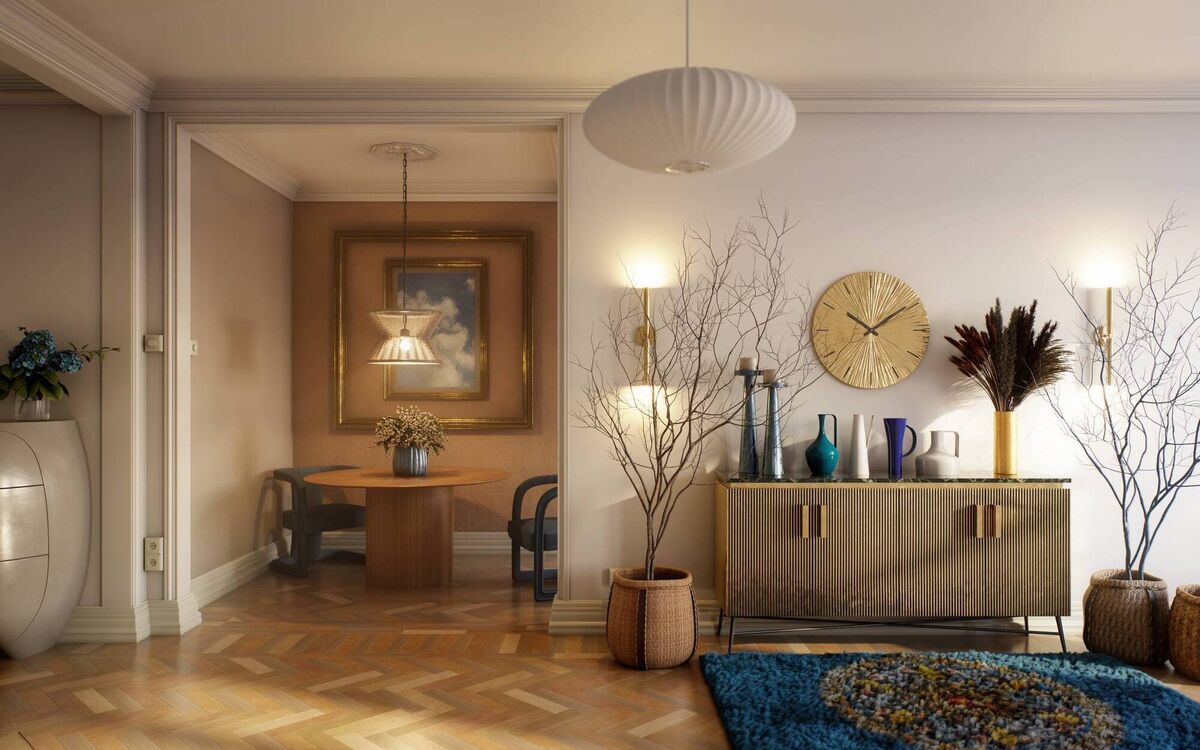
A digitally generated, sophisticated mid-century modern living room, complemented by contemporary accents. File picture

Can AI mislead us into wasting our time on a viewing or, God forbid, making an offer or bid on a building we haven’t even seen?

With a shred of basic common sense — no. With off-plan new builds, renovations, rentals and even standard sales virtual staging and virtual walk-throughs, which can include digital staging, are completely normal. Still, you have work to do.

There are things to keep in mind as a buyer. Go over the listing first. Does the size of the home, its room sizes and layout work for you? Where bold renderings of a gorgeous garden are just virtual — that could be the bones of €10,000 to design and load up with specimen-sized shrubs. Slip that into your dream budget. Is the furniture represented as big or as small as your own? AI will have scaled it precisely to the room. The light in the spaces can be brightened by the contrast and brightening tools of the AI, too.

If you’re going for the over-the-shop grant in a renovation, be warned. Some images I have found online have gone so far as to cheer up the street with more brightly surrounding painted shopfronts and windows loaded with artisan goods. Obviously, visit the area before you get cheerfully carried away and eyeball the raw photo provided.

Despite their pop, virtual room sets are generally easy to spot. They don’t float off the floor as early, glitchy digital images did, but they tend to be the same modern Scandinavian-inspired imaginary furniture in cream/grey bouclé, legged sofas, tasteful lamps and glass coffee tables. This fantasy is all designed to ping light around the room. It’s fresh, it’s trending, slightly impersonal and universally appealing without the backside divots or knick-knacks of the owner littering the property. Your pulse will race. This is by design.

This pale set, together with an airy, period-inclined aesthetic with darker wood furniture, is an agent’s go-to inspiration spell. Maybe you could conjure this look with what you have and a few buy-ins. Some of the digitally delivered detailing is hugely impressive, displaying runners and stair bars and the grain in wooden furniture.


Dara Carey, Create Property Staging: 'AI can stage the photo, but it can’t stage the viewing.'

The purpose of staging is to create an emotional connection, says professional home stager Dara Carey, who runs Create Property Staging, a well-known firm offering a range of services to sellers and property agents. “I can’t help thinking virtual staging is a shortcut that can actually cost vendors more than it saves them, and the emotional drop is real,” says Dara.

“Buyers need to walk into a property and feel something, picture their life there.

“Virtual staging can create beautiful listing images that generate that initial excitement online, but the moment a buyer walks through the door of an empty property, that feeling evaporates. The contrast between what they saw online and what they are standing in can be so disappointing, it’s very hard to recover from — and then you lose them.”

Virtual staging “is also an idealised version of a space, an illusion,” she adds. “AI can manipulate lighting, adjust proportions and select furniture that looks phenomenal on screen but bears little resemblance to what a buyer could realistically achieve themselves,” says Dara.

“A virtually staged sofa might be scaled in a way that makes a room look far more spacious than it actually is. Lighting in a photograph can be brightened and warmed in ways that natural light simply does not replicate on a grey Irish morning. Buyers arrive expecting one thing and find another, and trust takes a hit.

“Virtual staging has its place — particularly for properties that will never be physically occupied before sale, where budget is extremely tight, or where it is used purely to supplement physical staging in online marketing. But it should never be seen as a substitute for the real thing.”

Some providers of virtual staging make the distinction between what they do (virtual staging) and what they claim digital apps do (AI-assisted virtual staging). The truth is, if you have an eye and can manage the software — you can most likely virtually stage photographs of your own home, or use a relatively inexpensive AI specialist to guide you. 

We can physically stage some rooms, and virtually stage others, so long as all rooms are honestly presented as they are online. Virtualstaging.ie offers digital designs from €25-€100 depending on the number of images needed. The raw images must be of good resolution and pin-sharp.

We’ve all had a go with ChatGPT, and the results are reasonable, even with the free tools before subscription. Watch out for ticks like AI hallucination with free or cheaper software tools — you’ll know this madness when you see it.

As a seller, your estate agent can provide virtual staging for a fee using their software or an outsourced specialist (starting prices hover around €50 per picture). Property presentation is, after all, their full-time wheelhouse, and when selling, most of us are already mentally and emotionally on the edge. 

Really clever design apps can empty a room in one click, declutter, straighten odd angles, and even change the weather outside the window, and provide video walk-throughs, and generate 2D and 3D floor plans. Doing your own virtual decorating, stick to the same guidance used by agents and auctioneers to avoid valid complaints from viewers who might otherwise feel duped when they arrive at the house, and it’s not as digital-dreamy.

Putting the digitally tickled photo to one side, before viewing, it is extremely hard to judge the strengths of an empty or over-loaded room. Camera angles can be unintentionally deceptive as the taker tries to encompass the whole space in a wide angle. Even in person, an empty room can read bigger than it actually is. Aspect, window sizes, floor sizes, ceiling heights in metres and centimetres — this is what matters. AI is genuinely useful to show the promise of a home rather than a building, but it’s not a walk-through with a cool head and a tape in your hand.

x

More in this section

Revoiced

Newsletter

Had a busy week? Sign up for some of the best reads from the week gone by. Selected just for you.

Cookie Policy Privacy Policy Brand Safety FAQ Help Contact Us Terms and Conditions

© Examiner Echo Group Limited