Damien Enright: Larks don’t quite make hay while the sun shines
Skylarks make two or three nesting attempts in the same farmland during their long breeding season
Damien Enright: Larks don’t quite make hay while the sun shines

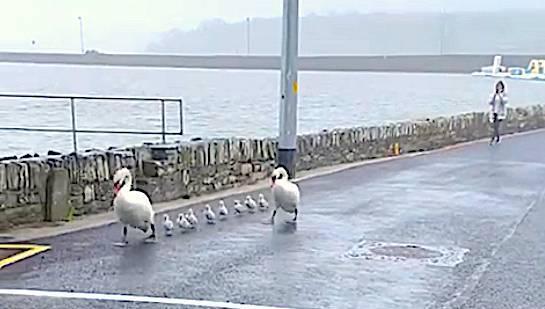
A proud cob swan and a motherly pen shepherd their clutch of 8 cygnets along the busy N71 road at Rosscarberry, Co. Cork. The family survives the 450 yard journey from their reed-bed nest to the sea.

The most arresting video that came through to me on my phone this week was of a pair
of parent swans leading their troop of eight offspring, only twice the size of day-old chicks, along the busy N71 road running alongside Rosscarbery Lagoon in West Cork.

They walked in a line extending more than a metre out from the verge. If one were to be anthropomorphic, and treat them as human beings with feathers, one might say that both cob and pen should have been arrested as irresponsible parents.

A bird-watching garda might have felt they should be, taken into custody for their own good and as a danger to motorised road users.

Defending counsel might, however, offer in mitigation, that they were walking on the correct side of the road, facing into the traffic. What a life-affirmative spectacle they presented on a wet May day! I wish I could show readers the entire 18-second video.

The cygnets had walked a long way for such tiny birds, their nest being
at the far end of the causeway, in the small reed bed facing the Celtic Ross Hotel, where swans nest every year. The causeway is 400m long, built as a ‘military road’ in response to the 1796 attempted French landing in Bantry Bay. Later known at the time as the Post Office Causeway, on the Post Road from Clonakilty to Skibbereen, labourers uncovered the bones of an Irish elk in the underlying peat when it was in construction across the estuary in 1814.

The Saturday of the weekend before last saw the best weather so far this year. The unwalked tracks of the Seven Heads and the sea below were in their glory. Silence, however, was intermittent. Huge beasts stalked the fields, travelling in pairs, while an
appendage, in silhouette like a dinosaur’s head and neck, extended from one to feed the other with freshly mown grass by the ton. Meanwhile, in the shorn fields, grass, already bailed in black plastic, glistened like truncated sausages in the sun.

Industrial-scale enterprise was in train on the houseless landscape of big fields over the blue sea, green plains of grass, one by one transformed to golden plains of stubble. Monster tractors, pulling cages of fresh-mown grass roared back and forth along the small roads flanked by stone walls naked of growth but whitewashed with lichens. The dinosaurs, their extended necks nodding as they moved, travelled down lanes from field to field, not a minute wasted as they migrated from one to the other. It was the best day of the year. Make hay, or cut silage, while the sun shines!

In fairness, the drivers, though often young men not long out of secondary school — perhaps, in the non-silage season, attending university — were considerate enough, and didn’t run us down and we quickened our steps to bring us into a gateway, where we’d stand, our breath held to make ourselves thin, as the behemoths passed, and the sweet smell of fresh cut grass enveloped us.

We had no complaints. Yes, the lark I had seen climbing the sky over these very fields two weeks before wasn’t to be seen. Perhaps it had already raised one clutch, and would raise another when the first-cut grass grows again to 20cm to 50cm tall.

Skylarks make two or three nesting attempts in the same farmland during their long breeding season, stopping if the vegetation becomes too tall, and not nesting at all if the fields are too bald.

The males mark their territories by a spectacular song-flight, rising almost vertically, with rapid wing-beats,
hovering for several minutes and then parachuting down.

Song flights can be sustained for an hour, and the birds can reach 300m before descending. Raising a few clutches a year, they will not be endangered provided habitat and insects remain available.

Speaking of behemoths, those of the mechanical kind, one wonders how moths could have anything to do with them. Some moth species are among the tiniest of flying insects.

I was impressed, that same glorious afternoon when, stopping to have a cup of tea with a friend who lives out there on the heads, his guest, a moth expert — research entomologist at UCC, Ken Bond, now retired — identified a moth no more than 80mm long, in flight. Mr Bond still traps moths for identification before release, as a hobby.

The Seven Heads, with its specialised and natural cliff flora, provides rich hunting grounds for scarce species. He mentioned finding orchids in flower and small heath butterflies, rare indeed, in fields high over the sea.

  • To finish, I must recommend all readers to follow Springwatch on BBC 2 TV, Tuesdays to Thursdays, 8pm. It’s unmissable.

More in this section

Revoiced

Newsletter

Had a busy week? Sign up for some of the best reads from the week gone by. Selected just for you.

Cookie Policy Privacy Policy Brand Safety FAQ Help Contact Us Terms and Conditions

© Examiner Echo Group Limited