How Christmas trees took root
Arriving in mid-winter, I was startled by the hearty embraces of the host family, moose steaks, pack-ice, and ultimately by how readily the Swedes would rise up as a body and prance lightly hand-in-hand around any Christmas tree booming out discordant, lilting song.
The fairytale castle where I worked was owned by the Baron Von S — a mercurial character who had inherited the title unexpectedly on the tragic death of his elder brother.
On the 13th of December, St Lucia’s Day, and as Scandinavian tradition dictates, the eldest daughter dressed in a white robe with a red sash, served us hot saffron buns for breakfast. She wore a crown of real, burning candles encircling her loose, flaxen hair.
Even acting out the role of the most incompetent, useless au-pair in the history of childcare, I tottered with fright. The Baron in hearty 18th century style also favoured hundreds of authentic candles on an eight foot spruce, terrifying and delightful by turns with the presents massed at the foot of the potential pyre.
The Christmas tree as we know it today is largely a 20th century development, but its origins go back through the swirling mists to pagan times, when you would be thrilled to crawl out the other side of March alive. Imbued with supernatural powers, evergreen boughs as symbols of renewal and hope were dragged indoors to adorn the home and chase away evil spirits when the protective powers of the gods were weak over the Winter Solstice.
The Vikings believed that the evergreen plants were especially beloved by their deity Balder, the sun god, and the attractive scent must have masked the cloying pong of the Dark Ages quite nicely too.
The decorating of tree limbs with fruit, cones, nuts, baked goods and straw figures recorded in Eastern Europe, spoke of the hoped for harvest and plenty, and it’s easy to see the naïve dressing of early trees in the rounded baubles and tinsel we love today.
The first glass baubles were produced in Thuringia in Germany in the heavily forested area of Lauscha, still famed for its glass blowing. We can thank reformist preacher Martin Luther for lighting a tree for his family as a theatrical flourish in the 16th century.
Oliver Cromwell famously spoke out against what he saw as the heathen distraction of decorated trees or any ‘joyful expression that desecrated that sacred event’ — the old pooh.
While in Ireland, greenery was brought in and simply used to cover sills and mantles, in Germany, the Christmas tree emerged as something of a social symbol in the upper Rhineland by the early 18th century. And a Protestant one, giving families an alternative centre to the decorating of the Holy crib, associated with Catholic celebrations.
By the mid 19th century the ‘Weihnachtsbau’ had a place in every household and Queen Victoria is generally feted for bringing the tradition of the Christmas tree to the British Isles in the 1840s, in swooning compliance to the wishes of the gorgeous Prince Albert. However, it was George III’s wife Charlotte, also German born, who introduced the tree to the royal household in 1800.
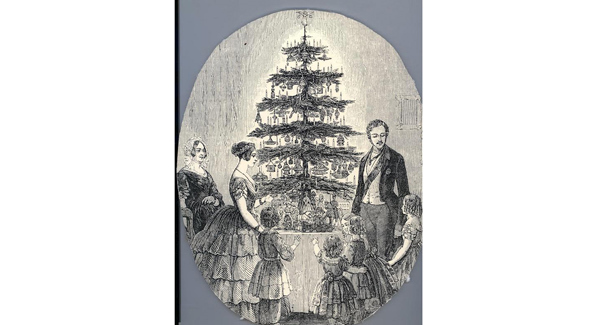
In December 1846, a sentimental sketch in the Illustrated London News of the Royal Family posturing with a decorated tree caused huge excitement in Europe and America among Anglophiles with the means to set up their own piney affectation.
Whereas in Europe, trees were generally shoulder height, in America they went large, taking current trees right to the ceiling. When a forestry college was established at Parnell’s old home of Avondale, in Co Wicklow in 1904, the first ever trees were grown to be used specifically for Christmas in Ireland.
The habit of putting up the tree on Christmas Eve and taking it down by Twelfth Night (January 5), so crucial to that exquisite suspense of Christ (and Santa’s) coming, has sadly long passed away with trees positively dusty and dead by the great day.
My middle-aged heart is still waiting, eyes searching through the frost-dashed rippled glass of that red brick schlott in Sweden.
On Christmas Eve, with the tree unveiled by the parents, the Baron departed abruptly for a meeting with his farm steward. Santa appeared as a watery star from far across the low, snowy hills.
Guided by a single lantern swaying on a shouldered pole, he finally strode across the glassy cobbled yard, all of us hollering like wolves with joy and excitement to greet him.
CONNECT WITH US TODAY



Be the first to know the latest news and updates