'Forest Flame' is a plant to remember
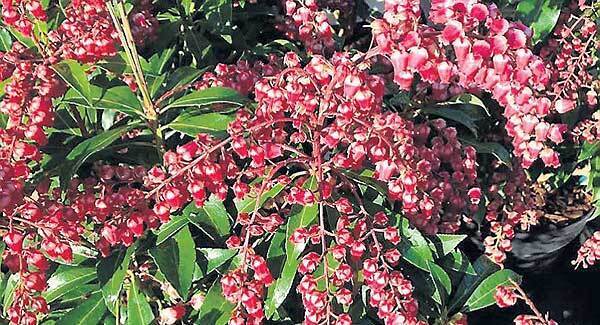
The spectacular red new growth of the Pieris Forest Flame.
The blood red flowers of Pieris Passion add definite colour to the spring garden and it’s less common that ‘Forest Flame’.
MANY plants have hints in their names as to their attributes — varieties like Acer pseudoplatanus (Sycamore), the species name translating as the fake plane tree, and indeed the leaves do bear a strong resemblance to Platanus hispanica, the London Plane tree.
Also Parthenocissus quinquefolia referring to the fact that this plant, Virginia Creeper to you and me, has five (quinque) lobes in its leaves.
The very aptly titled ‘Snow in Summer’ conjures up a much better image of what this plant looks like than its botanical name Cerastium tomentosum. Or Erinus alpinus, which has one of my favourite common names, Fairy Foxglove.
To the beginner, gardening can seem daunting with all the plants available and the long technical jargon and even to the most expert among us names can get confusing, particularly with botanists and taxonomists deciding at will to change names and genera of certain plants.
I remember when Photinia Palette was Stransvaesia ‘Palette’, Lithodora used to be Lithospermum, Myrtus became Luma and the list goes on.
One of my favourite of all evergreen shrubs has a name that you will never forget it — Pieris ‘Forest Flame’.
Many people struggle with remembering certain names of plants but not so this one, for its fiery red new growth which fades to a more muted pink and orange as it develops, is exactly as the name suggests, like a burning flame in the forest.
And again the hint is in the name when you are thinking about where to plant this beauty. Its preferred location is that of a forest or woodland area, so provide it with a semi-shaded area beneath trees — and to get best results mulch it regularly with leaf mould and pine needles to keep the pH correct and also the top layer of humus and thus soil texture.
It is similar to many of the spring flowering shrubs such as Magnolias, Camellias, Rhododendrons in that it likes a slightly ericaceous soil, that is slightly acidic, with a pH of 7 or under and also in its positioning.
It doesn’t like to be in full sun or facing south or east. The reason being that the sun from these aspects is too severe for the plant, particularly during the late winter/early spring months.
During this time, as the cold temperatures cover the shrub with an icy dew, (or even frost and snow), the early morning sun rises and burns off this frost and this ends up burning the emerging new red growth, so instead of a forest flame the new growth turns black giving the appearance of a forest burnt.
Last year I was looking at some Camellias that were showing signs of leaf discolouration and I was trying to figure out what had caused it. It looked far too severe to be any type of nutrient deficiency and it didn’t look fungal, not having any rust or powdery appearance, and it took me a while to click. The plants were facing due south and the sun last summer was so unbroken and strong that the plant was suffering from sun-scorch.
Not a problem I had seen too much of in my career. This positioning being far more relevant earlier in the year when new growth and blooms are at risk.
Pieris is also referred to as the Lily of the Valley Tree and when you see a good specimen in full flower you will understand why. Lovely stems of Lily of the Valley type pure white flowers are produced from buds developed the previous autumn which come into bloom at the same time as the stunning red foliage.
There are better varieties for flowers though, namely Pieris ‘Prelude’ and in particular Pieris ‘Debutante’ which won’t give you anything like the same amount of red foliage as ‘Forest Flame’, but what a display of white flowers it produces.
Being a dwarf form and not reaching much higher than 70cm about 2’ it makes it an ideal candidate for a rockery, or a pot, or a small area where its first cousin would quickly outgrow its space and its welcome — ‘Forest Flame’ being well able to reach upwards of 3m or 10’ though you can keep it around 2m (6’).
Keep an eye out also for Pieris ‘Flaming Silver’ which developed as a sport or mutation of ‘Forest Flame’ and has a very attractive silver margin to the leaves, producing a good red display of new growth and an average display of flowers which can be somewhat lost in amongst the creamy silver foliage. Pieris ‘Little Heath’ and ‘Little Heath Green’ are extremely dwarf staying less than 30cm (1’).
Look out too for Pieris ‘Passion’ with its blood red flowers, the nearly pink flowered ‘Katsura’ and ‘Wakehurst’ which is a compact form with mahogany-red new foliage.
All of them like the same conditions, and though some varieties have better displays than others all produce fiery new red growth, the hint surely being in the name.


CONNECT WITH US TODAY



Be the first to know the latest news and updates