Letters to the Editor: Water scarcity in one of the wettest parts of Ireland
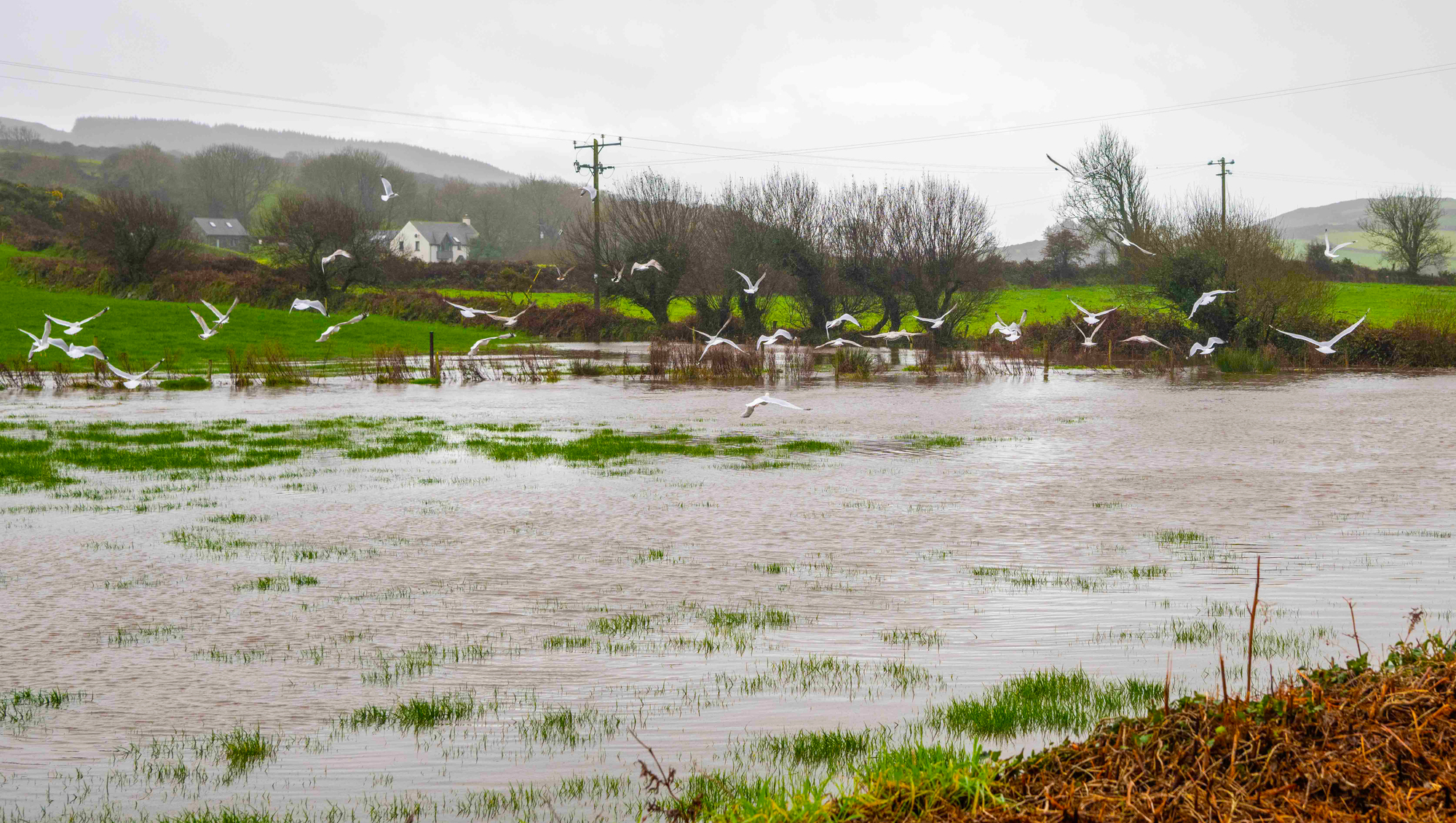
Could the heavy rainfall present an opportunity to alleviate the problem of water scarcity? Picture: Andy Gibson
It is of course well known to residents that there are regular supply problems due to failures of old pipework. For instance, since July 2025, residents in Adrigole on the Beara Peninsula have been left without water on 15 occasions.
West Cork is blessed with beautiful coastlines and natural landscapes, rivers and streams. For most of the year, it is one of the wettest regions in the country and is regularly impacted by heavy rainfall, strong gales, and localised flooding. A recent study showed that the West Cork area has more rain warnings than anywhere else in Ireland.
So, on the one hand, we have a wet climate in this region that has a surplus of rainwater. On the other hand, we are running out of water. Is it possible to have some joined-up thinking here?
Is it not the case that rainwater can be collected, recycled, and stored? Could the heavy rainfall present an opportunity to alleviate the problem of water scarcity? Especially at a time when we are seeing increases in rainfall year by year.
Rainwater harvesting has emerged in recent times as a practical solution for homeowners, housing schemes, businesses, farms, and community and sporting organisations. This would preserve a precious resource, reduce the demand on main water and meet our sustainability agenda. This would, of course, require some creative thinking from Uisce Éireann, our politicians and Cork County council.
However, one paragraph by Mr O’Callaghan jumped out at me. He writes: “Is it possible to move beyond grief? I don’t believe it is. When you come to an understanding of how love can transform your life, then nothing can replace that transformation, except emptiness.”
From a Christian perspective, this seems a rather bleak and distressing outlook, lacking any sense of hope for the future and in the true meaning and purpose of our lives here on earth.
Some years ago, I came across a very evocative quotation on grief in one of the novels of the prolific American suspense writer Dean Koontz. These words are from a wonderfully unique character created by Mr Koontz, Odd Thomas.
“Grief can destroy you — or focus you. You can decide a relationship was all for nothing if it had to end in death, and you left alone. Or you can realise that every moment of it had more meaning than you dared to recognise at the time, so much meaning it scared you, so you just lived, just took for granted the love and laughter of each day, and didn’t allow yourself to consider the sacredness of it.
“But when it’s over and you’re alone, you begin to see that it wasn’t just a movie and a dinner together, not just watching sunsets together, not just scrubbing a floor or washing dishes together or worrying over a high electric bill.
“It was everything, it was the why of life, every event and precious moment of it.
“The answer to the mystery of existence is the love you shared sometimes so imperfectly, and when the loss wakes you to the deeper beauty of it, to the sanctity of it, you can’t get off your knees for a long time, you’re driven to your knees not by the weight of the loss but by gratitude for what preceded the loss. And the ache is always there, but one day not the emptiness, because to nurture the emptiness, to take solace in it, is to disrespect the gift of life.”
So let these words be an encouragement to us to always love fully. Let no kind words be left unsaid. Let no acts of kindness be be left undone. Let there be no regrets when the time comes, as it inevitably will to all of us
Mr Clifford notes the attendees were mainly women. That is true, as women and girls are disproportionately affected by the Gender Recognition Act.
The conference brought together speakers from Ireland and abroad — experts and commentators who addressed the various impacts of the Gender Recognition Act on Irish society. As a journalist, Mr Clifford might have approached the event with curiosity and objectivity, listening to the concerns raised by women, parents, gay people, female athletes, women prisoners, barristers, and detransitioners.
Instead, his article ignored much of the day’s discussion, including the portion he did attend.
He wrote as though he had heard every speaker, repeated familiar trans activist talking points, and suggested that organisers, speakers, and attendees were lacking in compassion. The portrayal bore little resemblance to the event itself.
The first legal proceedings that began the long road to the passing of the 2015 Gender Recognition Act came in 1997. It was heard in the High Court in 2000, informed by a European Court of Human Rights case in 2002 and the 2003 European Convention on Human Rights Act, the passing of Britain’s Gender Recognition Act in 2004, a hearing in Ireland’s Supreme Court in 2005, another High Court ruling in 2007, the intervention of the European Commissioner on Human Rights in 2009, the government’s Gender Recognition Advisory Group in 2011, which led to two bills dealing with gender recognition in 2013 and more High Court proceedings, also in 2013.
Finally, the 2015 act was introduced in the Seanad and debated at length there and in the Dáil, with 10 of the 12 debates taking place before the same-sex marriage referendum.
At every step of the way, legal, medical, and political expertise was consulted and every position and nuance put under a microscope.
Just because a group of women in Wicklow weren’t personally consulted, or didn’t notice, doesn’t mean gender recognition was introduced ‘with little or no meaningful debate’.
It was a long time coming, it was widely welcomed, and it is largely working, for those whom it directly affects.
It was an enjoyable and engaging read. I hail from Westmeath and regard myself as a blow-in to these parts (Co Kerry) and — similar to Professor Bufacchi — I’m here 25 years. But that may be where our mutual experiences or identities end.
It may be that he feels safe in UCC to share his beliefs, which I presume adhere rigidly and robustly to the State narrative and ideology (which he alludes to).
I wholeheartedly disagree with him however, when he states — "identity is an artificial construct". To an extent, I understand his perspective but it concerned me to read that line.
As a Christian, my identity is in Christ. Scripture teaches us very clearly that when one is in Christ, one is a new creation. Your identity is in Christ. And that construct is not artificial.