Irish Examiner view: We need to stop Gianni Infantino's Trumpification of football
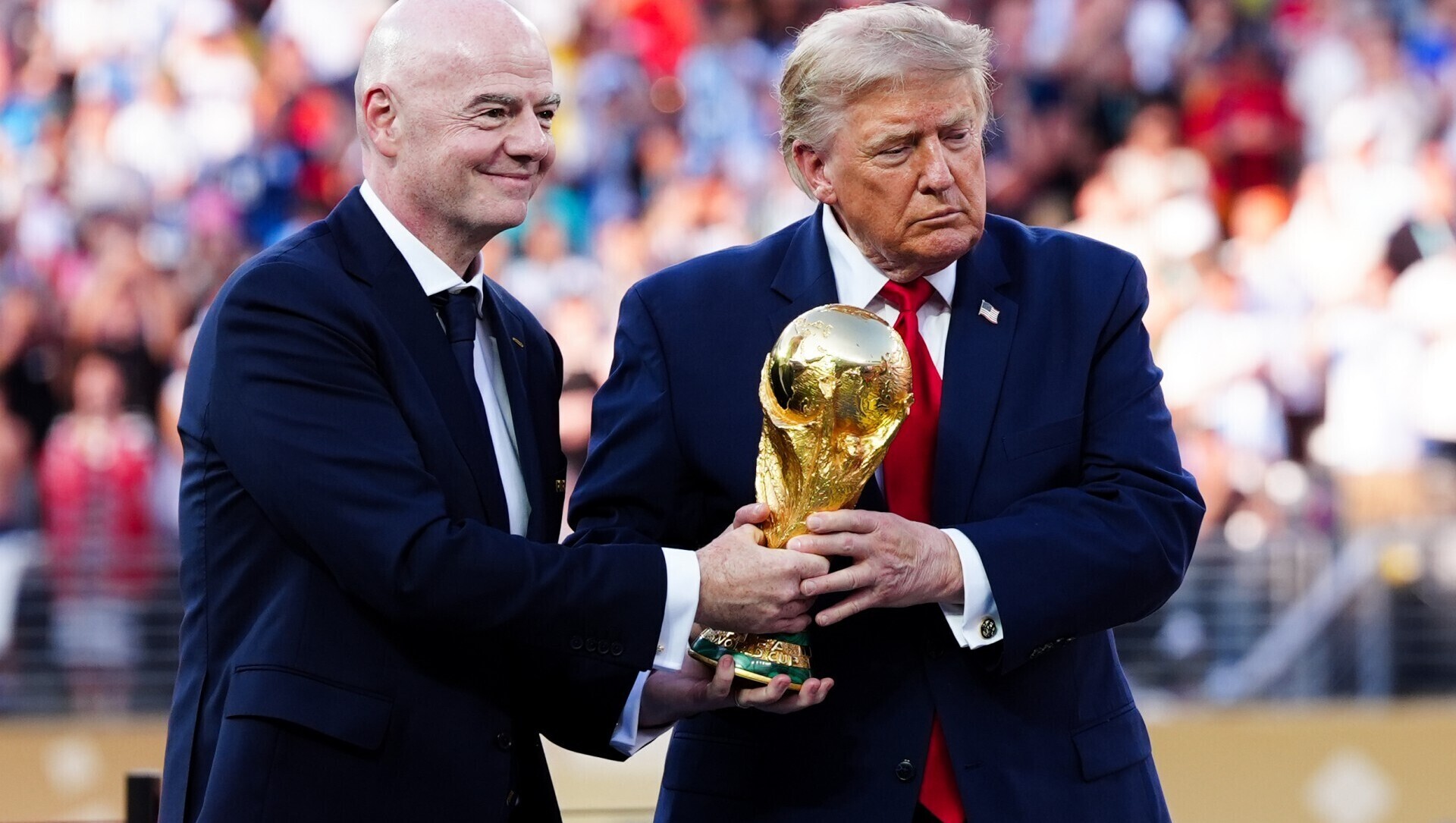
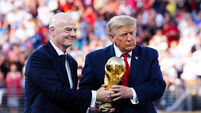
Fifa president Gianni Infantino and US president Donald Trump with the trophy at the Fifa World Cup final on July 19. File picture: Bradley Collyer/PA
There was a time when a prominent part of Fifa’s brief was to protect football from politics and commerce. Increasingly, it seems to believe its job is to protect politics and commerce from football.
Uefa’s extraordinary statement opposing Gianni Infantino’s proposal to sell a stake in the commercial rights of the Fifa World Cup should be read as far more than another spat between football’s competing power brokers.
It is a line in the sand.
European football’s governing body has accused Fifa of abandoning the principles of consultation, transparency, and solidarity in pursuit of a deal that would fundamentally alter the ownership of the game’s greatest competition.
At the heart of this row is a simple question: Who owns the World Cup, and by extension, who owns football? For almost a century, the answer has been the people.
The tournament has belonged, imperfectly but fundamentally, to the global game. It generated enormous wealth, certainly, but that wealth was supposed to be recycled back into football itself.
Infantino’s plan would move commercial rights into a new corporate vehicle before selling a minority stake to private investors, permanently introducing outside shareholders whose primary obligation is not to supporters or players but to financial returns. Supporters are told not to worry. Fifa would retain control. National associations would receive a significant financial windfall. Development funding would increase. Perhaps. But that entirely misses the point.
Once the logic of private equity enters the governance of the world’s biggest sporting event, it never leaves. Every future decision — broadcast rights, scheduling, expansion, hosting, sponsorship — will carry a second question: What does this mean for investor value?
This did not happen overnight. It is the logical endpoint of the Trumpification of football under Infantino.
Not in a partisan sense, but in a cultural one.
Leadership becomes personalised rather than institutional. Loyalty becomes more important than consultation. Governance becomes something to be managed around rather than respected. Critics are dismissed as obstacles to progress, while ever larger commercial deals are presented as self-evidently good because they generate more money. The institutions themselves begin to matter less than the individual leading them.

Sound familiar?
The World Cup is not merely another sporting property. It is one of the few genuinely global cultural events that still belongs, at least in spirit, to billions of people. It has survived wars, political boycotts, corruption scandals, and commercial excess because there remained a broad understanding that the competition itself stood above individual interests.
Uefa has now made clear that it believes that principle is under threat and voiced its intent to resist any attempt to fundamentally alter the ownership and governance of the game’s greatest competition.
One notable silence remains. At the time of writing, the Football Association of Ireland has yet to publicly state where it stands.
Given the scale of the proposal — and what it could mean for the future governance of world football — that silence cannot last indefinitely.
This is about much more than one commercial transaction. It is about whether football remains a sporting institution that happens to generate extraordinary wealth, or becomes a business that happens to stage football.
The most striking response to the latest Russian missile crossing into Polish territory was not outrage, but diplomatic restraint. Polish prime minister Donald Tusk resisted the temptation to inflame an already volatile situation, making clear there was no evidence that Poland had been deliberately targeted.

Yet, in the same breath, he warned that the next 100 days could prove decisive in determining the course of the war. Those two messages are not contradictory. They are precisely what this moment demands.
After more than four years of grinding attrition, Europe finds itself at a pivotal moment.
Russia’s latest barrage on Ukraine, involving scores of missiles and hundreds of drones, once again demonstrated both Moscow’s capacity to inflict devastation and Ukraine’s growing dependence on Western military support. The fact that one missile landed inside Nato territory is a reminder that this war has never been neatly contained by borders.
It’s tempting to view every escalation as another chapter in an endless conflict. But history rarely announces its turning points in advance.
They are often recognised only in retrospect, after a series of seemingly disconnected events begin to form a pattern. Tusk’s reference to the next 100 days suggests European leaders increasingly believe such a moment may now be approaching.
That does not necessarily mean a military breakthrough. It could mean intensified diplomatic pressure. It could mean renewed Western commitments to Ukraine’s air defences.
Equally, it could expose the limits of what either side can realistically achieve on the battlefield, forcing difficult conversations about the shape of any eventual settlement.

Victory, in this war, has never been a simple concept. Nor has defeat. Whatever emerges over the coming months will shape far more than Ukraine’s future. It will define Europe’s security architecture for a generation, influence the credibility of Nato’s deterrence, and determine whether borders on this continent remain protected by international law or by military force.
The next 100 days may not end this war, but they may determine how history remembers it.
Access to safe drinking water is one of the most basic responsibilities of any modern state. It should not depend on whether you live in a city suburb or down a rural boreen.
The Environmental Protection Agency’s latest findings that one in 20 registered private water supplies failed E.coli standards last year should concern us all.
More worrying still is the suggestion that many private supplies may not even be registered or routinely monitored, leaving families, schools, nursing homes, and businesses exposed to risks that are entirely preventable.
We often take clean drinking water for granted, noticing it only when something goes wrong. But invisible dangers are no less dangerous for being unseen. Safe water is not a luxury or an aspiration: It is a public health necessity. The EPA’s warning should prompt more than concern. It should prompt action. Clean drinking water must never become a postcode lottery.