Billy Burke’s death - Damning epitaph for health service
Sadly, despite spending four years on a British hospital’s waiting list, the 29-year-old Kerryman finally lost his battle with cystic fibrosis yesterday without getting the lifesaving operation he desperately needed.
If there is one positive aspect to his passing, it was in focusing national attention on Ireland’s failure to care adequately for victims of cystic fibrosis.

The stark reality is that we have the highest incidence of cystic fibrosis in the world. Up to the time of his death, Billy Burke was one of more than 1,100 patients suffering from the debilitating disease. Of those, 40% are adults and 60% are children.
Affecting one in every 2,000 people, it is Ireland’s most common life-threatening genetically inherited disease. And since there is no cure, patients are dependent on a health system which, up to now, has looked to Britain for lifesaving operations.
In addition, according to the national Cystic Fibrosis Association, the level of service being provided for sufferers here is so poor they have engaged an international experts to conduct a full review.
Though he had appealed directly to Taoiseach Bertie Ahern and former Health Minister Micheál Martin to intervene, Billy’s plight epitomised the inadequacies of this country’s health service. His cause was to inflame public anger.
Because of lack of facilities he, like many another Irish patient, ended on a waiting list for a double lung transplant at the Freeman hospital in Newcastle.
Under a contract with our Department of Health, the British hospital performs surgery on Irish patients and also receives Irish lungs which go into a national pool in Britain, where they are allocated according to need. Most Irish patients receive British lungs.
Unfortunately, confusion surrounding Billy’s case has led to a widespread perception that bureaucratic bungling was the crux of the problem, a view that is not entirely accurate.
The confusion arose last year when the Freeman centre took Billy’s name off the waiting list because he had contracted an infection. Doctors believed an operation to be too risky. In contrast, however, surgeons at Wythenshawe hospital in Manchester felt the transplant could go ahead. But under the British pooling programme, they were unable to secure suitable lungs for him.
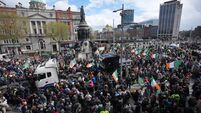
In Ireland, the reaction was an outburst of raw emotion. Billy’s hometown of Killorglin came to a halt as 5,000 people took to the streets in protest and more than 55,000 signed a petition.
Since then, the country’s planned centre for lung transplants, the Mater in Dublin, comes on stream for transplant operations. But even though it has been on call since September, the hospital has yet to receive suitable donors. So far, the lungs of only two donors have become available.
Six patients are waiting for transplants at the Mater, but a further 18 are hoping for lifesaving operations in Britain.
Until the Mater can cope with more than three transplants a year, that dependency looks set to continue. Obviously, there is an urgent need to accelerate the Irish programme.
Billy Burke’s death is a damning epitaph for a health service that remains over-dependent on Britain for lifesaving transplants. His refusal “to die without a chance to live” is a monument to his courage and hopefully, it will result in others being saved.