Cop31: As co-host, Ireland must keep lobbyists away from fossil fuels transition conference
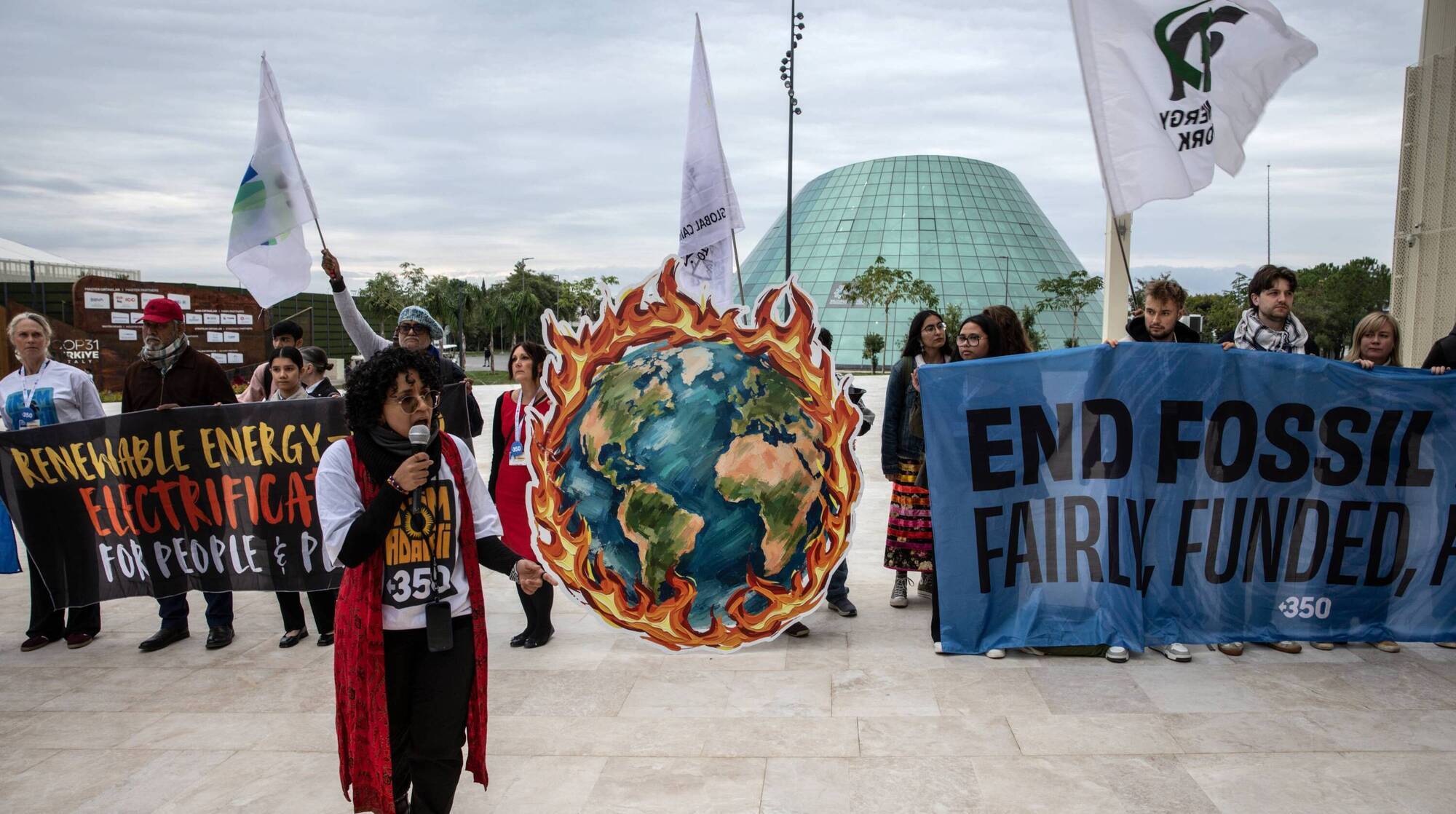
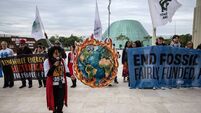
Activists at an End Fossil Fuels: Fair, Fast, Forever protest at the Cop31 Climate Conference on Tuesday in Antalya, Turkey. Photo: Chris McGrath/Getty Images
Cop31 is taking place amid another year of devastating climate impacts, and with the knowledge that the Paris Agreement’s critical 1.5°C temperature limit will be breached significantly.
From horrific flood scenes in Nepal to widespread wildfires and heatwaves across Europe, we don’t need to imagine the apocalyptic scenes the Intergovernmental Panel on Climate Change (IPCC) raised alarm on years ago. The UN has warned we are at significant risk of breaching tipping points which would reshape the world forever.
Through escalating climate extremes and fuel price shocks, Europe is now experiencing the impacts of its failure to reduce emissions and phase out fossil fuels urgently, impacts that have long been known to the most climate-vulnerable countries.
This summer’s heatwaves caused 50,000 premature deaths across European cities, while fossil fuels, driving these heatwaves and other climate-related deaths and harms, cost the EU €53bn more in just four months of imports.
Cop has failed to deliver the climate action we need, but governments attending Cop each year are failing to implement climate action at home to avert climate catastrophe.
The EU is no exception and despite knowing the human, ecosystem, societal and financial costs, both domestically and internationally, the EU’s proposals to reach post-2030 climate targets would further reduce the EU’s responsibility on already-inadequate targets.
Read More
Also Ireland’s proposed post-2030 carbon budgets have been rightly criticised for the potential to allow additional overexploitation from the biggest historical polluters while penalising climate-vulnerable countries and worsening global inequality.
Europe’s growing self-interest and shift to the right cannot excuse domestic climate action failure, or the shirking of international responsibilities. As the third-largest historical climate polluter the EU’s obligations are undeniable.
However, the EU’s 2030 targets are aligned with 3°C of warming, twice the Paris Agreement’s limit, while if global climate pollution reflected Ireland’s, we would already be at 3.6°C of warming.
Conveniently forgetful on its historical contribution, the EU also contributes to the Cop stalemate where richer countries claim progressive climate action and denounce other polluters, including on climate finance.
The Fund for Responding to Loss and Damage (FRLD) was agreed in 2022 but with less than 1% of annual funds available, the FRLD is currently unable to meet the needs of those who have faced the worst climate impacts for decades.
Nepal evidences this failure starkly; losses and damages from August’s catastrophic floods amount to $2.7 billion (recovery and reconstruction estimates total $4.7 billion), but Nepal has provisionally been allocated $20 million from the FRLD.
The EU and Ireland are part of this dire failure.
Ireland has provided a fraction of 1% of its annual fair share of loss and damage finance since 2023, allocating this from already-underfunded mitigation and adaptation finance thereby creating a case of robbing Peter to pay Paul.
As a formerly colonised state, Ireland must stand for equity and justice at Cop31 and use its EU presidency to raise national and EU climate ambition.
Currently the world’s poorest countries are forced to foot the bill for the climate crisis, in lost lives, livelihoods, ancestral lands, and through devastating impacts of famine, drought, floods, crop failures, storms, cyclones and sea level rise.
To add insult to injury the most climate-vulnerable countries are also the most debt-burdened.
Somalia accounts for 0.002% of global emissions, and yet ActionAid analysis shows it is among several climate-vulnerable countries spending more than a thousand times on debt servicing than on climate spending.
However, Ireland must also take significant action at home to course-correct on climate-regressive policies if it’s to lead on any international stage.
How can the pursuit of new fossil fuel infrastructure, including Liquefied Natural Gas, the proliferation of energy-hungry data centres, the importation of US fracked gas, and the facilitation of investment managers channelling billions into carbon majors, including ExxonMobil and Chevron, be reconciled with the ambition needed to co-host the second conference on Transitioning Away from Fossil Fuels (TAFF) in Tuvalu next year?
Pacific states including Tuvalu are driving the climate ambition needed for a liveable future, and Ireland’s climate inaction and backsliding must not undermine that ambition and hope the world needs.
We call on Government to use Cop31 to set a new path for climate justice; a call echoed globally by the public and by the highest court in the land, the International Court of Justice.
Polling shows the majority of people in Ireland and globally want greater climate action including on fossil fuel phase out.
The outgoing Cop presidency, Brazil, have launched a new roadmap on transitioning away from fossil fuels, and while it will be applied on a state-by-state approach, the overarching obligation that these roadmaps must deliver is clear; a national phase-out of fossil fuels that is aligned with the 1.5°C limit.
Paradoxically, the minority polluters and their lobbyists, profiting from ongoing and expanding planet-wrecking activities, enjoy access to the negotiations tasked with averting the very crisis they are driving.
At Cop30 in Brazil, fossil fuel lobbyists outnumbered all but the host delegation; at Cop29 they outnumbered the delegations of the 10 most climate-vulnerable countries combined.
This ‘flooding the zone’ works. Cop30 and Cop29 failed to even mention fossil fuels in official agreements and the 30 years of Cops have been unable to agree a plan to phase out fossil fuels.
Again, Ireland’s EU presidency and co-host role of the TAFF, which, in its first year, has aimed to keep fossil fuel lobbyists out, has an important responsibility and policy precedent to follow.
Earlier this year it was reported that Irish diplomats in Brussels were advised to avoid meeting tobacco industry lobbyists to prevent them from influencing policy.
This acknowledgement that even meeting industry representatives can divert policymakers’ focus away from the public good toward private profits begs the question: will Ireland recognise fossil fuel lobbyists’ undue influence?
So far, the discussions on climate finance have been fraught and there has been little political will for climate pledges at Cop which does not bode well.

The EU’s commitment to improve access to climate finance, and particularly to ensure direct access, is important, but access can only go so far if there is no finance to access or if access is improved only to debt-creating finance.
Ireland and the EU cannot continue their failure on climate obligations; ongoing failure means continuing to disregard the rights and existence of communities around the world, putting their safety, welfare and most fundamental human rights on hold.
Cop31’s outcomes and the actions of those most responsible, including the EU and Ireland, must be judged in the context of ever-escalating climate impacts.
- Sinéad Loughran is Trócaire's climate justice policy and advocacy advisor

CLIMATE & SUSTAINABILITY HUB
CONNECT WITH US TODAY



Be the first to know the latest news and updates