As we dare to feel more European, our deep ties to the US through trade, culture and history will remain
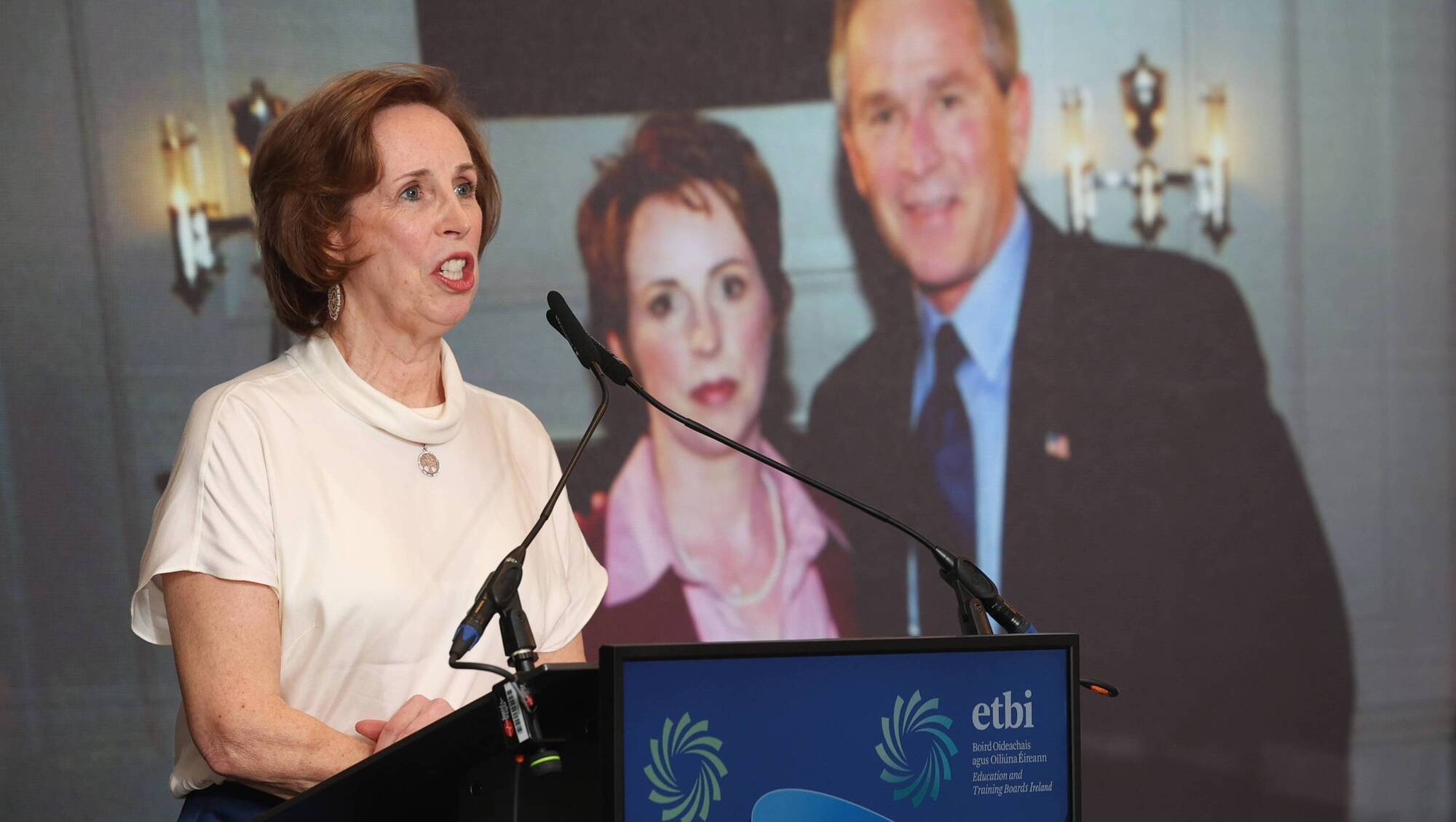
Carole Coleman, freelance journalist and teacher, was keynote speaker at the 2026 ETBI annual congress.
What does it mean to be Irish and European? This question was posed in a short drama performed by post-primary students from Kerry at the Education and Training Boards (ETBI) annual congress earlier this month.
“Are you Irish?” a student asks her classmate. “Yes!” comes the confident reply.
“Are you European?” “I think so.”
On stage, another classmate stares blankly at the copybook in front of her as she struggles to explain how she can be both Irish and European.
The student’s dilemma highlights the deep contradictions that remain at the heart of our European identity, even as the world rapidly shifts around us.
In recent months, Ireland’s presidency of the Council of the European Union has made Europe a little more visible here. Key EU meetings are being staged around the country. Cavalcades of ministerial cars are causing traffic jams in all sorts of places.
This presidency puts Ireland at the heart of EU business. Taoiseach Micheál Martin is overseeing the bloc’s budget for the next seven years.
In Tralee, the ETBI, which oversees the country’s 16 Education and Training Boards, looked at deepening connections with Europe.
More than 500 education and training centres come under the ETBI umbrella, as well as 250 post-primary schools, special schools and 32 community national schools. Youth Reach, Music Generation, adult literacy and English language classes are also among the boards’ offerings.
Read More
Students doing post-Leaving Cert courses (PLCs) are being urged to apply for the EU’s Erasmus study programme, or complete a short work placement in another EU country.
Many Irish students are put off by the language barrier they face in places like Portugal or Poland. But those who take the plunge, delegates heard, return with greater confidence, new friends and a feeling of being European.
Former tánaiste and trade minister minister Mary Harney famously placed Ireland as closer to Boston than Berlin. Indeed, our mindset has certainly tilted more towards New York than Prague. We know the streets of Chicago better than those of Copenhagen.
The recent visit of US president Donald Trump to Ireland shows we remain tied to America through business, trade, culture and history.
But will 1,700 days of Russia pounding Ukraine — and America’s tepid and confusing response — weaken this bond?
Will Donald Trump’s decision to reduce foreign aid to poorer countries make us think again?
Will his order to shut down diversity, equality and inclusion (DEI) programmes in workplaces and universities shift our Irish mindset eastwards? We like to think we’re still a fair, decent lot who include everyone and back each other up when things go pear-shaped.
The EU values of democracy, respect for human dignity, equality and the rule of law chime with recent statements from both our president and Taoiseach. These overlap too with the ethos of our ETB schools — care, equality, community, excellence and respect.
I recently asked a Roscommon friend — living in New York for 40 years — what do Americans really think about Europe?
His answer was swift and brutal. “They think Europe doesn’t matter.” The US sees Europe as overrun with migrants. It points to France and Germany and sees Britain as a place practically living under Sharia law — a falsehood President Trump referred to at the UN last year.
America sees Europe as a continent that has lost its faith. This is not a new opinion. Fifteen years ago, I lived in Maryland, where our priest constantly reminded his congregation the churches in Europe were empty.
The US strongly believes Europe has left itself undefended, due to decades of underinvestment in military hardware and personnel. Donald Trump has questioned the relevance of Nato and threatens regularly to pull out of the alliance.
On top of this, Washington sees the EU as bad for business. There are too many rules and regulations, including the GDPR privacy laws and the Digital Services Act, which aims to protect consumers online.
Indeed, the present picture in Europe is not rosy.
Madrid has seen angry protests over vulture funds buying up apartments and tripling rents. French students feel neglected and left behind, and Germany is witnessing the electoral success of the far right.
Yet despite growing discontent, the EU still shows signs of life. Canada has applied for associate EU membership. Ukrainians are dying on the battlefield for the right to be European, and the UK — 10 years gone from the EU — is making noises about closer cooperation.
The European Union may not be the world’s top economic superpower. But as American economist Paul Krugman recently wrote, it is “possibly the world’s only democratic superpower right now”. While the Kerry students were working out if they felt European, America’s biggest morning television attraction was broadcasting a marathon four-hour live show from nearby Kenmare.
The visit of the NBC , weeks after President Trump’s Doonbeg visit, reminds us that even as we dare to feel more European, we’ll always look in two directions.
“Can you be both?” ask the students in the drama. The answer seems to be that we have to be both.
- Carole Coleman is a freelance journalist and teacher. She was keynote speaker at the 2026 ETBI annual congress

CONNECT WITH US TODAY



Be the first to know the latest news and updates