Israelis go to the polls today to decide the fate Benjamin Netanyahu
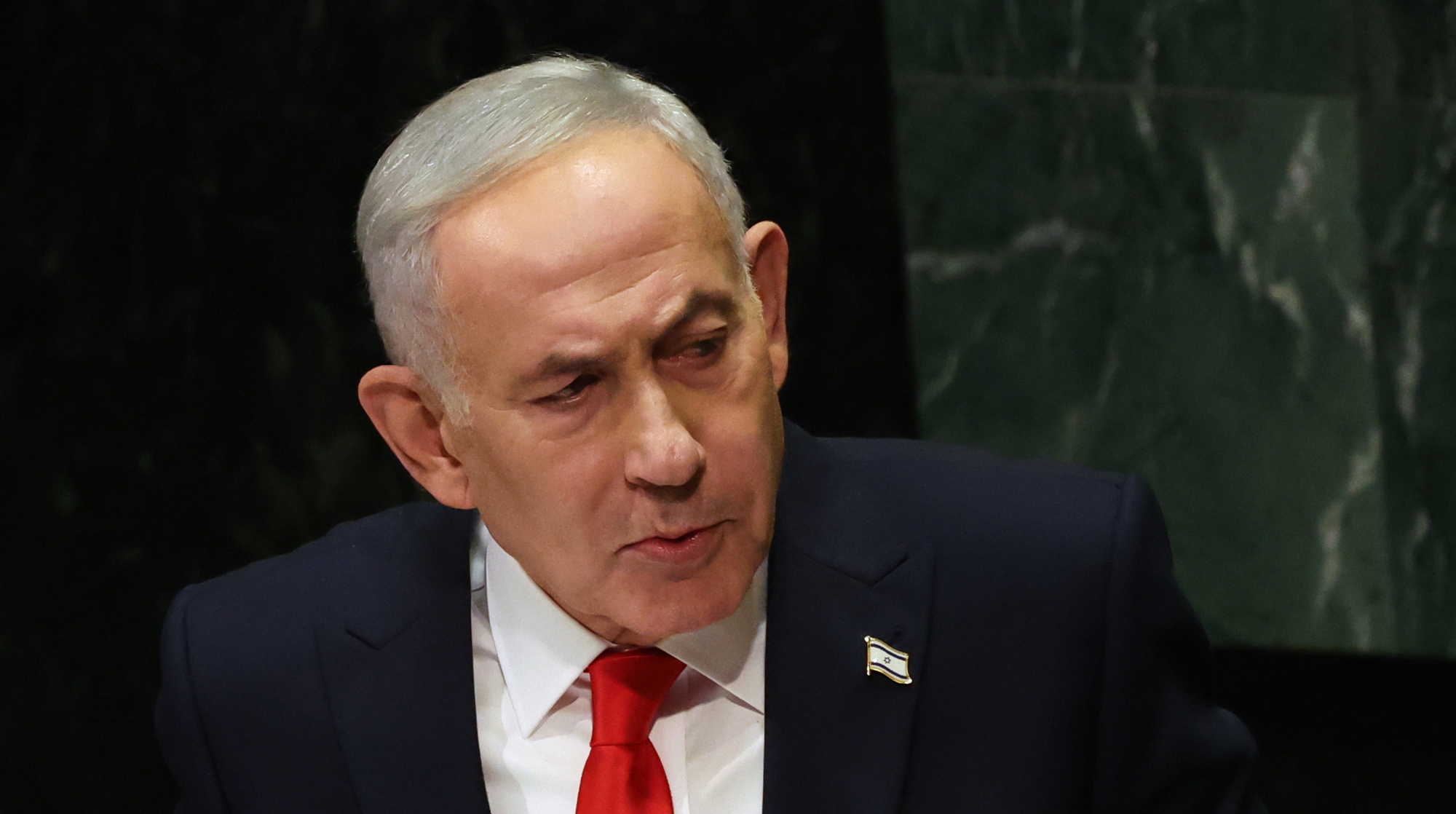
Benjamin Netanyahu’s appeal as Israel prime minister is as an indispensable leader with privileged access to Washington. File picture: Heather Khalifa/AP
Israel will decide today whether to give Benjamin Netanyahu another opportunity to remain prime minister.
Winning an election and retaining power are related activities in Israel, but they are not necessarily the same thing.
Netanyahu understands better than anyone the space between them. His opponents can win more seats, yet fail to agree on a government.
For an incumbent whose political career has become entangled with his defence against criminal charges, deadlock offers something valuable: More time.
Calling him a “great survivor” makes endurance sound like an achievement detached from its consequences.
The more useful question is what has allowed him to remain through prosecution, political defeat, and the Hamas attack and catastrophic security failure of October 7, 2023.
Not to mention the moral bankruptcy of the before and after of his policies of subjugation in Gaza, the Occupied Territories, and Lebanon.
An even more profound question: What would his departure change for Palestinians?
Read More
Born in Tel Aviv in October 1949, Netanyahu was the first Israeli prime minister born after the state’s establishment.
He grew up between Jerusalem and the United States, attending high school in the Philadelphia area.
He returned to Israel in 1967 (after the Arab–Israeli War), served in the elite Sayeret Matkal unit, then studied architecture and business management at the Massachusetts Institute of Technology.
His brother Yonatan was killed leading the Entebbe hostage-rescue operation in 1976.
His American education and fluent English equipped him for a diplomatic career, including as Israel’s ambassador to the United Nations.
First prime minister from 1996 to 1999, he returned in 2009 and remained until 2021. Eighteen months in opposition followed before his return in December 2022.
Political defeat has repeatedly proved temporary. Donald Trump supplied another endorsement on October 18, calling Netanyahu a “great warrior prime minister”.
It reinforced an image central to Netanyahu’s appeal: The indispensable leader with privileged access to Washington. His opponents insisted that Israelis would choose their government.
Polling suggests another impasse. N12 and Channel 13 surveys published on October 21 put Likud on 19 seats, behind former military chief Gadi Eisenkot’s Yashar party.
N12 gave the opposition bloc 55 seats against Netanyahu’s 51; Channel 13 put the figures at 52 and 49. Neither reached the 61 required for a majority.
Israelis elect party lists, followed by negotiations over who can govern. Small parties falling below the 3.25% electoral threshold receive no seats, potentially transforming the coalition arithmetic.
Netanyahu’s vulnerability is real; so is the possibility that his opponents cannot exploit it.
The legal stakes are substantial. Indicted in 2019, Netanyahu faces three criminal cases and denies wrongdoing in all of them. His trial began in 2020.
Case 1000 concerns expensive gifts, including cigars and champagne, and alleged favours for Hollywood producer Arnon Milchan.
Case 2000 concerns discussions with newspaper publisher Arnon Mozes about favourable coverage in exchange for measures against a rival publication. Both involve charges of fraud and breach of trust.
Case 4000 carries the additional charge of bribery. Prosecutors allege Netanyahu advanced regulatory decisions benefiting telecommunications company Bezeq in exchange for favourable coverage on the Walla news website. These remain allegations, rather than convictions.
Sara Netanyahu’s conviction was separate. In June 2019, she admitted a lesser offence under a plea agreement concerning publicly funded catering at the prime minister’s residence, receiving a fine and an order to repay money.
Her husband’s continuing trial should not be confused with that concluded case.
Netanyahu portrays his prosecution as a politically motivated attempt to remove him.
Scrutiny becomes a loyalty test: Supporters are encouraged to understand an investigation of their leader as an attack on their political camp.
That conflict sharpened during his government’s judicial overhaul in 2023. Supporters described a correction to excessive judicial power; opponents warned of weakened checks on government.
Attorney general Gali Baharav-Miara said Netanyahu’s criminal trial created a conflict of interest preventing his involvement.
His personal interests and the institutions scrutinising him had become inseparable political questions.
His governing alliances reinforce the arrangement. Ultra-Orthodox parties and the far-right forces associated with Itamar Ben-Gvir and Bezalel Smotrich supply essential parliamentary support.
Their demands constrain him, while their shared interest in retaining power helps sustain him. The bargain has consequences far beyond his premiership.
There is also the rather life-defining matter of the International Criminal Court’s arrest warrant, issued in November 2024, alleging responsibility for war crimes and crimes against humanity in Gaza, including starvation as a method of warfare.
The court lists Netanyahu as at large. This is distinct from his domestic prosecution.
The documentary , directed by Israeli filmmakers Yuval Abraham and Rachel Szor, brings the machinery behind the destruction in Gaza into focus.
Drawing on testimony from Israeli military insiders, it examines systems of surveillance and targeting. Its title refers to a military acronym indicating the number of civilians expected to die in an airstrike.
What it depicts in its simplest form is the bureaucracy of mass murder: Human beings reduced to calculations, categories, and anticipated casualties.
The film confronts viewers with a system whose participants describe their individual technical functions within an operation of devastating human consequence.
Netanyahu has labelled the film a “propaganda piece”. He also moved to advance legislation targeting the defamation of IDF soldiers and the state, including potential moves to strip the filmmakers of their citizenship.
Its relevance to today’s vote lies in the distance between what it describes and what the election is principally being fought over.
Responsibility for October 7, military effectiveness, and Israeli security matter profoundly to voters. Accountability for the destruction inflicted on Palestinians occupies a different place in the debate.
Polling helps illuminate that distinction. Pew Research Center findings published in September, following interviews in April and May, showed 64% of Jewish Israelis believed the US provided too much humanitarian assistance to Palestinian civilians in Gaza.
Among Jewish respondents who did not support Netanyahu’s coalition, the figure was still 50%. Among Arab citizens of Israel, by contrast, 67% said Washington provided too little.
Earlier Israel Democracy Institute research in July 2025 found 55.6% of Jewish respondents were “not at all troubled” by reports of famine and suffering in Gaza.
Majorities on the Jewish centre and right were not troubled; a majority on the left were. Neither survey asked whether genocide allegations would determine votes.
They nevertheless challenge any assumption that opposition to Netanyahu necessarily encompasses a moral rejection of his treatment of Palestinians.
In September 2025, the UN’s independent commission of inquiry concluded that Israel had committed genocide in Gaza. Israel rejected the finding.
The commission’s conclusion is distinct from an international court judgement, but belongs squarely in any assessment of the accountability facing Israel’s leadership.
The alternatives require scrutiny accordingly. Eisenkot and other prominent challengers oppose near-term Palestinian statehood, although differences exist over settler violence and security policy.
His refusal to align with Arab parties also constrains the coalition arithmetic that could remove Netanyahu.
Today may end his premiership or begin another period of paralysis. Either outcome demands scrutiny beyond one man’s fortunes. Netanyahu’s departure would be consequential.
Whether it brings accountability, or a different future for Palestinians, remains a separate question.

CONNECT WITH US TODAY



Be the first to know the latest news and updates