Priyanka Borpujari: Watching India's Gen Z 'cockroach' protests from Ireland is tough
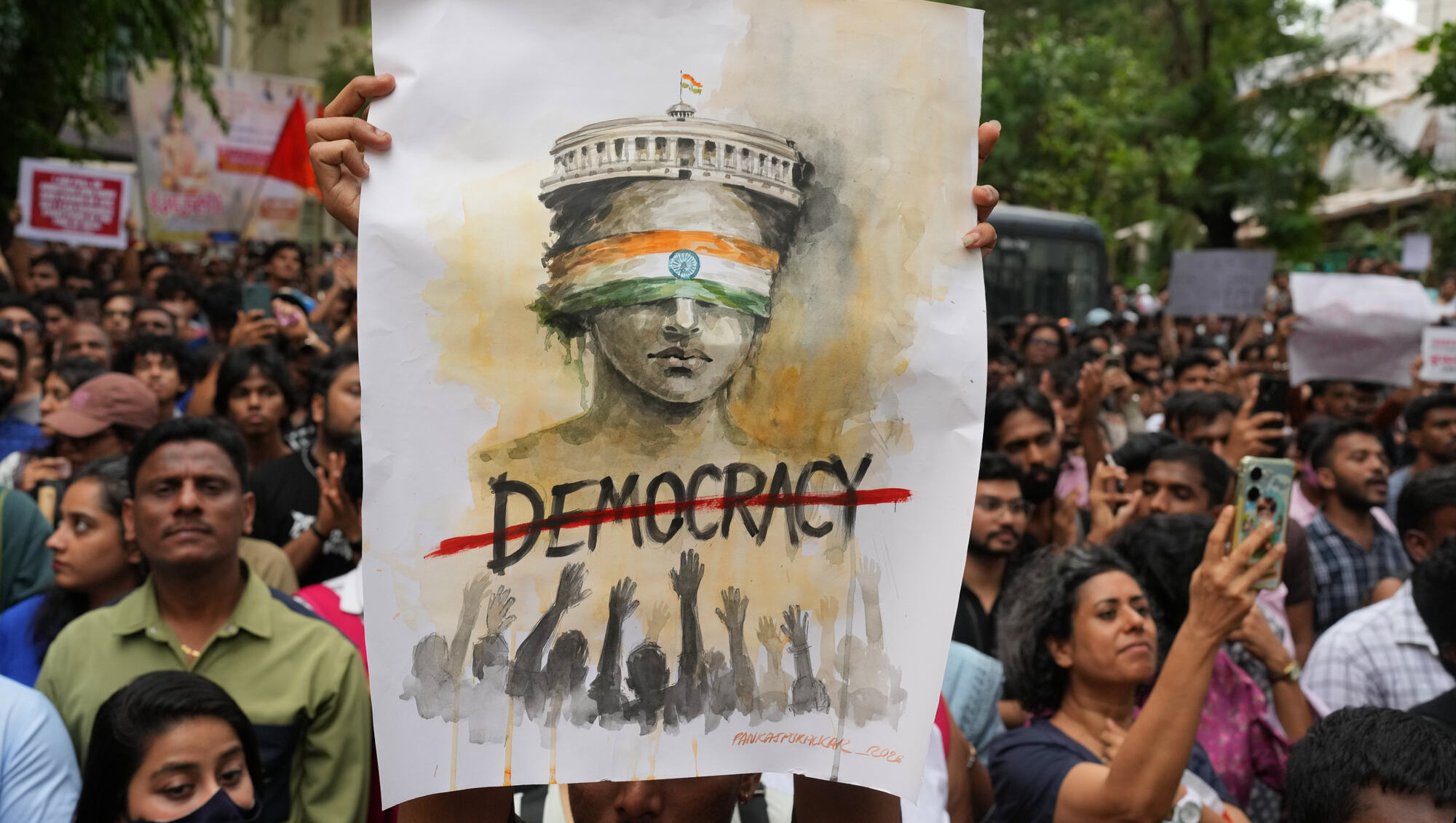
A supporter of the Cockroach Janta Party holds a placard during a protest demanding the resignation of education minister Dharmendra Pradhan over alleged examination irregularities and repeated paper leaks in Mumbai, India. Piture: AP
Last Sunday, along with 15 other Indian people, I stood outside the GPO, scanning for anyone who might be interested in the leaflets we were holding. Passersby were intrigued by the candles lit for a photo of 14 young boys and girls: they had died by suicide, when they failed to make it to India’s notoriously stringent medical school entrance exam.
Along with the leaflets, we carried the complex feelings of being so far from our homeland: where every bend of infrastructure is crumbling, where millions of youths had mocked prime minister Narendra Modi for 36 days. The protests led to the education minister’s resignation, the first such in the Modi era of repeated economic and political catastrophes since 2014.
The students’ drastic step to end their lives was not simply about their failure to find a seat among 2.27m candidates. This year’s exam was voided when it was found that the exam paper might have been leaked. Some students study for this exam for a few years, taking loans to get adequate coaching. I know too well the importance of these exams in determining our life trajectory: I studied 14 hours daily, but it never felt enough.
Since May, the youths on India’s streets were protesting a slow leakage of infrastructure that had repeatedly failed them. One student —working as a delivery driver — screamed at a camera that there was no hope for someone like him, when he missed his place in the civil service exam by one mark, twice over.
Winning three elections since 2014, Modi’s BJP government has torn the secular fabric of India and left it reeking with Hindu fundamentalism and Islamophobia. Deaths during disasters are not counted; neither were those during the Delta variant of the pandemic. Demonetisation of older currency notes in 2016 led to severe liquidity crunches and caused the death of up to 100 people from waiting in long queues outside banks, or by suicide when their cash savings were rendered scrap. Agricultural deregulation laws led to huge protests in 2020-2021, leading to the death of almost 750 farmers. More than 80% of those unemployed are under 30. Government skills initiatives have managed to employ only 15% in the last decade.
India’s Boomers have been Modi’s apostles, spreading Islamophobia over WhatsApp and solidifying the caste system through new forms of gated communities. Middle-class millennials, while hiring cheap labour for all errands, have scrambled to sustain a decent living through decades-long loan repayments, even as they watch anyone criticising — or even joking about — the supreme leader being sent to prison. For challenging an amendment to the Constitution that could erase India’s secular basis, student activist Umar Khalid has been in prison since 2020. Meanwhile, India’s land, forests, water and air have been either plundered, privatised or polluted and the list of millionaires has been growing.
In May, when India’s chief justice likened the country’s unemployed youth to cockroaches, an Indian working in Boston created the Cockroach Janta (People’s) Party as a joke. That joke turned into a movement, when an education activist began a hunger strike to push for educational reforms, following the paper leak and the suicides. He sat under a tent, in Delhi’s blistering summer, while the youth — like cockroaches creeping in slowly — gathered around him. On the 21st day of his hunger strike, the police violently took him to a hospital, but he refused medical treatment.
This changed the sombre tone of placards. Gen Z turned jokes into a protest movement: they brought their Internet vocabulary and refreshing irreverence to the streets. What the adults had learnt to murmur and self-censor, the kids were saying out loud. Modi won the election by promising “good days”; students demanded a return of the bad days. They told him to return to selling tea; their dating app matches responded faster than the government (alluding to Modi not facing a single press conference).
Gen Z laughed at the man and his cronies, and they conveyed this through a new swarm of independent news media who carried curiosity with their smartphones: speaking to families who lost their children to the exams, young couples with toddlers hoping for a better future. A police aspirant questioned her ambitions after she fell under one the many batons of brutal repression of the protesters.
In Delhi, pellet guns and teargas were fired by police personnel without name tags. Misplaced sandals lined up a long stretch of footpath after the violent repression. Hundreds were detained.
But people ordered food to be delivered to the protest sites. Some brought charged battery packs to power the protesters’ phones. Gurudwaras (Sikh temples) opened their doors for the protesters to sleep in at night.
When protesters were being taken away in a police van in my home city of Mumbai, a young woman held up the van with her hand, despite the rain. She was neither a student, nor a farmer, nor someone from the lower caste. Her brave act has become the image of this movement.
Gen Z made protesting a FOMO moment: they went back even after their bodies were bruised with batons. They no longer only demanded the resignation of the education minister. Modi was on the placards, paraded as someone that could and should be mocked, giving many of us self-censored tired souls a bone of renewed faith.
But Modi assumed that the quietly crawling cockroaches wouldn’t swarm at him. Modi made a reel on Instagram to address the paper leak; Gen Z analysed his bad teeth and his camera angle. He improved his camera angle in the next two reels, but the kids made it clear: Modi was giving the kids the ick.
When the education minister resigned last week, we celebrated, but with caution: across cities, police were arresting protesters based on their social media posts. Many social media accounts were suspended.
And so, I write this essay with my identities clashing:
As an Indian, I am glued to the phone, to soak every ounce of all that I am missing out on by not being home during one of the most pivotal churns of my country’s lifetime.
As a millennial, I am in awe of the irreverence of the youth who have been able to laugh at themselves and mock the leaders during the long hot days and nights of protest.
As a journalist, I am sceptical about the possible traction of this movement, from the streets to the parliament, and independence of the press in the long-term.
As a migrant, I am worried how far does the promise of free speech — and the freedom to protest — extend, for a foreigner like me who views the world as her home and hence the possibility of everything being connected.
Academics will use their petri dish of theories to analyse if this movement was an effective one: whether these protests demonstrated a breathing democracy, or if elections alone are enough. Until then, the first draft of history has been meticulously documented by independent journalists with limited resources. These drafts have also been etched on the bodies of those riddled with pellets and baton strikes.
The analyses can all wait. For now, I want to enjoy the moment of what the Gen Z have enabled. So many of us have been angry too long; have self-censored ourselves too quiet. Now, we wrap our arms around the kids and remind them what we have known too long: the farce of India’s supreme leader is visible, and he – and his devotees – cannot pull any more tricks.
CONNECT WITH US TODAY



Be the first to know the latest news and updates