Letter from Cape Town: Rassie ban will make him even more of a martyr to players and diehard supporters
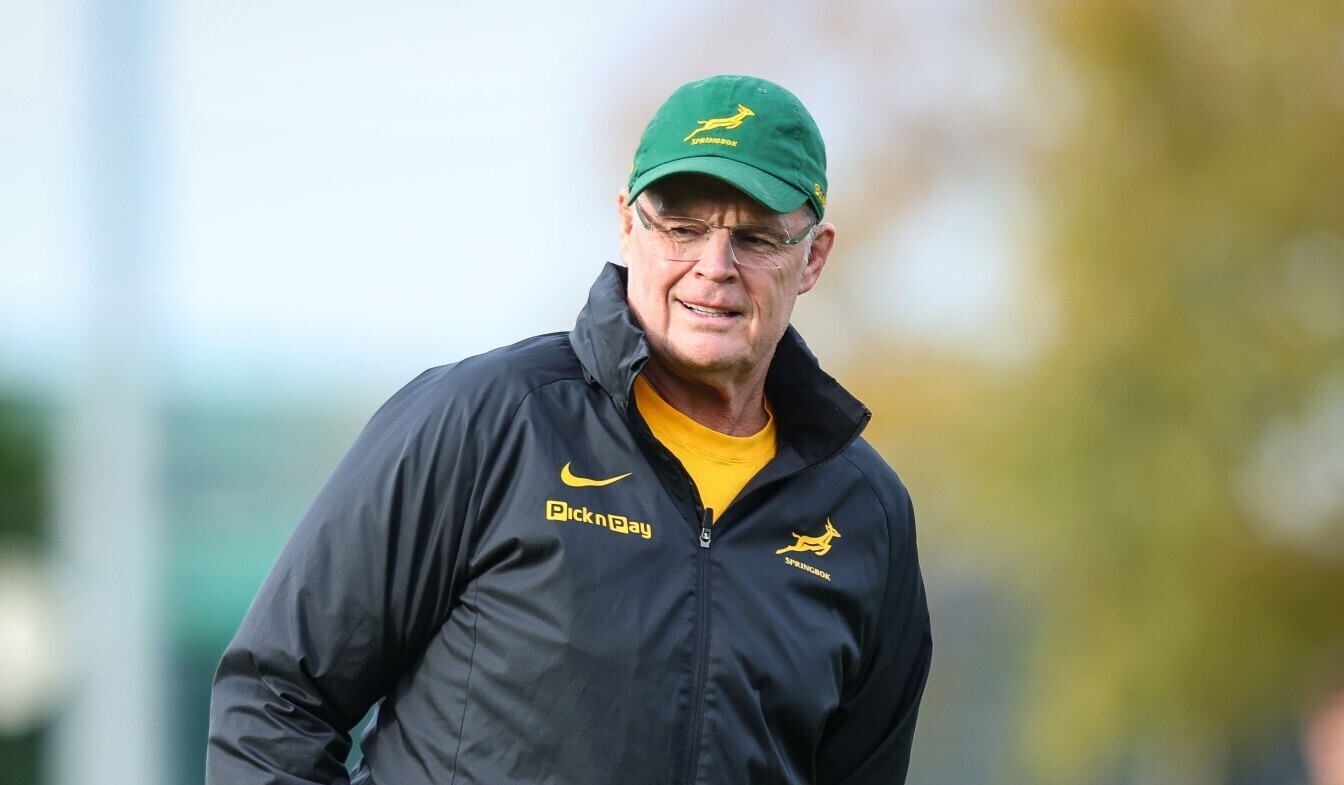
Don’t expect Rassie Erasmus's players to believe anything other than his six-match ban proves the world is out to get the Springboks. Pic: ©INPHO
Springbok coach Rassie Erasmus has destroyed the relative calm of the Nations Championship with suggestions of match-fixing.
Erasmus’s team announcement media briefing in Dublin was moving along without much fuss on Monday. He discussed his changes to the squad to face Ireland at the Aviva and seemed to be going through the motions.
But if you look closely at the video, there was an anger in his face, slightly less obvious than on Saturday night in the bowels of Stade de France.
After the Boks had just been beaten 21-19 by France in a match that had as much drama as it did quality, Erasmus’s jaw was clenched and his eyes narrowed.
Read More
He was bristling in Paris, but with great effort, he largely stuck to the party line about his own team’s failures that led to defeat against Les Bleus.
Two things can be true at once of course – and there was no doubt the Boks failed to convert numerous chances against France.
It’s also true that they were a little unlucky with some bizarre officiating – from Maxime Lucu’s seven-minute yellow card to a deliberate knock-on with a two man overlap not ending in a penalty try for the Boks.
Watching the review would not have helped Erasmus’ mood, nor his sense of injustice. Stewing on the result and the officiating errors – real or perceived – is always a potential powder keg in the Erasmus orbit.
By the time he fronted the media in Dublin around 60 hours after the Paris defeat, he was ready to fire shots.
A routine enquiry about whether Erasmus thought Ireland out-half Sam Prendergast would play after an off-field citing for a dangerous tackle against Fiji, went off in a direction no-one anticipated.
In a calm, but obviously angry manner, Erasmus predicted Prendergast would be free to play, that the panel would find a “technicality” to let him off. As it transpired, he was correct.
Erasmus mused aloud that the same treatment for a Bok player would be highly unlikely – citing the Tadhg Furlong/Gavin Coombes “genital grabbing” incident and comparing it to the Jan-Hendrik Wessels and Connacht’s Josh Murphy incident last season.
Furlong escaped any sanction while Wessels received a nine-game suspension for what in Erasmus’ mind, was the same incident.
The monologue then turned to the game against France and an alleged 17 knee-drop tackles by French players, of which none was punished.
There are some videos doing the rounds, with pretty compelling evidence that Erasmus might be right about most of them.
It’s certainly not a comfortable watch for Italian referee Andre Piardi, who does often seem to be involved in games that become slightly unhinged.
It could be that Piardi is unlucky, or it could be that he does not have the gravitas and skill to control matches of such high intensity.
Erasmus let that implication hang, as well as the implication that the Television Match Official (TMO) Matteo Liperini abdicated his duties.
“I’m not saying he’s (the TMO) wrong, I’m saying if he didn’t see it, it must be a technology problem,” Erasmus said.
“If he saw it and decided not to act on it, is that not match-fixing? Is that not interfering with the outcome of a game if you see this injury that happened there, a knee-drop tackle happened there, and it’s been decided that knee-drop tackles are out?”
That ended any argument he had. Erasmus had introduced a highly inflammatory claim – even if it was posed as a rhetorical question.
Suggesting that match-fixing might have occurred at a media conference, even if he was musing about it in a theoretical way, was only ever going to end one way – another ban from World Rugby.
The obvious question is “why”? Erasmus is many things, but a fool is not one of them.
He seldom, if ever, attends a media conference without a theme that he wants to introduce into the public discourse. He is a master at driving a narrative via the media to either send a message to the opposition, law makers, or his own players. Sometimes all three at once.
Whether he was advised to utter the words “match-fixing” and did it deliberately, or whether it was a slip of the tongue, is a moot point.
The bullet had been fired and the damage had been done.
World Rugby wasted little time in issuing a six-match suspension, to add to his 10-month ban from rugby activities in 2021 and another two match ban in 2022.
Erasmus will appeal of course, as a formality, but it’s impossible to see how he defends this.
It’s also telling that his personal lawyer, Frikkie Erasmus (no relation) is almost always part of the Springboks entourage on tours. It does raise the question if there was a discussion between coach and lawyer before the now infamous presser.
In some ways, this was a classic Rassie tactic after a defeat. He fronts the media and throws out some really interesting points of debate. He positions himself as the central figure of the week’s narrative.
It has two functions. The first is to take the spotlight off the team’s defects and weaknesses and gives them space to prepare while everyone is preoccupied with Rassie’s latest musings.
The second function is that it breeds intense loyalty from the players. They see and hear their coach standing up for them, challenging wrongs, real or perceived and sometimes being pilloried for it.
Erasmus is demonstrating that he has their backs and will challenge the baddies at World Rugby/France/New Zealand/Ireland publicly, and at personal cost.
In return, players will walk through fire. They will accept his ruthless rules where some know they won’t feature in marquee games, or will only play 30 minutes before being replaced without question.
It’s all part of the loyalty he breeds by shielding them and climbing hills where, in rugby terms, he will die on. For them.
This week, he went too far and deserves his sanction. But don’t expect his players to believe anything other than it proves, once again, that the world is out to get the Springboks.
And that makes them more dangerous than ever.

BLACK FRIDAY
Already a subscriber? Sign in

CONNECT WITH US TODAY



Be the first to know the latest news and updates