Donnacha Ó Beacháin: Refusal to act on Aughinish is deeply damaging to our reputation in EU
This is not about one industrial plant in rural Limerick. It is about whether Ireland is prepared to confront the consequences of its failure to act, writes Donnacha Ó Beacháin
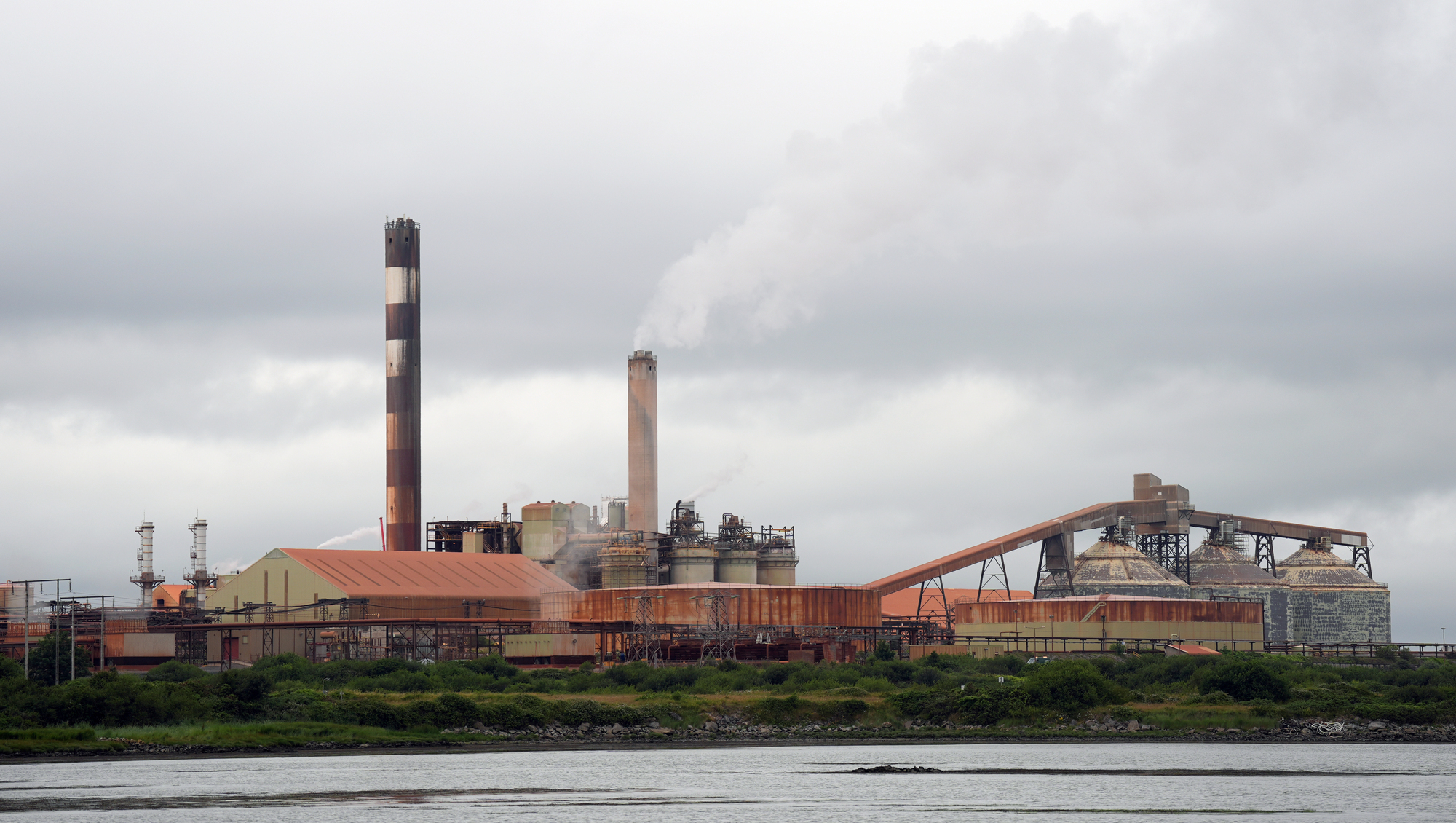
n investigation by the Organised Crime and Corruption Reporting Project in March reported that Aughinish Alumina in Co Limerick was exporting a large share of its production to Russia, where it was alleged to feed a supply chain ultimately used to produce aluminium for Russian defence manufacturers, including companies involved in missiles, aircraft, and other weapons used against Ukraine.
n investigation by the Organised Crime and Corruption Reporting Project in March reported that Aughinish Alumina in Co Limerick was exporting a large share of its production to Russia, where it was alleged to feed a supply chain ultimately used to produce aluminium for Russian defence manufacturers, including companies involved in missiles, aircraft, and other weapons used against Ukraine.

When I travelled to Ukraine earlier this month, I downloaded, as usual, a phone app that sends push notifications about Russian military threats in the region or city where I was staying. When danger is imminent, users receive an audible siren alert warning of an air raid or incoming missile strike.

The missiles and drones that trigger those alerts are built with aluminium alloys. Aluminium is one of the most important strategic materials in modern defence industries. 

Lightweight, strong, corrosion-resistant, and relatively inexpensive, it is used in everything from combat aircraft and helicopters to rockets, armoured vehicles and military satellites.

That brings us to Aughinish. An investigation by the Organised Crime and Corruption Reporting Project in March reported that Aughinish Alumina in Co Limerick was exporting a large share of its production to Russia, where it was alleged to feed a supply chain ultimately used to produce aluminium for Russian defence manufacturers, including companies involved in missiles, aircraft, and other weapons used against Ukraine.

Those weapons have in turn been linked to attacks on civilian targets, including residential buildings.

The Aughinish plant is owned by Rusal, the Russian aluminium giant founded by Oleg Deripaska, a businessman closely associated with Vladimir Putin and subject to Western sanctions. 

The investigation described a vertically integrated supply chain in which bauxite is mined in Brazil and Guinea, processed into alumina at Aughinish, exported to Rusal smelters in Russia, and converted into aluminium sold to companies connected to the Russian military-industrial sector.

According to the investigation, the majority of Aughinish’s alumina exports now go to Russia, and these exports have increased substantially since the full-scale invasion of Ukraine in February 2022.

That raises an obvious and uncomfortable question: Why did Ireland’s exports to Russia expand during a period when Russia was dramatically increasing military production?

Calls for action

Earlier this month, the European Parliament overwhelmingly adopted a non-binding motion calling for sanctions to ban the sale of alumina to Russia.

Its vice-president, Pina Picierno, said: “It is unacceptable that, while the EU funds Ukraine’s defence, a Russian-owned company operates undisturbed within a member state [Ireland], supplying the Kremlin’s military industry”.

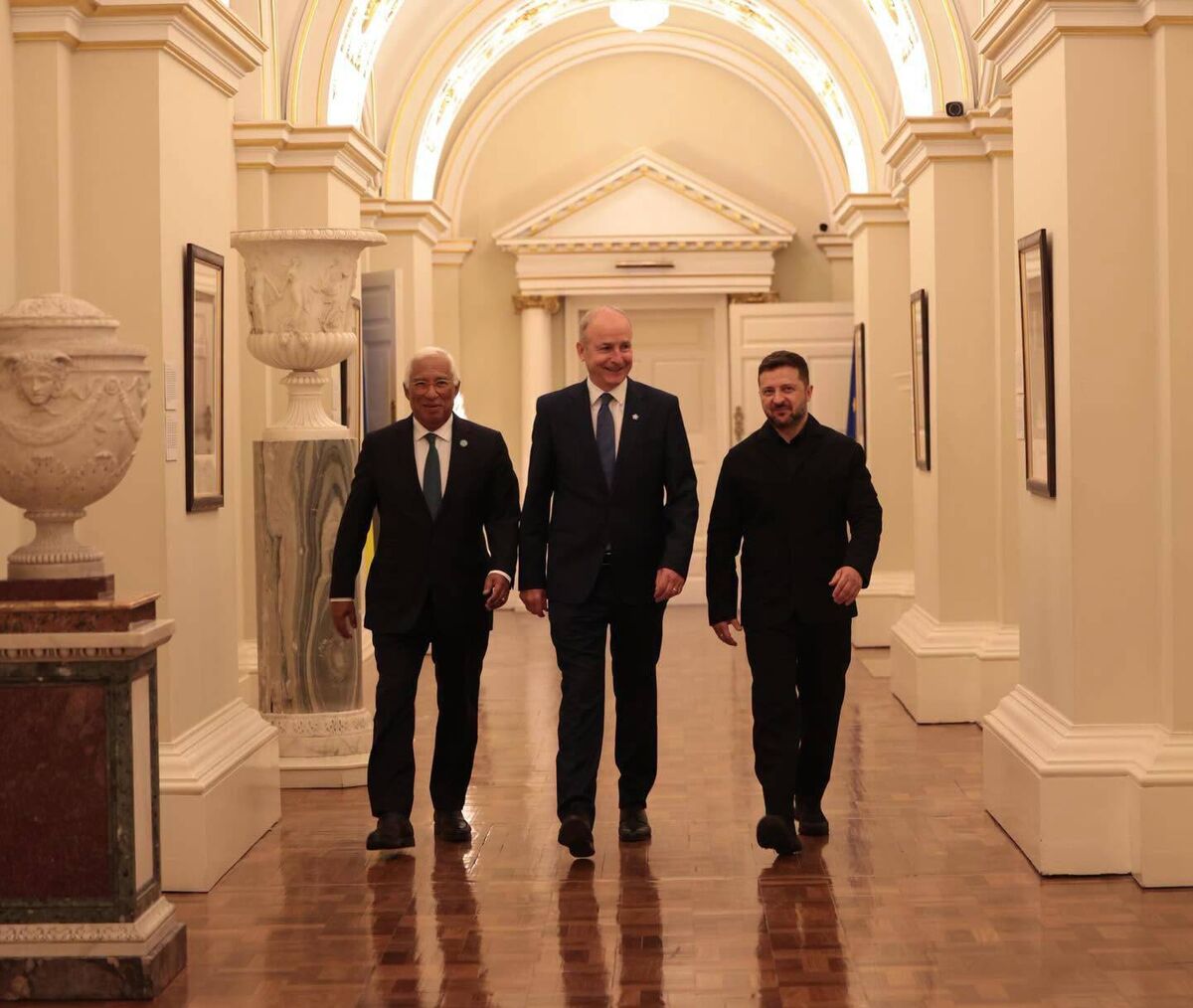
Taoiseach Micheál Martin and Volodymyr Zelenskyy, with the president of the European Council António Costa, left, during the Ukraine president’s recent visit to Ireland, during which he said to Mr Martin: ‘Every tonne of raw materials that end up in Russia is used against us in this war.’

Most importantly, Ukraine itself has urged Ireland and the EU to add alumina exports to the sanctions regime while warning that continued shipments from Aughinish undermine sanctions and strengthen Russia’s military capability.

President Volodymyr Zelenskyy has publicly pressed the EU and Ireland to sanction alumina exports to Russia. He raised the issue directly with the Taoiseach earlier this month during his visit to Dublin, where he said: “Every tonne of raw materials that end up in Russia is used against us in this war.”

Australia provides a precedent. When Russia launched its full-scale invasion of Ukraine on 24 February 2022, around 20% of its alumina needs came from an Australian plant co-owned by Rusal, the same Russian company that owns the Aughinish site in Limerick.

The Australian government quickly recognised how central aluminium was to Russia’s war effort and moved to ban alumina exports, treating the issue as one of principle and wartime responsibility rather than an embarrassing technical problem to be explained away.

Describing the raw material as “a critical input into weaponry, including guns, ammunition and missiles”, then prime minister Scott Morrison said the ban demonstrated Australia’s “absolute commitment to holding the Putin regime to account”. Rusal was shut out of the company’s operations, alumina exports were reoriented away from Russia, and new markets were found. The jobs were preserved and the company continued to thrive. In the end, Canberra accepted a simple principle: Where there is a credible risk that a strategic raw material is supporting Russia’s war machine, the default response should be to stop the flow and deal with the consequences.

Glacial caution

Australia did not hide behind uncertainty or wait for perfect proof before acting. By contrast, the Irish Government’s instinct has been to delay and rationalise. For four years it took no meaningful action, even as the Aughinish Alumina refinery became more integrated into the Kremlin’s industrial economy.

Ireland consistently proclaims its solidarity with Ukraine, backing sanctions, and condemning Russian aggression. That support is genuine and deeply appreciated in Ukraine. Yet when confronted with a compelling prima facie case that Irish-produced alumina may be entering Russia’s military supply chain, the State responded with glacial caution.

Only the publication of the Organised Crime and Corruption Reporting Project investigation prompted the Government to establish an inquiry. Even then, the review was narrow in scope, brief in duration, and had no access to evidence inside Russia. As the Taoiseach arrived in Kyiv on Friday last, the first details of the inquiry’s findings emerged. 

In a carefully worded statement, the Government said it found no ‘definitive’ evidence linking Aughinish exports to Russian weapons production, but neither could it rule out such a connection. That is hardly a clean bill of health for the Russian-owned alumina plant. As the old adage reminds us, absence of evidence is not evidence of absence.

An inconclusive report

The report appears less like the product of a rigorous investigation than a holding operation. It allows ministers to claim they examined the issue while sidestepping the harder question of how governments should respond when the evidence is incomplete but the potential consequences are profound.

The Government has sought refuge in the complexity of global supply chains. Ministers stress that alumina is vital to European industry, that jobs are at stake, and that tracing raw materials is difficult. All of this is true. 

But the issue was never whether the problem was complex; it was whether the State had the political will to confront it. Instead, the Government has behaved as though the absence of definitive proof settles the matter. It does not. 

There is a long-overdue debate about responsibility and complicity. Such caution might be defensible in a routine industrial dispute, but not during the largest war in Europe since 1945.

Justification for inaction

The evidential threshold set by ministers is impossible: Prove beyond doubt what is happening deep inside a sanctioned Russian industrial system operating under a dictatorship and wartime secrecy. That is not a realistic standard of proof but a built-in justification for inaction. If the Government requires iron-clad evidence from inside Russia before acting, it has effectively decided not to act at all.

There is also a significant reputational cost. Ireland, which currently holds the presidency of the Council of the European Union, has presented itself as a principled supporter of Ukraine. 

Yet those declarations sit uneasily alongside a government that allowed the Aughinish controversy to drift before treating an inconclusive report as a satisfactory endpoint.

This is not simply about one industrial plant in rural Limerick. It is about whether Ireland is prepared to confront the uncomfortable consequences of its own economic arrangements when they intersect with a war that has devastated Ukraine and transformed European security. 

It is about whether the State can distinguish between legal defensibility and moral responsibility. More broadly, the issue forms part of a wider debate about how seriously governments are prepared to limit Russia’s capacity to wage war in Europe.

  • Donnacha Ó Beacháin is professor of politics at the School of Law and Government, Dublin City University (DCU), where he lectures on post-Soviet politics, unrecognised states, Irish studies and foreign policy

x

More in this section

Revoiced

Newsletter

Had a busy week? Sign up for some of the best reads from the week gone by. Selected just for you.

Cookie Policy Privacy Policy Brand Safety FAQ Help Contact Us Terms and Conditions

© Examiner Echo Group Limited