Dorcha Lee: The end of peace in Europe has completely exposed our depleted Defence Forces
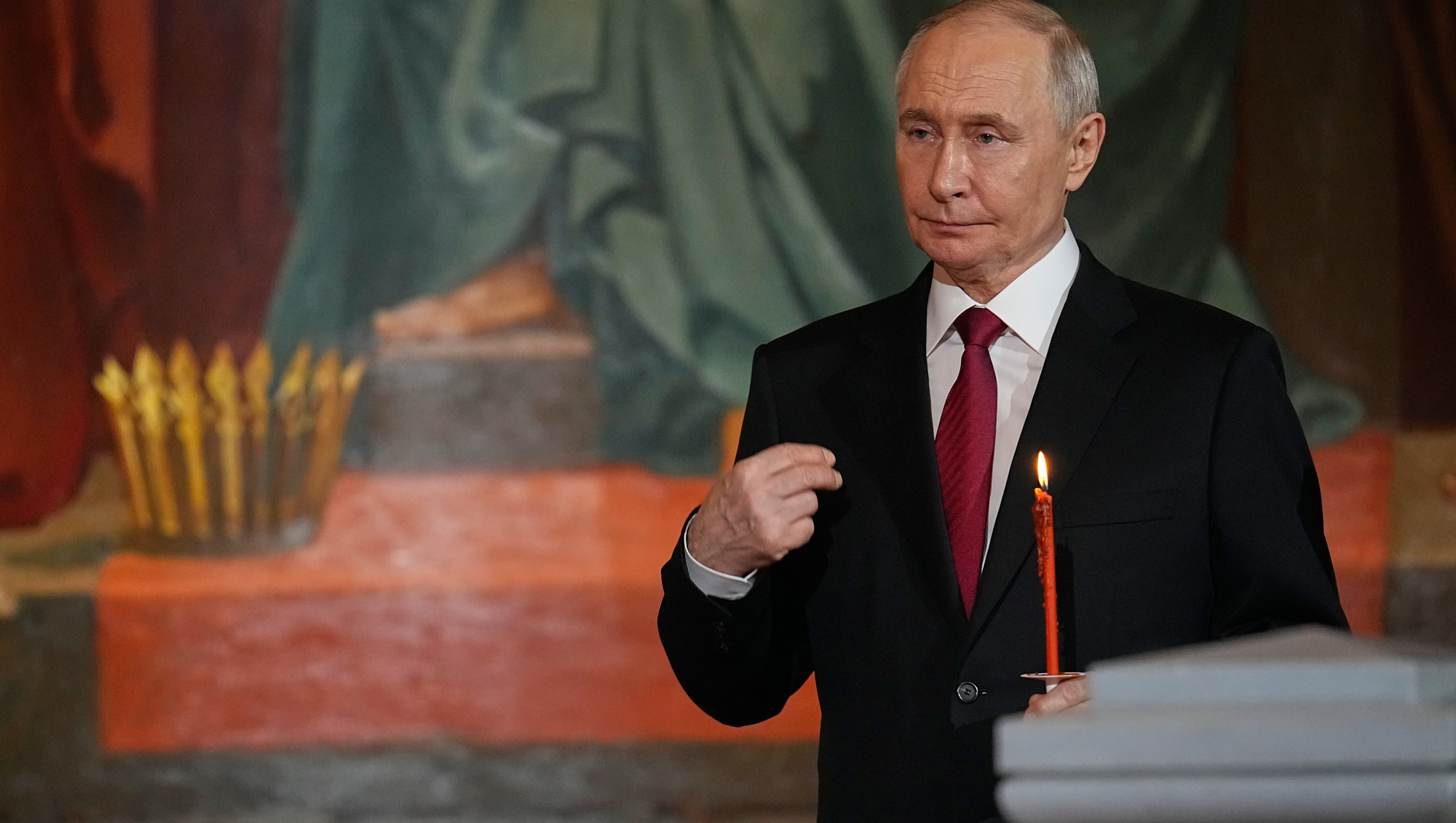
Russian president Vladimir Putin in April. In the years to come, Russia will continue to pursue its national objectives. Sooner or later soft targets in the West, like Ireland, will be engaged. Photo: AP/Alexander Zemlianichenko
According to experts, Russia will be ready in 2029 to initiate ‘special military operations’ against EU member states in the Baltic region. Both the EU commissioner for Defence and Space, Andrius Kubilius, and the chairman of the EU Military Committee, General Sean Clancy have recently warned of the threat from Russia.
If an EU member state is attacked by Russia, all EU member states will be expected to show solidarity with them. Even as it is, the enforcement of EU sanctions against Russia’s shadow fleet could shortly bring the Russian Navy into direct confrontation with Ireland's Defence Forces.
Defence minister Helen McEntee is fast-forwarding legislation to give legal cover for the Defence Forces to board and seize ships suspected of breaking the sanctions.
For sure, the Irish EU presidency will be supporting the EU’s various programmes to enhance the Union’s military and non-military capabilities, to manage a wide range of security and defence contingencies.
But what is Ireland itself doing for the security and defence of its own population? For example, who is responsible for providing air raid shelters? Is it the State, the county councils or is it the private sector?
Read More
Are there back-up contingency plans to replace the internet when it goes down? Are there up-to-date lists of citizens with specialist qualifications who can be invited to join the Defence Forces in time of national emergency?
Is there a national database of ships, aircraft and road haulage vehicles, with their potential military applications? These questions would feature as part of normal contingency planning for war.
TG4 recently produced an excellent programme about Finland, Sweden and Norway not just planning for war but actively preparing for it, including a nuclear war. Already there are air raid shelters for 85% of the Finnish population.
All three countries have limited conscription, or national service.
The defection of Finland and Sweden to Nato meant they had also walked away from the four-nation, neutral/non-aligned group, (Austria, Finland, Ireland and Sweden) that had played an important role in UN peacekeeping for decades, especially during the Cold War.
Probably the best practical outcome of our policy of military neutrality was Ireland’s military collaboration, mainly on peace support operations, with the other three neutral/non-aligned nations.
At the turn of the millennium, the four neutral/non-aligned member states represented a block of 25 million people within the then 15 member states of the EU.
Working together we were able to influence the shape of the new military structures of the EU and the planning for EU military capabilities to manage crises in and around Europe, in situations where the US ‘as a whole’ did not want to engage.
Above all, we four ensured that our corporate knowledge and experience of UN peacekeeping were reflected in the emerging EU military structures, in training and in operational procedures. There was real solidarity there at the time.
Our policy of neutrality, at the time, was closer to Sweden’s than to Finland’s or Austria’s. So, in 2010, when Sweden closed its embassy in Dublin, it was a real shock.
Our common bond, as neutral/non-aligned, meant nothing to the Swedes. It was just an Irish illusion.
In 2021, the Swedish Ambassador returned to Dublin, but things were never the same again.
In May 2021, the Russian build-up of forces and military exercises on the Ukrainian border signalled that war was on the horizon.
In the Group of Four, Austria was always in a more difficult situation than the other three, because it had permanent neutrality imposed on it, in its Constitution, as part of the agreement on the USSR’s withdrawal from Austria in 1955.
After the extended Russian invasion of Ukraine began in February 2022, the Austrian chancellor, Karl Nehammer, was the first western head of Government to meet Putin in Moscow.
The stated purpose of the Austrian-requested ’closed door’ meeting, on April 11, 2022, was to "seek an end to the conflict between Russia and Ukraine".
However, commentators at the time, suggested that the chancellor was also reassuring president Putin that Austria would honour its post-Second World War agreement with Russia, as the successor state of the USSR.
In other words, Austria would not join Nato. In fairness to Austria it has still supported Ukraine, particularly in participating in EU sanctions and other pro-Ukraine initiatives, including, like Ireland, with so-called non-lethal military support.
There are still four neutral/non-aligned EU member states in the EU as Malta and Cyprus had joined the EU in May 2004.
However, given the expansion of the EU to the current 27 member states, and the move away from UN peacekeeping operations to missions run by regional organisations, such as the EU, Nato, AU and OSCE, the remaining neutral/non-aligned group within the EU, has become largely irrelevant.
When Finland and Sweden joined Nato, the four neutral/non-aligned group that dominated UN peacekeeping for decades is no more. Moreover, their departure served to highlight the fundamental weakness of our policy of undefended neutrality.
The steady decline of investment in Irish defence from 1.67% of GDP in 1987 to 0.24% in 2025 was a deliberate gamble on peace. That prolonged period of peace in Europe is over, the music has stopped and Ireland is completely exposed.
Exposed to what you may ask? Our Army cannot function on the modern battlefield. Our Air Corps has not got one single jet fighter to defend our skies, and the Naval Service has not got even one warship capable of naval combat.
We are committed to supporting Ukraine, and rightly so, even though it is about to effectively lose 20% of its national territory as the price of peace.
In the years to come, Russia will continue to pursue its national objectives. Sooner or later soft targets in the West, like Ireland, will be engaged. Ireland has already been subject to cyber and drone attacks.
Let us have no illusions about our involvement in the war in Ukraine, which I fully support. Ireland’s so-called non-lethal military and logistical support for Ukraine is not directly lethal, but its indirect effect is most definitely lethal.
Assumptions that the UK will step in and defend us are optimistic. The UK recently indicated it may have to request France to assist in stopping Russian shadow ships in British waters.
The greatly underfunded Royal Navy has insufficient warships to protect is own coasts, never mind ours.
All political parties in the Dáil strongly support Irish neutrality, but the ideologues of undefended neutrality are putting the future freedom and independence of our country at risk. Sticking with neutrality means robustly defending our neutrality.
Finland and Sweden have, as we used to say in Brussels, "joined the other organisation (Nato) across town". Austria is committed to a delicate pas-de- deux with the Dancing Bear.
We are on our own now.
- Dorcha Lee is a retired Army Colonel and defence analyst.

CONNECT WITH US TODAY



Be the first to know the latest news and updates