The hand of God? Most of the World Cup winners have been Catholic
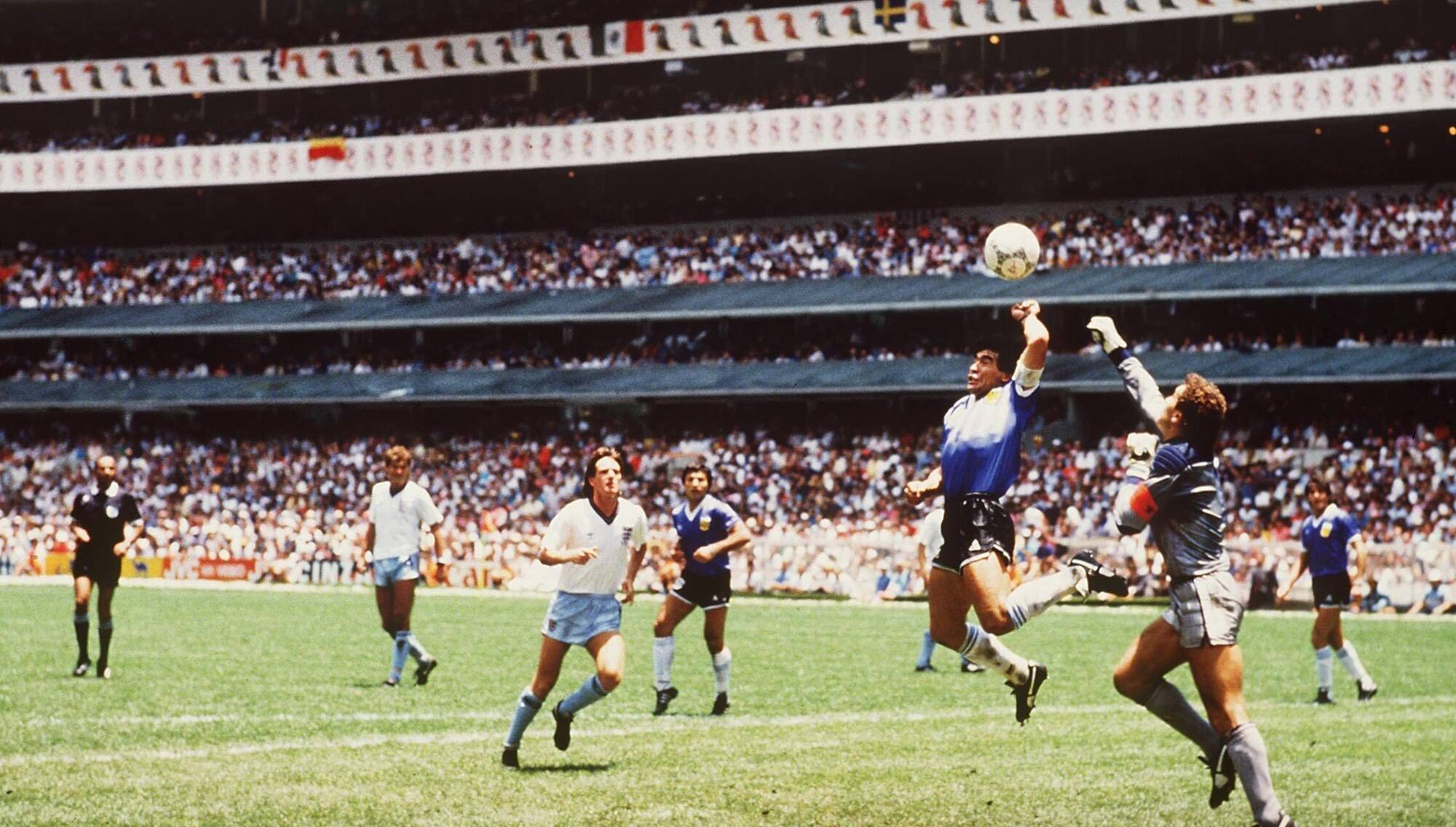
Argentina’s Diego Maradona handles the ball past England’s Peter Shilton to score the opening goal of the World Cup quarter-final at the Azteca Stadium in Mexico City on June 22, 1986; Argentina won 2-1. Picture: Bongarts
Are you watching the World Cup? Chances are that the answer is yes: the planet’s biggest sporting competition is a truly global event, followed by an estimated six billion people in every nook and cranny on Earth.
Famously, though, this world-straddling lollapalooza has actually been won by only eight countries (a further five made the final). And an interesting sub-fact is that almost all were majority Catholic.
Simon Kuper of the , in his book , points out that, of 22 iterations, 17 were won by predominantly Catholic nations (be they devout, “culturally Catholic” or somewhere in the middle): Brazil have five, Italy four, Argentina three, Uruguay and France two each, Spain one.
A further four were secured by Germany/West Germany, split roughly 50-50 between Catholic and Protestant.
England is the only majority Protestant country to take home soccer’s most iconic prize — though the Netherlands have come close, losing three finals.
Read More
Incidentally, Catholic (and tiny) Croatia is probably the greatest overachiever in World Cup history. Only in existence since 1991, they’ve made one final and three semi-finals. Their record post-2002 outdoes Brazil.
Catholic nations are again fancied to prevail this time: favourites include France, Spain, Brazil, Argentina and Portugal, with England, Germany (kind of) and the Netherlands flying the flag for the sister branch of Christianity.
Meanwhile Italy, notoriously, failed to even qualify for the last three World Cups: Catholicism’s spiritual and administrative heart being in Rome adds a further layer of painful irony for the Azzurri.
I find this fascinating. Soccer is inarguably the world game, but why did it become particularly strong in Catholic societies, as reflected in dominance of its most prestigious competition?
To be honest, I have no idea — but in the spirit of sports fans everywhere, I’m prepared to conjecture wildly.
This phenomenon may, for example, be related to the deeper culture of individualism within Protestantism, historically speaking.
On one hand, in broader social terms, this was very good: while Protestant North America was giving land and civil rights to Europeans fleeing penury or danger, Catholic Latin America was holding fast to gigantic plantation economies, indentured servitude, and political repression.
On the other, in World Cup terms, not so good: less of a “one for all, all for one” collective spirit, less willingness to follow orders and subsume oneself to the needs of the collective.
Maybe soccer, and sport in general, just means more to Catholic countries which have tended to be poorer economically.
People mired in poverty and drudgery will naturally latch onto anything that promises hope, excitement, or freedom — ultimately, the feeling of being a winner for once.
You could see this at the last World Cup, where recession-afflicted Argentinians travelled in huge numbers — they basically saved Qatar from being a total washout — and, at home, celebrated victory with a fevered nationwide outpouring of emotional release.
Meanwhile, in affluent France, the team’s appearance in the final barely registered with many people by all accounts.
Maybe it’s divine intervention, proof that God really is Catholic. Although if that be so, why have Mexico — massive soccer-mad population, robust domestic league — been such perennial underachievers at the World Cup?
And where do non-Christian countries fit into this paradigm? Morocco became the first first Muslim country since Turkey in 2002 to make a World Cup semi-final in 2022: is this a sign that the sporting/celestial balance is beginning to shift?
Will Buddha smilingly drive Japan to glory this summer? And though their neighbours in South Korea have a significant Catholic population, they’ve been knocked out, and the ancient Persian deity Ahura Mazda didn’t tilt the scales in favour of Iran.
If a sub-Saharan African team eventually wins the competition, as Pelé predicted they would, will it hail from the Islamic north of the continent or the Christian/Catholic south?
Most importantly, are Ireland totally goosed now that we’re supposedly in a “post-Catholic” era?
I don’t personally believe in God anymore (although as the man says, God’s existence is not dependent on me believing in it), and even I can’t help thinking: weren’t we much more successful back when most people went to Mass?
Of course, there are other factors at play in World Cups. Being a host nation helps, for instance, with six of them winning it outright — though only one of those (France in 1998) was in the last half-century or so.
And as we’ve already established, that probably wouldn’t have happened without the Catholic element.
I’m being a bit facetious here, obviously. But it is kind of funny, and interesting, that even today, in an industrialised sport where money almost always decides levels of success, Catholic countries (be they from the poor-ish “global south” or the relatively poor south of Europe) continue to lead the way.
Maradona wittily attributed his memorable handball goal against England to “the hand of God”.
Going on past results, that invisible hand may well still be directing things, in mysterious ways or otherwise.
- Darragh McManus is a journalist and author
CONNECT WITH US TODAY



Be the first to know the latest news and updates