Catherine Conlon: Andy Burnham's dumping of neoliberalism should be a model for our TDs
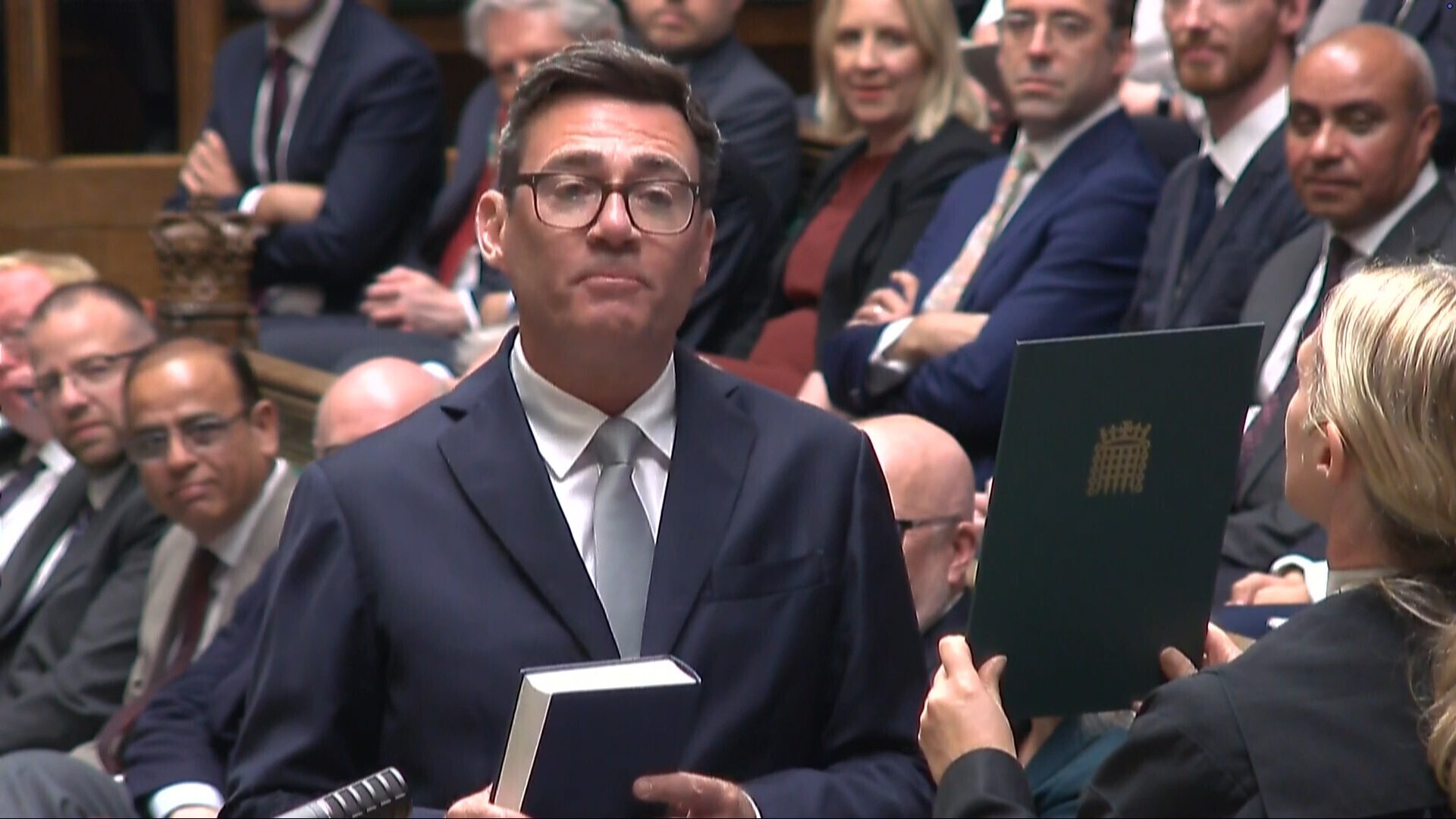
The eight core principles to achieve health equity and build fairer communities are the principles that guide Britain's newly appointed member of parliament for Makerfield and former mayor of greater Manchester Andy Burnham. Photo: House of Commons/UK Parliament/PA
In Henrik Ibsen’s 1882 play, the character Dr Stockman, investigating an outbreak of illness concluded that contamination of the public baths was the source.
His recommendation that the baths be closed and the water supply cleaned was opposed by local politicians who were concerned about lost income from tourists who branded the doctor an ‘enemy of the people’. Almost 150 years later, little has changed.
Michael Marmot is professor of Epidemiology and Public Health at University College London and director of the UCL Institute of Health Equity. Writing in the Lancet this month, he asks “How can the noble scientist, speaking truth to power, with concern for the public’s health, be an enemy of the people — a term used by modern day autocrats to describe their opponents?”
What is clear is that the war between profit and health continues to rage. Experts in public health continue to decry the powerful vested interests that continually push profit over health — tobacco, alcohol, gambling, social media, cars and unhealthy food, that underpin falling life expectancy and increasing numbers of years of life spent in poor health.
Even more detrimental are the social determinants of health. These have been framed by Marmot as the Marmot Principles — an eight-point framework for reducing health inequalities. Grounded in research, the guidelines outline that health is underpinned by social, environmental and economic conditions far more than by access to healthcare.
The eight core principles to achieve health equity and build fairer communities are the principles that guide Britain's newly appointed member of parliament for Makerfield and former mayor of greater Manchester Andy Burnham, who confirmed his intention to stand for the Labour leadership shortly after Britain's prime minister Keir Starmer resigned.
So, what are the eight Marmot Principles?
- Give every child the best start in life.
- Enable all children, young people, and adults to maximise their capabilities and have control over their lives.
- Create fair employment and good, quality work for all.
- Ensure a heathy standard of living for everyone.
- Develop and sustain healthy, sustainable places and communities.
- Strengthen the role and impact of ill-health prevention.
- Tackle racism, discrimination and their outcomes.
- Pursue environmental sustainability and health equity together.
During the Makerfield campaign, Burnham’s promises included cutting train fares, cheaper water and energy bills; more investment in public services; training and “re-industrialisation” to help working-class communities.
These promises will be difficult to realise in a country with a debt-to-GDP ratio of 95%, a spiralling benefits bill; nervous bond markets and calls for the defence budget to be bolstered.
Key to his agenda are public control of utilities and transport; regional devolution; housing; social care reform and a rejection of trickledown economics. Essential services such as water and rail should be brought under public ownership.
Political power should shift away from London with local mayors in control of utilities, housing and education. He has pushed for council housing building on a mass scale to combat the housing crisis.
He has long argued for major social care reform such as replacing the inheritance tax with a “national care levy” with elderly care free and the wealthiest paying the most.
He also rejects the Milton Friedman principal of “trickledown economics” of free markets, deregulation and monetarism aligned with the “Reaganomics” of former US president Ronald Reagan and “Thatcherism” of UK prime minister Margaret Thatcher.
Instead, Burnham advocates for increased public investment in state infrastructure and technical education to boost local economies.
Burnham's support of the Marmot Principles are relevant to Ireland — recently found to the be the second most expensive country in the European Union with prices here more than a third (36%) above the EU average — behind only to Denmark.
This new finding from Eurostat comes at a time when prices continue to soar especially for food, energy and rent. More than one-in eight Irish people were at risk of poverty in 2025, up from 11.7% the previous year, according to the CSO.
The statistics, released from the CSO’s Survey on Income and Living Conditions (SILC) 2025, showed the richest 20% of the population had 3.9 times the income of the poorest.
The SILC showed that 15.1% of the population were defined as living in enforced deprivation in 2025. Enforced deprivation is the inability to afford goods, services or utilities that are considered necessary for an acceptable standard of living.
Yet while the corporate tax take in Ireland has ballooned in 10 years to €35 billion, our infrastructure index has not kept pace. The rail network is half of what it was a century ago, primarily connecting major cities to the capital only.
Thousands of graduates stream out of Ireland, unable to afford to live here. In terms of food security, the country exports quality meat and dairy but provides minimal support for crops or tillage. Agriculture is threatened by floods, droughts, and the cost and availability of fertilisers.
Water and sewage systems buckle under the weight of what is asked of them while congestion in cities grinds them to a halt, making active travel piecemeal and hazardous. Repeated flooding of urban architecture centred around coasts is an ongoing and spiralling threat.
The data suggests that Ireland is a booming country that lacks the institutional architecture to allow a flourishing economy to function effectively.
In his contribution to the Lancet, Prof. Marmot highlighted the flaws in the neoliberalism approach to the market economy that the Western world has embraced so enthusiastically.
Firstly, freedom rarely stands alone. “In an integrated society, we simply can’t look at an individual’s liberty without looking at the consequence of that liberty for others.”
Marmot suggests that a major flaw with neoliberalism is that the market is not “free”. Asymmetry of information means that the market is rigged towards the producers and purveyors of goods.
Read More
Critically, the market does not deal with the environmental consequences of its operation. The tobacco, alcohol and food industries do not pay for health harms caused while fossil fuel industries do not make amends for environmental and ecosystem damage that threaten our very existence.
In discussing the notion of freedom, Marmot considers both “negative freedoms — freedom from want and freedom from fear” and “positive freedoms — the freedom to live up to one’s potential and freedom to flourish.”
To get there Marmot has a job description for politicians.
“It comes from a speech that John F Kennedy made in January 1961, shortly before he was inaugurated as 35th US President: our leaders must have courage, judgement, integrity and dedication.”
Andy Burnham is emerging from a muddy pool of politicians to speak to power with courage, judgement, integrity and dedication. He urges us to throw away the neoliberalism ideals that ignore equity, health and wellbeing in the pursuit of profit.
It remains to be seen how much of his policies that are now whispering through the corridors of Westminster survive the murky waters of politics. One thing he has demonstrated is an unwavering support for the underclasses — providing them with something they had almost completely buried — hope.
- Dr Catherine Conlon is a public health doctor in Cork and former director of human health and nutrition at Safefood

CONNECT WITH US TODAY



Be the first to know the latest news and updates