Louise Burne: From tension with Sunak to warmer ties under Starmer — where will Burnham fit?
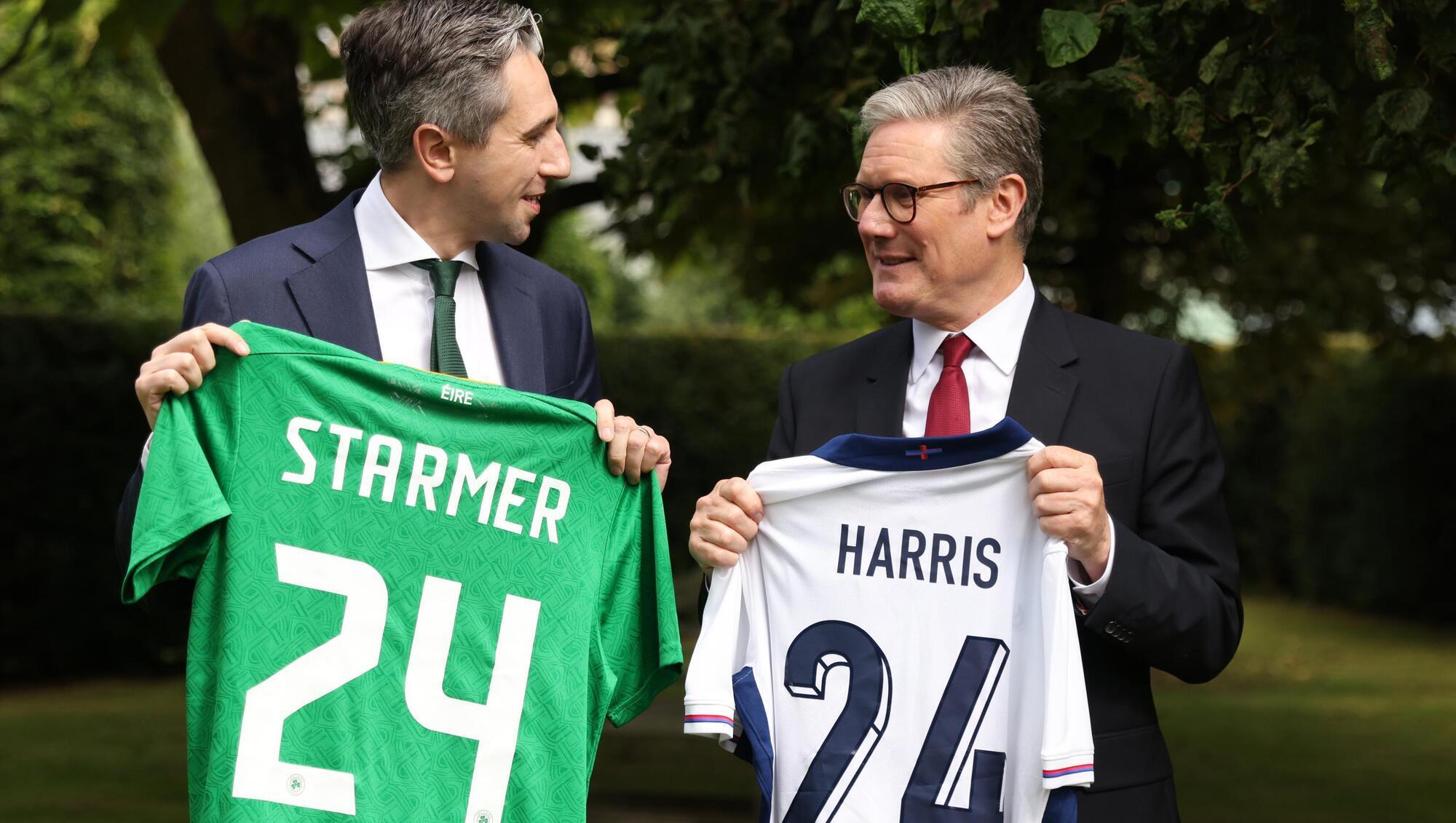
Then taoiseach Simon Harris and British prime minister Keir Starmer with their team shirts at Farmleigh House ahead of the Republic of Ireland v England match on September 7, 2024. File picture
Just a fortnight after he became British prime minister, Keir Starmer sat on wicker garden furniture, sinking pints of (questionable looking) Guinness with then taoiseach Simon Harris in the Chequers sunshine.
It was July 2024. Harris had become taoiseach in April, and both men were finding their feet running their countries.
The meeting over dinner saw the two new leaders toast a “reset in relations” between Ireland and Britain after a decade of frostiness, tensions, and bad breakups.
Starmer made a return trip to Dublin in September 2024, attending the Ireland vs England soccer match in the Aviva Stadium.
Harris and Starmer swapped jerseys before the match, with their surnames and the number “24” on the back of the tops.
When Starmer held up his green top, there was no way he could have realised that the number would ultimately represent the number of months he would spend as prime minister.
He was back in Chequers this last weekend. But rather than being at the start of his premiership, he was coming to the realisation that he was being forced to end his time at Number 10 as his Labour Party colleagues became increasingly despondent but determined that his time was up.
Read More
In this resignation speech, Starmer listed some of his achievements. This included turning the Labour Party around, Britain’s economic growth, and the UK’s improving relationship with Europe.
What he did not mention, however, was the work he did to improve Irish-Anglo relations. It is something he deserves a lot of credit for.
Brexit, and the UK’s decision to leave the EU, fractured its relationship with Ireland so acutely that there were times when it looked like it could never be repaired.

Former Irish leaders, including Leo Varadkar and Simon Coveney, became boogeymen for the Brits under successive Conservative PMs.
While Varadkar managed to talk Boris Johnson around at a now-infamous meeting at the Wirral that saved both the UK and the EU from a “no-deal Brexit”, trust remained at an all-time low in the intervening years as the briefing and bitching about Ireland continued in the British press.
Things got off to a relatively good start with Rishi Sunak. That was, at least, until the Irish Government found itself in an unholy spat with him over asylum seekers.
As Sunak continued to face backlash over his inhumane Rwanda policy, in April 2024 he celebrated the influx of those seeking international protection in Ireland, having travelled from the UK via Northern Ireland.
He insisted that the UK would not be taking those asylum seekers back. Despite the Irish Government making moves to certify the UK as a “safe country”, this plan later fell flat after it was deemed unlawful by the Irish courts.
As then justice minister Helen McEntee confirmed that 80% of people seeking asylum in Ireland were travelling from Northern Ireland, Harris fired warning shots at Sunak, insisting that there was an agreement in place and Ireland would not be a “pawn” in UK politics.
Just as it has for most of our shared history, the border between North and South was again hurting British-Irish relations.
Sunak infamously called a general election in the lashing rain just a few weeks later and was gone by mid-July.
Starmer brought with him a new government, a new mindset, and a new approach to dealing with Ireland.
And it was not all pints and jerseys.
One of the first things agreed at the meeting between Harris and Starmer at Chequers was a new annual summit where the leaders would come together to discuss issues and build a programme of work upon which ministers could work within.

The first summit was held in Liverpool in March 2025, with Cork hosting the return leg earlier this year.
Starmer and his Government also worked closely with their Irish and Northern Irish counterparts to repeal the Troubles Legacy Act. The legislation did something that is not often done in Northern Ireland, and united all parties in opposition. There was particular unease about providing conditional immunity from prosecutions for Troubles-era crimes.
In the mid-2000s, Starmer had been a human rights adviser to the Northern Ireland Policing Board, and replacing the Legacy Act was among the first promises he made as PM.
As he announced that a new framework had been agreed last September, Harris noted that the Legacy Act was “unilaterally conceived, unilaterally drafted, and unilaterally implemented” by the previous Tort government.
As he unveiled the framework with Starmer’s secretary of state for Northern Ireland, Hilary Benn, the Tánaiste said the new plan was a “step-change from that”.
While migration across the border continues to pose a challenge, Starmer’s decision to kill off the Rwanda Act eased tensions.
While the ink on Starmer’s resignation letter to King Charles is barely dry, attention is already turning to who will be moving into No 10.
As he paid tribute to the outgoing PM, Taoiseach Micheál Martin remarked that he had “no doubt that his successor as Prime Minister will wish to continue to deepen and strengthen the relationship between the UK and Ireland”.
It looks like that person will be Andy Burnham, the former mayor of Greater Manchester who, as the so-called King of the North, won a seat in the Makerfield by-election last week and truly sealed Starmer’s future.
Speaking at the Alliance Conference in Belfast earlier this year, Burnham said his ancestors, including his great-grandfather, left Drogheda, Co Louth, for Liverpool in the late 1800s. His ancestors went on to work in the Liverpool docks. He is also reported as having links to Donegal.
Following his victory last week in Makerfield, and with the full knowledge that plans to make him prime minister would be in full swing before the end of the weekend, Burnham said he had one priority.
“I’m going to have a pint, is what I’m going to do,” he told reporters.
“That’s first.”
The Irish Government will be hoping that pint diplomacy with the British government continues and that Burnham will be able to maintain the good relations that Starmer repaired.
- Louise Burne, Political Correspondent