Singing together can help build community in divisive times
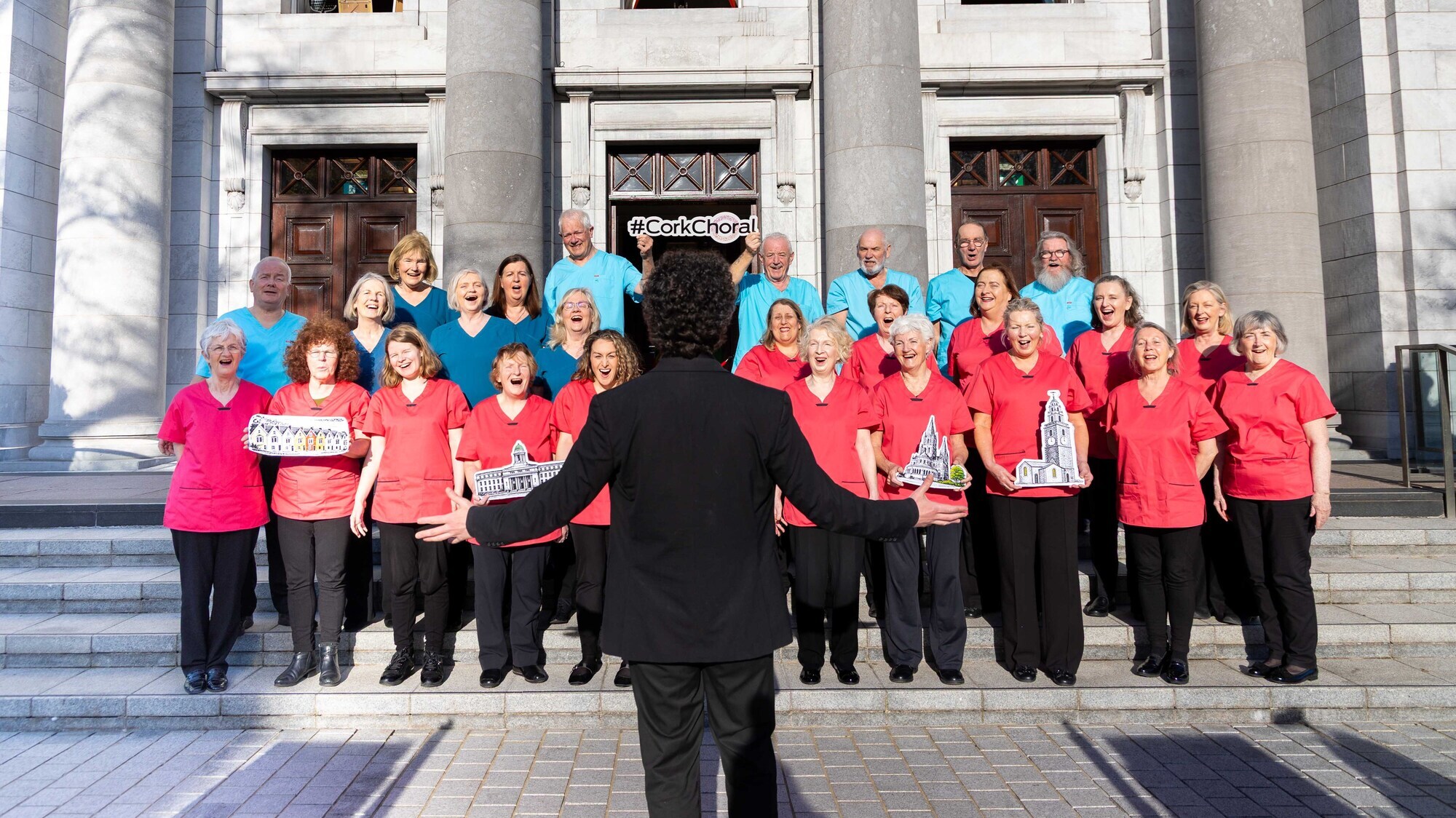
​Scrubs Choir with conductor Patrick D'Alton at the launch of the Cork International Choral Festival 2026 Programme. Picture: Alison Miles / OSM PHOTO
In a world that regularly feels fractured and focused more on differences than commonalities, there is something very powerful about people coming together to sing.
Singing together is one of the most natural ways people connect. From early human gatherings and ancient Greek choirs to medieval church music and Irish sean-nós singing, people have come together to share songs.Â
Read More
Singing has been part of both joyful and sorrowful moments, part of ritual and daily life. That instinct remains strong today, and now science is helping us to understand why.
Over the past two decades, a growing body of research has shown that singing in a group can have a measurable impact on wellbeing. People who sing together often report lower levels of stress and anxiety, improved mood, and a stronger sense of connection with others.Â
These findings support what singers have always felt, while helping to position singing not just as an art form, but as something that contributes to public health and community life.
Part of this comes down to what happens in the body. When people sing together, breathing patterns begin to synchronise, heart rates can align, and cortisol levels decrease. At the same time, endorphins and oxytocin, linked to pleasure, trust and bonding, are released.Â
The result is a shared physiological experience that helps people to feel calmer, more connected and more at ease. There is something quite remarkable about a room full of people quite literally getting in sync with one another.
Singing also provides an accessible and unthreatening way to express emotion. For many, it offers a space to process feelings that can be difficult to articulate in conversation.Â
Research has shown that singing can support emotion-focused coping, helping people to manage their response to stress rather than remove it entirely. In doing so, it can reduce reactivity, support resilience, and create a sense of release that is both personal and shared within the group.

There are cognitive benefits too. Learning music, following a conductor and performing as part of a group engages memory, concentration and co-ordination.Â
For younger participants, this supports communication skills and confidence, helping them to find their voice both musically and socially. For older adults, it has been linked to maintaining cognitive function and overall quality of life.Â
In that sense, singing is one of the few activities that genuinely spans all ages, offering something valuable at every stage of life.
One of the most powerful aspects of singing is its accessibility. It does not require specialist training or expensive equipment, only a willingness to take part. This openness allows people from different backgrounds and experiences to come together on equal terms. In a choir, everyone contributes to the same shared sound, and every voice has a place within it.
This sense of inclusion is what makes choirs such important community spaces. They provide a regular opportunity to meet and collaborate. For many, choir rehearsals become a routine and grounding part of the week, offering structure, social connection and a sense of belonging.Â
At a time when genuine connection can feel harder to find, these opportunities matter.
We saw a striking example of this during the covid-19 pandemic. At a time when people were physically separated, singing became a way to reconnect. Virtual choirs emerged around the world, with thousands of people taking part from their homes, while workplace choirs and online sessions offered a shared outlet during periods of isolation.Â
While nothing quite replaces the experience of singing together in person, those moments highlighted just how strong the desire for collective musicmaking is.

That instinct to sing together, even when apart, speaks to something fundamental. It highlights how deeply people value shared creative experiences, and the role they play in supporting wellbeing and connection.Â
It also reminds us that singing is not just about performance. It is about participation, expression and the simple act of doing something together.
Moments where choirs gather on a larger scale build on that same foundation. The anticipation in the lead-up, the focus of rehearsals, and the shared thrill of performance all contribute to a strong sense of collective achievement. For many singers, these moments represent the culmination of months of preparation, carrying a real sense of pride and fulfilment.
That is part of what makes gatherings such as the upcoming Cork International Choral Festival, returning from 29 April to 3 May, so meaningful. They provide a focal point for choirs throughout the year, creating anticipation, purpose, and an opportunity to connect with others who share a love of singing.Â
With thousands of performers travelling from across Ireland and around the world, they also bring a wider sense of cultural exchange, where different traditions, styles and voices can be experienced side by side.
At its heart, singing together is about people. It is about showing up, taking part and contributing to something greater than one’s self.Â
At a time when many are looking for ways to feel more connected, more grounded and more engaged, the simple act of singing together offers a powerful and long lasting answer.
- Peter Stobart is festival director at the Cork International Choral Festival, which returns from 29 April to 3 May. See corkchoral.ie