TP O'Mahony: Link between religion and politics in the US is unique in the West
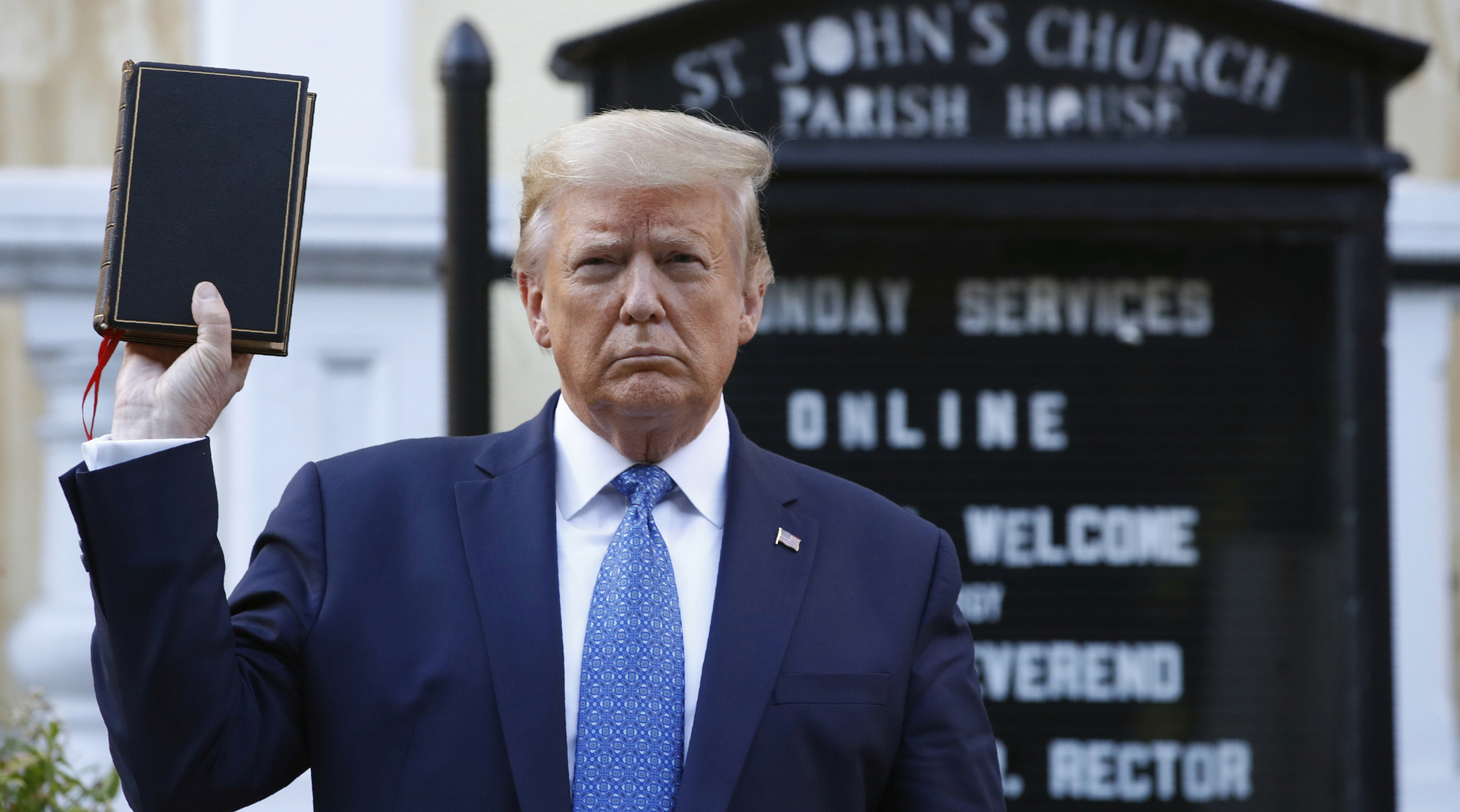
Even president Donald Trump — not ostensibly a God-fearing man, regarded by his critics as the most profane, religiously illiterate president in the country’s history — knows the importance of playing the 'God card'. Photo: AP/Patrick Semansky
The weaponising of religion for political ends — which now seems to be the settled policy of the Trump administration — is just the latest chapter in the long history of the often poisonous symbiotic relationship between religion and politics.
What the contretemps that followed president Trump’s criticisms of the anti-war pronouncements of Pope Leo XIV also illustrates is the peculiar place and role of religion in the United States and the extent to which it has embedded itself in the political culture of one of the world’s great superpowers.
An edition of magazine in November 2006 had a striking photograph on its front cover — it showed a cross tightly wrapped in the Stars and Stripes. The title of the cover story was “America’s God Complex”. Inside the cover this was the line used to plus the story: "America’s political system has increasingly fallen under he sway of Christian evangelicals".
In a world where Church leaders such as the Pope and the Archbishop of Canterbury are alarmed at the spread of secularisation in Europe, it is astonishing that, even in the 21st century, no candidate in the USA can expect to be elected to the White House without playing the 'God card'.
Unlike Europe, the USA remains an intensely religious society. Even Sam Harris, one of the militant new atheists whose books sell very well, has had to concede this.
“Despite the explicit separation of church and state provided for by the US Constitution, the level of religious belief in the United States (and the concomitant significance of religion in American life and political discourse) rivals that of many theocracies.”
This is the main reason why candidates for high office seek to outdo each other in establishing and displaying their religious credentials. Even president Trump — not ostensibly a God-fearing man, regarded by his critics as the most profane, religiously illiterate president in the country’s history — knows the importance of playing the "God card".
One of the abiding images of his first term as president was a photograph of him standing in front of St John’s Episcopal Church (a small 19th century building known as “the church of the Presidents” across from the White House) with a Bible in his hand.
All candidates for the White House ignore, at their peril, the vast religious constituency spread across the USA. “Religion has been inseparable from American politics for as long as America has had politics,” according to Stephen Carter, professor of law at Yale University, “and will likely remain inseparable as long as Americans remain religious.”
The same, of course, could be said of Ireland, where the interface between religion and politics has been a central characteristic of the culture in both parts of the island, though the consequences of such an interface have had diverse effects North and South.
One of the big differences, however, between Ireland and USA is that the latter, from its very founding, has nurtured a conviction that it was “God’s own country” and destined to be a beacon of liberty to the rest of the world.
The pilgrims who set sail from England in the 17th century on board the Mayflower and other vessels to settle in America were imbued with a religious zeal that has coloured American civic life and politics ever since. The belief that America has been the recipient of God’s favour took root.
This interplay between religion and politics in America is unique among Western nations.
In , former US secretary of state Madeleine Albright addressed the question of why religion cannot be kept out of politics.
“My answer is that we can’t and shouldn't. Religion is a large part of what motivates people and shapes their view of justice and right behaviour. It must be taken into account.
"In any case, why should world leaders who are religious act and speak as if they are not.”
The republican impulse to separate church and state is motivated primarily by a desire to prevent or nullify the emergence or growth of political religion or what some scholars refer to as “faith-based politics”.
But the separation doctrine doesn’t mean, as Professor Carter has pointed out, “that people whose motivations are religious are banned from trying to influence government, nor that government is banned from listening to them”.
Secularists envisage a scenario in which religion and politics may co-exist like parallel lines but where there is no crossover; they do not intermix or interact. That may be fine in theory but the reality throughout the world is very different.
Even in avowedly communist and post-communist countries like Russia, China, Cuba and Vietnam religion is, however reluctantly, tolerated. It may be driven underground, but it has not been eradicated.
It continues to influence the lives and behaviour of people, even though they may only constitute a small minority, as in China. It is true that religion is excluded from the “public square” (Russia is an exception here), but it has a social presence nevertheless.
Indeed, in Vladimir Putin’s Russia, there is now a very clear alliance between the Putin-led administration and the Russian Orthodox Church.
In Stalin’s Russia, just as in Mao’s China, years of brutal oppression and persecution failed to wipe out religion, so today in both countries an accommodation of sorts has been arrived at.
This is far more visible and substantive in Russia. But in both places the lessons of the failure of Stalin and Mao to eradicate religion have been learned.
In Moscow, Putin now regards the Russian Orthodox Patriarch, Kirill I, as an ally, and the Church is looked on almost as a department of state.
And in March 2019, the Kremlin reported that Putin had “dipped into his own pocket” to pay for a religious icon to adorn a new Russian Orthodox cathedral near Moscow dedicated to the country’s military.
It was a protest against this cosy relationship between Church and State that brought Pussy Riot global notoriety. On 21 February 2012, five members of the feminist punk band staged an obscenity-laced performance of their in the Cathedral of Christ the Saviour in Moscow.
Orthodox clergy condemned the protest as “sacrilegious” and there were calls for the introduction of a blasphemy law. Members of Pussy Riot were arrested and charged with hate crimes and violations of public order. Three were imprisoned.
Writing later that year of the protest in magazine, Jeffrey Taylor said: “Patriarch Kirill has moved the Church ever closer to the Kremlin and, ahead of presidential elections last March, openly called on Russians to vote for Putin.”
What the Russian invasion of Ukraine in February 2022 showed unmistakably was that Kirill’s support for Putin and his geopolitical ambitions extended even to war-making.
This is just a further but deeply unsettling example of “political religion”, this time taken to extremes and with lethal consequences.
Trump’s war in Iran, justified on religious grounds, falls into the same blood-stained category.
And what it all reinforces is the acknowledgement by Linda Hogan, professor of Ecumenics at Trinity College Dublin, that religion is “here to stay, and its impact on political life is likely to persist in multiple forms”.
- TP O’Mahony is the author of
CONNECT WITH US TODAY



Be the first to know the latest news and updates