Neurological patients outside Dublin face 'stark inequalities' in care, experts warn
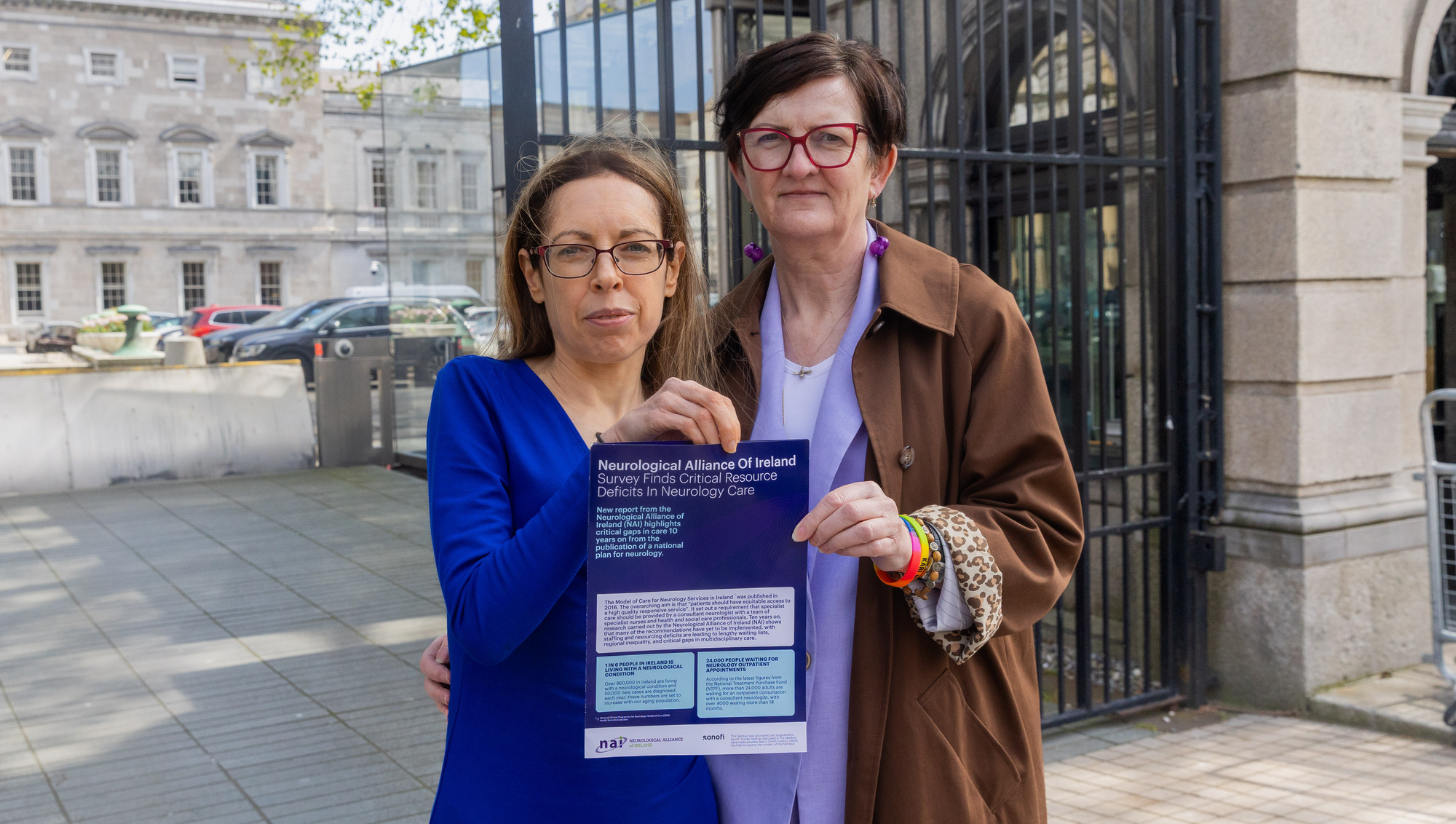
Mags Rogers and Brenda O Connell outside Leinster House. Picture: Gareth Chaney
People with neurological illnesses living outside of Dublin are being “disenfranchised” and face “stark inequalities” in care compared to those in the capital, it has been claimed.
Of the 24,000 people nationally waiting to see a neurologist 4,000 are waiting across Cork, Waterford, and Limerick.

But the patients in those counties are facing additional barriers even after this appointment happens. Large hospitals there do not have dedicated therapists to support patients.
They include people with Parkinsons, motor neurone disease (MND), epilepsy, and multiple sclerosis (MS).
The Kerry service, meanwhile, is run by a locum consultant even though funding for a permanent role was approved in 2024, along with Wexford, Portlaoise, Mayo, and Letterkenny.
In Clonmel, the hospital does not have a neurology service.
Neurological Alliance of Ireland chief executive Mags Rogers said an investigation it has carried out, published on Wednesday, shows “stark regional inequalities”.
The HSE’s model of care plan for neurology is now 10 years old. Then, there were around 12,000 people nationally waiting for a first appointment.
“That has now jumped up to 24,000 this year,” Ms Rogers said. “It reflects shortages and also does reflect increased demand.”
This is being exacerbated by limited access to a range of therapists especially outside of the capital.
“We found this is really a critical problem especially when you get outside Dublin,” she said.
“That’s where the regional neurology centres are particularly disadvantaged in not having that multi-disciplinary team.”
It means consultants must refer patients to the community. “They don’t have their own team to relay on," she said.
Cork University Hospital is one of two designated National Neuroscience centres in Ireland.
It does not have a dedicated psychologist, medical social worker, or dietitian for neurology and the speech & language therapist covers part-time hours.
Beaumont Hospital, the other national centre, has most of these therapists but data was not available on neuropsychology.
Professor Orla Hardiman is a neurologist at Beaumont hospital and co-founder of the NAI.
She echoed NAI's concerns, saying of budget limits and staff shortages: “This is much worse outside Dublin than it is in Dublin.
Now that the HSE works in regions, she said: "There is a risk that if we don’t have a baseline level of service and expertise in the regions, then patients will be left behind."
On Wednesday, the NAI presented these findings at Leinster House.
Chair of the Oireachtas Cross-Party Group on Neurological Conditions, Colm Burke, said it showed a “deeply concerning picture” of services.
A response to the concerns is being prepared by HSE regions.
Brenda O’Connell lives with Parkinsons and faced a three-year battle to get a diagnosis.
She called for funding for dedicated clinics as well as more recognition that neurological conditions are life-long and life-changing.
Ms O'Connell's symptoms started in 2020, soon after she recovered from breast cancer.
"I started to have problems with balance, literally walking, I was finding very difficult,” she said.
By 2022, she had “very strong suspicions” she had Parkinson's, but her GP did not agree. It was only confirmed with a DaTscan done privately in 2023.
“I felt relieved,” she said.
"To be honest, I thought I was going mad, and I was close to a breakdown with anxiety because anxiety is a massive non-motor symptom of Parkinson's."

Despite support from Parkinson's Ireland and her family, gaps remain even in Dublin, where she lives.
“The neurologist situation in Ireland is awful. I only get to see my neurologist once a year,” she said.
“The clinic in (the hospital)is not just for Parkinson's, it’s a neurology clinic, and it’s pretty chaotic as they are dealing with way too many patients.”
She supports the NAI's call for investment in a network of dedicated clinics, including better local care.
One service saw a fourfold jump in referrals between 2019 and 2024, while many struggle with limited access to therapists.
“We found this is really a critical problem, especially when you get outside Dublin,” she said.
Regional neurology centres are "particularly disadvantaged", she said, describing patients essentially “competing” for therapists.
Ms Rogers said: “Clonmel (hospital) in Tipperary has no neurology service.”
Prof Hardiman warned about budget limits and staff shortages.
- Niamh Griffin is Health Correspondent.