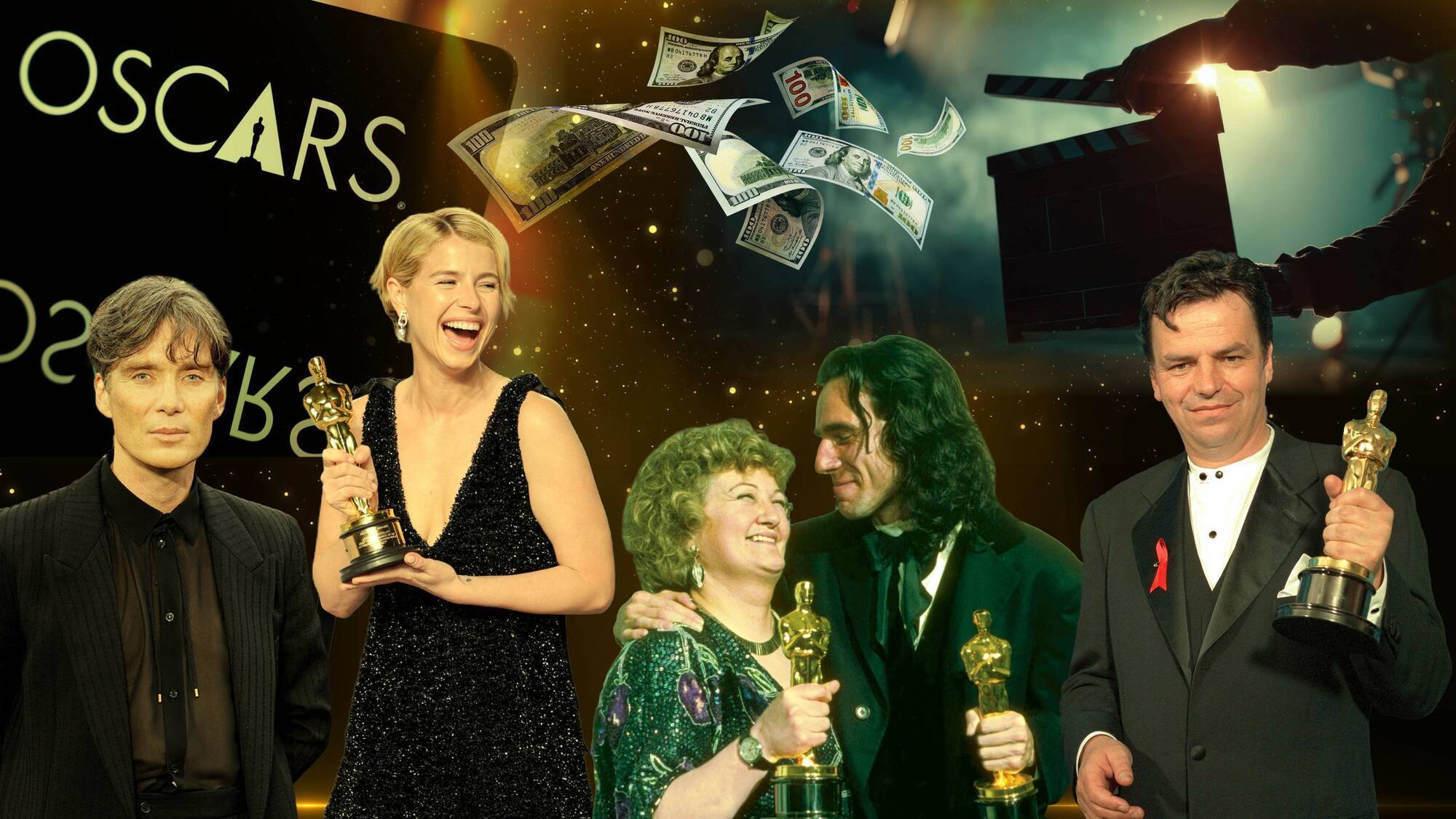
Colin Sheridan: And the Oscar goes to... the campaign with the most money and influence

Winners of the film industry’s showcase awards are not random, but are rather the end result of months of lobbying, writes Colin Sheridan
Colin Sheridan: And the Oscar goes to... the campaign with the most money and influence

Once a film is established as a frontrunner, that status can become self-reinforcing.

AWARDS season likes to present itself as a kind of cultural weather: Something that gathers, builds, and breaks of its own accord. A performance catches fire. A film finds its moment. Momentum appears, as if naturally, and carries a contender all the way to the stage. 

But films do not win awards by accident. That is the uncomfortable truth humming beneath the afterglow of last Sunday night’s Oscars, where celebration and narrative fused seamlessly. 

For Irish audiences, in particular, the moment carried an added charge: Jessie Buckley’s win felt, in the language of awards season, ‘inevitable’. But inevitability is rarely organic. It is constructed.

We are encouraged, every year, to believe in surprise. The gasp in the auditorium. The trembling speech. The idea that a performance or a film has, against the odds, captured the collective imagination of an industry. 

Yet behind that theatre lies something far more deliberate: A parallel ecosystem of strategy, persuasion, and long-game positioning that begins months — sometimes years — before a single envelope is opened.

The awards industry

Awards season is not a season. It is an industry.

Long before audiences encounter a film, decisions are being made with awards in mind. 

What kind of story travels? Which historical period confers weight? Which real-life figure offers both prestige and narrative clarity? 

Casting, too, becomes part of this calculus. 

A certain kind of performance — transformative, visibly effortful, rooted in suffering or physical change — has, over time, proven legible to voters. It signals seriousness. It signals worth.

None of this is accidental.

Studios speak, in public, about artistic instinct and creative risk. 

In private, they understand the grammar of awards. A film can be ‘positioned’. A campaign can be ‘run’. A performance can be ‘framed’. 

These are not cynical aberrations; they are standard practice. 

As one long-standing critique has it, the Oscars function as ‘the greatest promotion scheme’ the industry ever devised for itself.

Oscars campaigns

And then there is the campaign itself.

To the viewer at home, awards season appears to unfold naturally, as critics’ lists give way to guild nominations, which give way to the Oscars. But this apparent progression is underpinned by relentless outreach. 

Screenings are organised for voting bodies. Q&As are staged. Interviews are secured, not merely to promote the film, but to shape a story around it. 

Profiles emphasise dedication, sacrifice, and craft. A performance is no longer just a performance; it is a narrative.

Trade publications become battlegrounds. Full-page advertisements — ‘For Your Consideration’ — appear with increasing frequency as the season intensifies. 

These are not subtle. Faces fill the page. Categories are specified. The ask is explicit. It is lobbying, dressed in tasteful typography.

Or, as one insider put it more bluntly: “People campaign viciously and vigorously… and spend a lot of money.” 

The line between persuasion and pressure can blur.

Studios routinely spend millions on these campaigns — on screenings, on access, on visibility — creating a parallel economy alongside the films themselves.

The better funded a campaign, the louder its presence; the louder its presence, the harder it becomes to ignore. 

Smaller films, however admired, can find themselves crowded out not by quality, but by volume.

So how much of a win comes down to the campaign, and how much to the work itself?

Erik Anderson, editor-in-chief of industry staple AwardsWatch, is clear-eyed about the balance. “A win is almost always a combination of both,” he says, “but in varying degrees, depending on the film and/or performer.” 

In other words, there is no single formula; only a shifting calibration between art and advocacy.

Sometimes, the campaign falters. Anderson points to Timothée Chalamet’s recent push; an initially aggressive, highly visible strategy that pivoted mid-season in an attempt to appear more “palatable” to voters. 

“It didn’t work,” Anderson notes. “They didn’t buy it.”

By contrast, Michael B Jordan’s more consistent, lower-key approach — paired with what Anderson describes as a stronger film — proved more persuasive.

And then, occasionally, the system bends the other way. “You can have Sean Penn win a third Oscar with virtually no campaign,” Anderson says. “Not everyone can do that; few can.” 

It is the exception that proves the rule: A reminder that while campaigning dominates, it has not entirely eclipsed performance.

Oscars momentum

More often, however, what matters is momentum.

Oscar campaigning has been said to be “at a volume and intensity similar to major political campaigns” and the comparison holds. There are narratives to shape, constituencies to reach, inevitabilities to construct.

Once a film is established as a frontrunner, that status can become self-reinforcing.

“Sometimes, the narrative of an early frontrunner can hurt a film,” Anderson says. “But, most of the time, a non-stop momentum makes it impossible to avoid.” 

He points to this year’s One Battle After Another as a case in point: Despite attempts to frame it as a close contest with Sinners, “that wasn’t the case”. The story of the race had already been written.

Even those within the system have expressed discomfort. George Clooney once described the process as “like kissing babies… it starts to feel unclean”, a line that captures the uneasy proximity between art and advocacy. 

More recently, Matt Damon went further, calling Oscar campaigning “completely backwards”, a striking admission from an actor who has both participated in and benefited from the process.

In this context, the idea of a ‘surprise win’ becomes more complicated. Surprises do occur, of course. But they tend to emerge from within the parameters of what has already been made visible. 

The groundwork has been laid. The campaign has done its work. When the envelope is opened, it reveals not a bolt from the blue, but the culmination of months of careful orchestration.

The Oscars machine

What people outside the industry often misunderstand is not just the scale of the machine, but its texture.

“So many things,” Anderson says, when asked what the public gets wrong. “How voting works, for one.” 

There is also a tendency, he suggests, to project rivalry where little exists. 

“The nominees… are more often than not actual friends and not competitive in the way that fan bases perceive them.” 

And then there is the quieter, less quantifiable element: Timing. 

“Sometimes, the Academy will have an ‘it’s time’ moment”, Anderson notes, pointing to landmark wins that arrive not at the peak of a campaign, but at the intersection of history, sentiment, and overdue recognition. 

Other times, those moments simply do not come.

And yet, for all this complexity, the façade of spontaneity remains essential.

We want to believe that art rises. That excellence is recognised. That the best work finds its way to the top. Awards depend on that belief. 

Without it, the entire enterprise risks appearing transactional, even hollow. The emotional power of a win — especially one that resonates culturally or nationally — relies on the idea that it was earned in a pure, almost organic way.

'You campaign for that Oscar'

This is where the tension lies.

Buckley’s win will be remembered as a moment of pride and recognition. It speaks to talent, to persistence, to the global reach of Irish performers. 

But it also exists within this broader system, a system that identified, early on, the potential for that performance to travel, to connect, to be championed. The narrative of inevitability did not emerge by chance. It was built. 

As another actor once put it, with disarming clarity: “You don’t just win an Oscar… you campaign for that Oscar.” None of this diminishes the achievement. But it complicates it.

For film-makers and studios, awards confer visibility and longevity. A nominated film is more likely to be seen, to be discussed, to be remembered. 

For actors, a win or even a nomination can re-shape a career. For audiences, awards offer a guide — imperfect, but influential — through an overwhelming landscape of content.

And for the industry itself, awards season provides a narrative. It tells a story about what matters, about what is valued, about what is worth celebrating. That story is not neutral. It is shaped by taste, by power, by access.

As this year’s awards cycle fades into memory, replaced by the slow churn towards the next, it is worth asking how much of what we witnessed was discovery, and how much was design. 

How early were the contours of these victories visible? Who decided which performances would be ‘in the conversation’? And what does it mean, for audiences and artists alike, if the answers to those questions are less romantic than we might like?

The envelopes may be sealed. The results may be presented as revelations. But the story, more often than not, has already been written.

More in this section

Revoiced

Newsletter

Sign up to the best reads of the week from irishexaminer.com selected just for you.

Cookie Policy Privacy Policy Brand Safety FAQ Help Contact Us Terms and Conditions

© Examiner Echo Group Limited