‘The people save the people’: the message of Valencian resilience after deadly floods
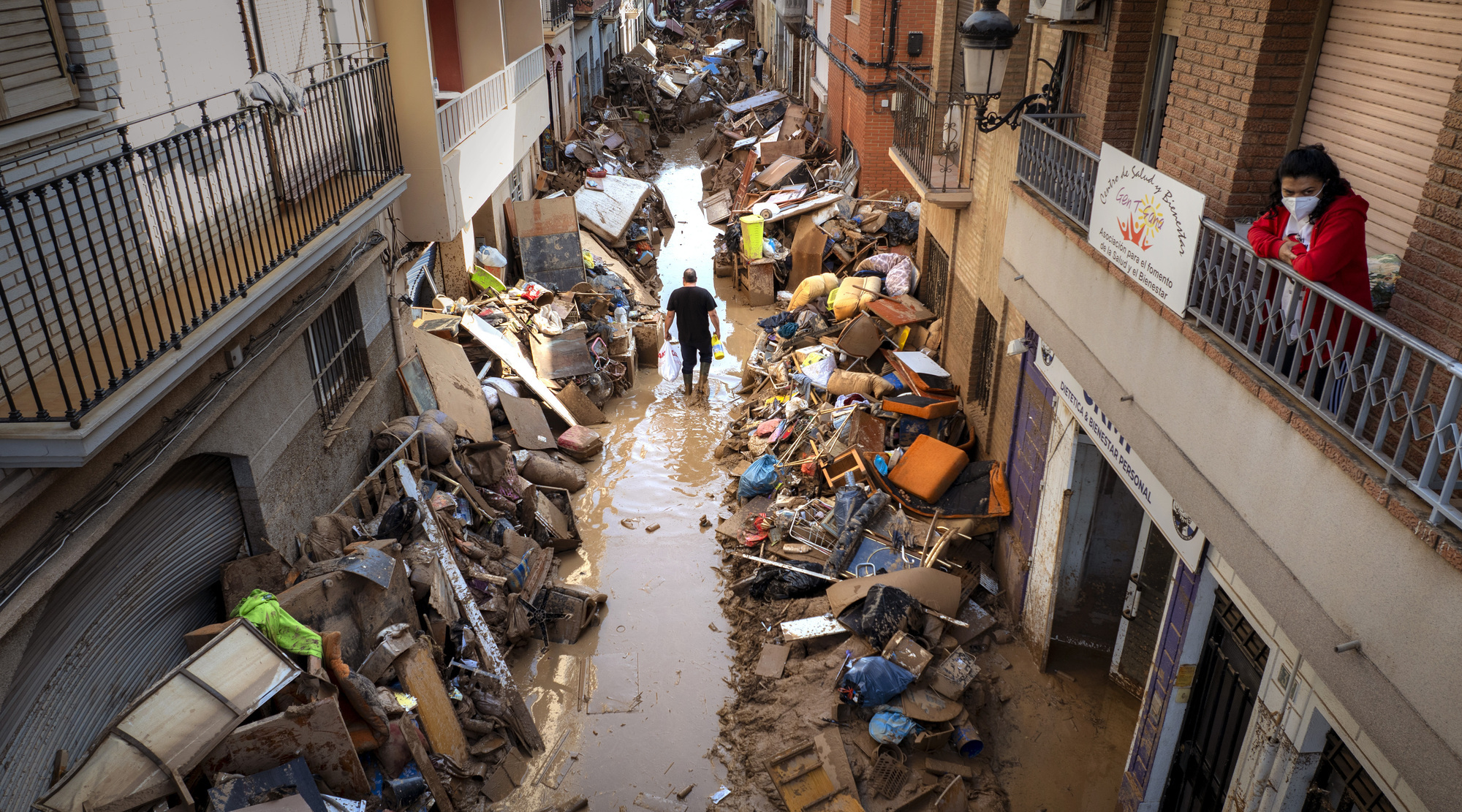
People walk through a street with piled furniture and rubbish in Paiporta, Valencia, Spain, on Tuesday, November. 5, 2024. Picture: AP /Emilio Morenatti
Since then, there has been a series of ups and downs in the city. For sure, the past few weeks have not been without hostility.
Mere hours after submitting that previous article, where I described the response as “one of the most beautiful things I have ever seen”, fights and riots broke out across the city as emotions grew more and more belligerent.
Opportunist criminals exploited those who had to flee their homes; breaking in and taking whatever remained.
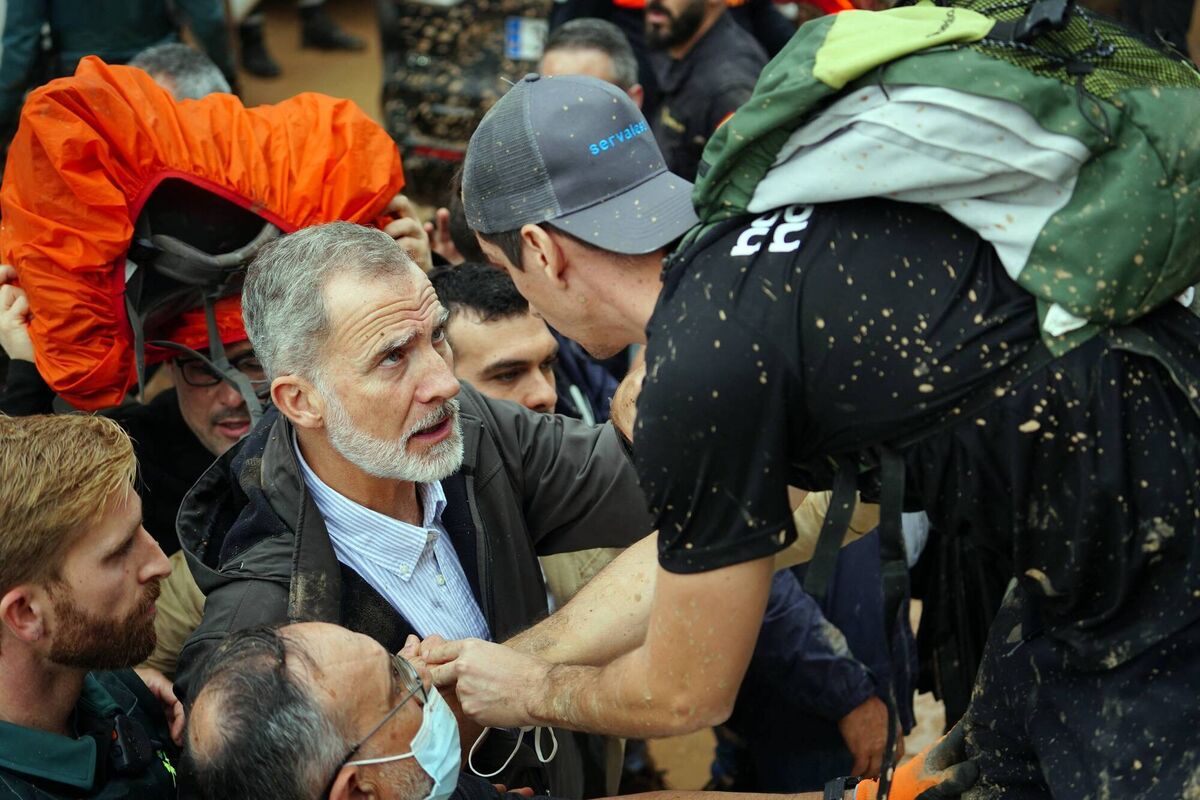
A visit from the Spanish royal family was met with even more anger and violence; crowds booed and threw eggs at King Felipe VI, and kicked and vandalised state vehicles.
Protests took place over the management of the disaster. A campaign was launched calling for the resignation of council president Carlos Mazón. The movement bore the slogan ‘Mazón dismissió’ (‘Mazón dismissed’) and highlighted the anger over the “incompetence” of Mazón and his political party, Partido Popular, in how they handled the response to the flooding.
On November 9, tens of thousands of people marched in protest over the mismanagement of it all. Many sported mud-stained outfits, having spent days tirelessly cleaning disaster-struck areas. In Plaça de l’Ajuntament, where the march culminated, mud was thrown at the council buildings and flares were set alight.
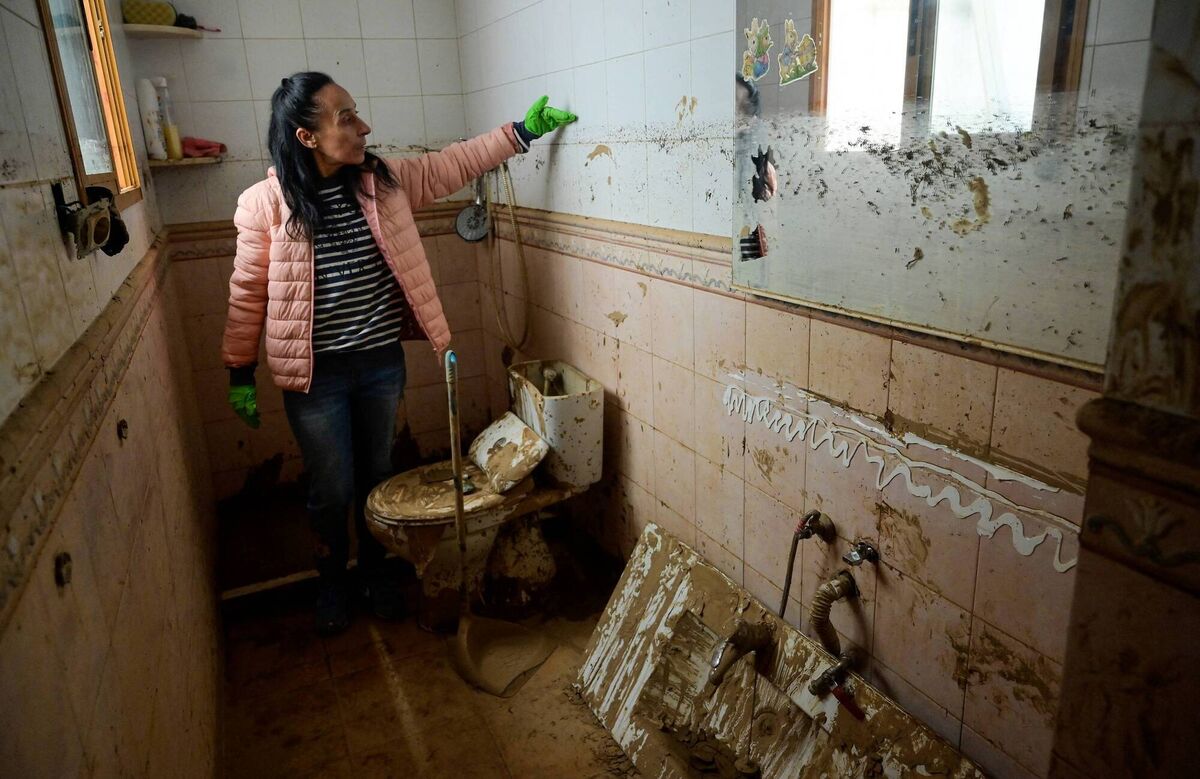
Many buildings and businesses still display a black ribbon in their windows, and flowers and wreaths are laid in remembrance.
However, in the midst of all the anger and controversy, there were moments of hope and optimism too.
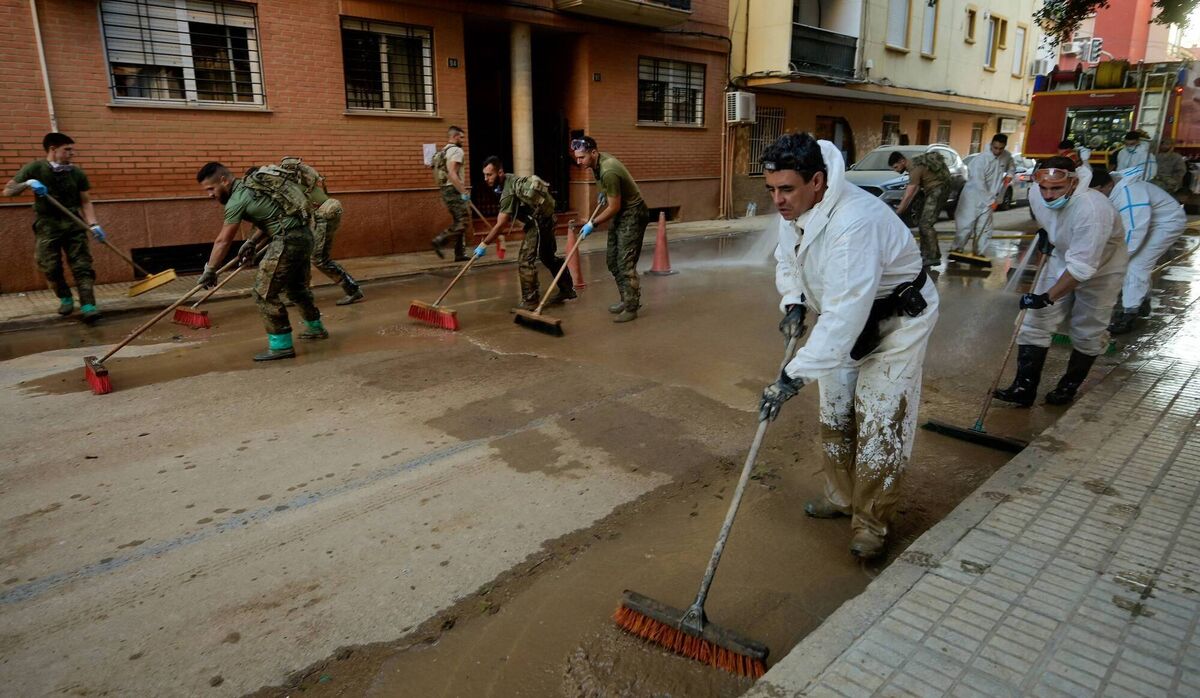
People are still working in their droves to clear dirt and debris from affected areas.
Misplaced pets have been fostered and rehomed.
Music still plays in the street and people dance.
Children can still be heard laughing and playing in the city’s squares.
Tourists are still coming to explore everything Valencia has to offer — and perhaps, appreciating it that little bit more now.
On December 1, after much deliberation and speculation over whether or not it would go ahead, the Valencia Marathon took place under blue skies. Before the starting gun was fired, an emotional tribute to the 224 known victims of La Dana was held. An estimated 35,000 people took part in the race, many of whom wore Valencian flags and jerseys in solidarity with the city and flood victims.
On December 4, the city of Valencia was lit up in dazzling Christmas lights. Like in Ireland, families made an evening out of it; wrapped up in scarves, hats, and jackets, sipping hot chocolates, and listening to carolers. True to Valencian form, fireworks lit up the night sky, and the local anthem, Himne de l’Exposició, was sung by thousands of people.
Life is slowly getting back to normal, but echoes of the floods remain, and the memory of it all is still very clearly etched into everyone’s mind here.
Marte Roma is an artist from Argentina who has been living in Valencia for over a year now. Their mother, Anahi, had recently bought an apartment in Sedaví, which was one of the hard-hit areas during the floods. They described what the evening of October 28 was like for them.
“I was here [in my apartment] and I was actually gonna go to my mom’s house, and then I couldn’t,” they say, “because the roads were closed. She video calls me and she’s like, ‘hijo, mucho agua’ (son, a lot of water).”
At this point, they say, Anahi noticed foreboding signs begin to emerge. Their mother noticed some of the cars in the street: “The [hazard] warning lights started going off, maybe because the water was getting into them.
“And then we start hearing people screaming,” they say, speculating, “maybe there was someone trapped in one of those cars, and people from the balconies that were seeing everything and couldn’t do anything.” Anahi told Marte that she would pack some things and she was going to go to the third floor of her apartment block.
After the call, Marte grew worried because, for about an hour, phone service had fallen in the area (they presume due to traffic on the networks or flood damage to the cell towers).
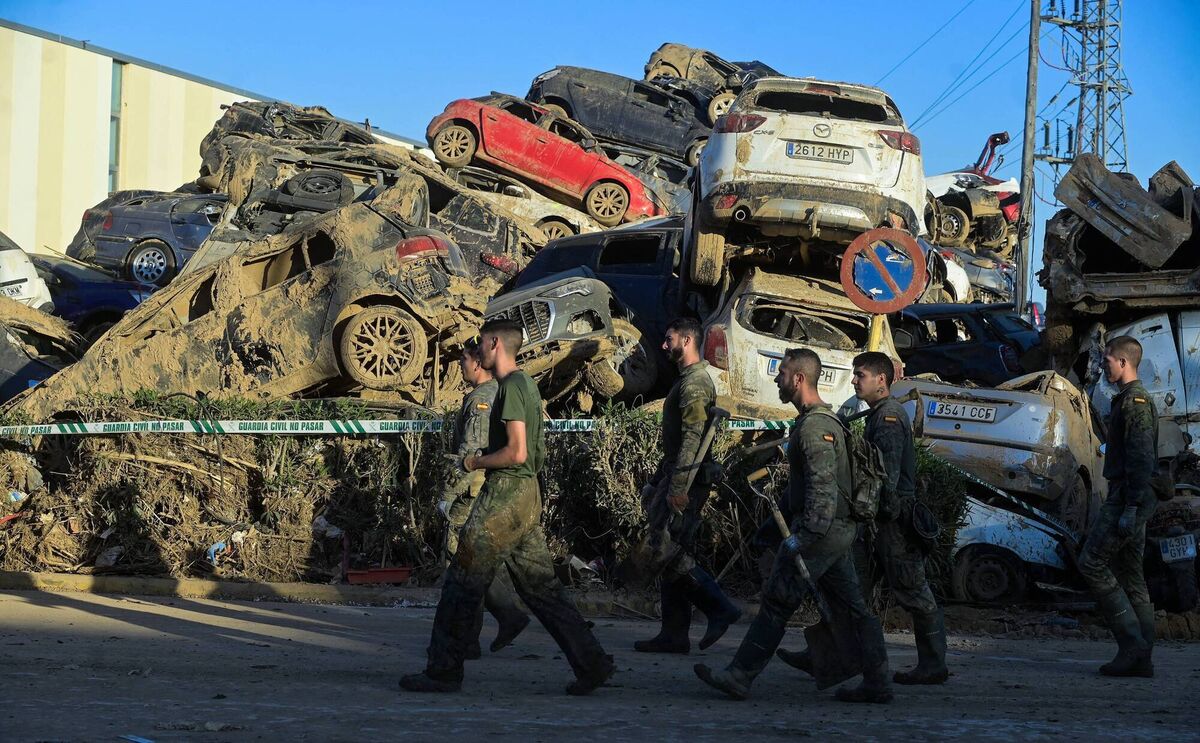
They managed to make contact again and Anahi was well, but the destruction was immediate. Water levels nearly reached the first floor of the apartment block and cars had piled up at the door of the building.
Marte also kept their car at their mother’s home as the two shared the vehicle for getting in and out of the area. The car, a Fiat 500, was swept away in the storm, and was found 11 days later.
“Someone — I think, not publicly — developed a website where you put your car [registration] and they tell you exactly where they saw it,” they explain.
“So we tried it and it actually turned up, it showed a picture of our car, above like an entire mountain [of debris].” From the picture they saw, the car looked intact and Marte and Anahi were hopeful the car would be repairable.
“We found it totally destroyed,” they say, “like, the entire front of it was cut off, basically. It’s like it’s been beheaded.” As well as the inconvenience of now being without a car (not to mention that in the aftermath of the floods, many transport lines were out of action), there were possessions in the car too, including a sentimental painting Marte had created for their mother.
While water levels didn’t quite reach Anahi’s floor in the apartment block, the smell and conditions made a lot of the building temporarily uninhabitable. At the time Marte was speaking with the , Anahi was staying with others in the area, who reached out to Marte after they posted on social media asking for a helping hand. Yet another demonstration of the generosity and goodwill of the people in the city.
Many will know by now that Valencia’s famous Jardín del Turia was constructed following the great flooding of 1957. It involved the rerouting of the Turia River and constructing a green space where the riverbed was.
Marte draws my attention to the House of Cats — an art installation of sorts — in the city centre. Rumour has it a previous owner of the building constructed a small Spanish-style ‘house’ for feral cats to claim. Beside the house is a tile demonstrating the level the water rose to in the city in 1957.
Above it, two new tiles have been hung. One reads: “This is where the incompetence of the [Partido Popular] rose to in 2024”, the other reads: “Water will be here by 2100.” One of the most controversial topics this year — and yet to be clarified — is the implementation of the National Civil Protection System. Anger mounted over the (late) time it was signalled, the level of alert it issued, and political figures distancing themselves from the controversy in the aftermath.
As for response measures, Marte feels there is a very clear and obvious solution to stopping this from happening again. They point out that the location of where the river was rerouted to is still in an area of Valencia that is populous — especially nowadays as more and more people find it difficult to afford accommodation in the centre area and begin to move more toward the suburbs.
“One of the things that I’m thinking — and I’ve been thinking, and I talked about it with my mom as well — it’s why are they not proposing an expansion of it [the reroute]? Even more down south,” they say, “because it will happen again.
“It will happen again,” they reiterate.
“And they’re talking about relief efforts and all, and it’s OK and it’s totally right, but I feel like we’re talking about [relief efforts] like the actual solution to it.”
Rachel McCourt is from Midleton, Co Cork, and has been living in Valencia since October 2023. When she speaks to the , she is in her native Cork for the Christmas holidays.
She describes what happens there when the weather forecast takes a turn for the worst.
“Midleton often gets hit by flooding throughout the year,” she says. “So anytime there are high tides and maybe, you know, heavy rain forecast, people are always kind of on the alert; you’d often see sandbags out, some businesses have floodgates and stuff.
“It’s always been an issue, and I think they’ve been talking about it for years in terms of trying to make a plan, a flood prevention plan, with the council and the OPW.”
While she was already living in Spain when Midleton flooded following Storm Ashley, in October 2023, McCourt draws some parallels with what she saw in Valencia.
“In a way, it was kind of similar to Valencia in that it wasn’t in the town [centre] that the river burst its banks,” she says, adding: “They were lucky [in Midleton] that that happened during the day.
“I remember hearing of someone who had to swim out their front door to cross the street and get out of their house. So there were really badly affected areas in and around the town.
“And there was a lot of damage done. Luckily, no lives were lost or anything, but again, similar to Valencia, I suppose, the reaction or the response from the council wasn’t good.”
However, she points out there was one strong common, somewhat positive, thread between the floods at home and in Spain.
“There is a great community spirit,” she says, speaking of the Cork floods, “and everyone was out helping to clean out shops, and you know a lot of shops lost all their stock, and stuff was destroyed, and everything has just been thrown into skips.
“A lot of groups from, like, schools as well came down, and a lot of the students were helping out, and there was really good community spirit. So that’s definitely something that you can see panned out similarly in Valencia: People just had to take action themselves, and band together, and kind of, get going and try and solve the situation themselves.”
But she adds: “What happened in Valencia, I’d never seen anything on that scale, firsthand. And it was really scary.
“And it just goes to show, on a larger scale, what can happen if the authorities don’t respond quickly and appropriately and help the people who are living in those areas.”
As for her concerns for the future? “It’s very upsetting because you can easily see how that happened here, and it’s a much smaller scale; so like with climate change, if things are going to get worse, would we be able to deal with it? I’m not sure we would.”
Tom Hopcroft is from Birmingham in the UK, but has been calling Spain his home ever since he moved there some eight years ago.
With a background in design, and now based in Madrid, Hopcroft runs ‘Guiris de Mierda’, a community that hosts social events across the country; with the idea behind them being to ignite and nurture “human connection”.
Recently, he walked and skateboarded the length of Spain, from Gaztelugate in the north to Tarifa in the south. The journey is well over 1,000km (think Malin to Mizen, and back up again) and took him 40 days, and is all documented on his Instagram page (@tomcharliedesign).
As he was finishing the mammoth journey, reports of floods in Valencia were beginning to emerge and, on his return to Madrid, Hopcroft decided to join the efforts to help out in Valencia for a few days.
“Spain has been home for me over the past eight years,” he says, “and Spain has given a lot to me, so I kind of felt like it was the right thing to do, it wasn’t any deeper reason than that.
“I also represent my brand, which is an English person in Spain, and so I want to show the best of that, so there’s an element of that as well. I want to represent Guiris de Mierda in a positive light and practise what I preach: That there are good guiris (foreigners) here in Spain as well and people want to integrate and give back — and it’s a great opportunity to do that as well.
“I was cautious; I didn’t want to just go down by myself, with zero organisation, so I went with an NGO called Lo Que De Verdad Importa, and they organised the schools that we would be going to, they organised a daily itinerary,” he adds.
[media=insta]https://www.instagram.com/reel/DChm2YftJbn/[media]
[media=insta]https://www.instagram.com/reel/DCwjQn_twxh/[media]
Lo Que De Verdad organises conferences, and with one planned to take place in Valencia, it cancelled the conference but decided to use the opportunity to help out.
“They were organised, but it’s still kind of a shit show down there. It was hard for everything to be completely organised because a lot of it is just, kind of, going and helping people on the streets and that sort of stuff.”
He and the team he went with spent three days helping in Paiporta in Catarroja. The latter he described as being like a “complete warzone”.
“I don’t want to over-dramatise it — I don’t know what was there before, maybe it was just a field — but it was just these big spaces of nothing,” he says.
“It was definitely quite shocking to see the level of destruction. And also just the mud, there’s so much mud everywhere. I could see if you are living there, it would definitely be quite overwhelming,” he tells the .
In terms of the response from the locals and residents he met, Hopcroft says: “They were super super nice. They were amazing. They were coming up to our group and being super appreciative and thankful. They were amazing.”
With the warm reception he experienced from the Valenican community, will he bring his events back to the city?
“Maybe Q2 next year, maybe the summer,” he says. “But that’s not to say we won’t do events in Valencia in the meantime. There’s totally a possibility to do pop-up things here and there.” ‘Humanity before anything’ The sentiment of people of different nationalities pitching in to help out was also felt by Roma.
Before finishing our conversation, I ask them if there was one message they would like to get out there, one thing for people internationally to know, what would it be?
They don’t hesitate when they answer: “There were a lot of foreigners who went to help. There was a lot of people, they grabbed a shovel, and they went there and they shovelled the mud and the water and everything with every other person there.
“It wasn’t just like Spanish people, it was everyone; Irish and British, yeah, everyone was included,” they say.
In the days that followed La Dana, the phrase ‘el poble salva al poble’ could be heard and seen everywhere. It translates as ‘the people save the people’.
“It became the main phrase of the entire thing,” Marte says. “Cause what Dana showed us was, we have only ourselves to rely on; before governments, before anything else, it’s literally just humanity before everything.”

CONNECT WITH US TODAY



Be the first to know the latest news and updates