Sinn Féin is taking a gamble with radical proposals for housing sector
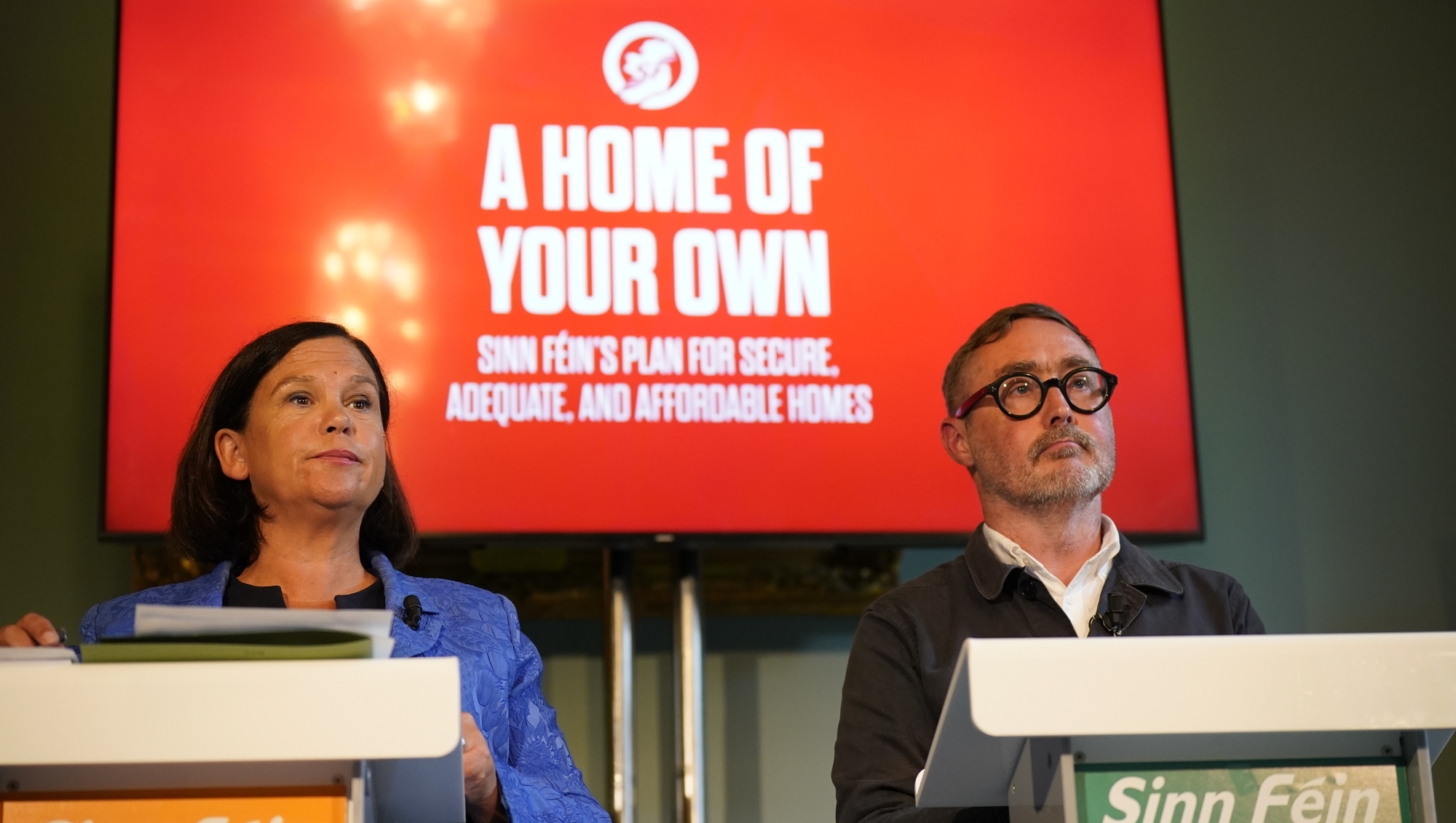
Mary Lou McDonald and Eoin O'Broin at the launch of 'A Home Of Your Own', Sinn Féin's comprehensive housing plan, at the Royal College of Physicians in Dublin.
The publication of Sinn Féin’s housing plan last week has put the issue back at the centre of political debate.
However, while most discussion has focused on the party’s plans for affordable home ownership, its proposals for the private rental sector are perhaps the most radical.
The big areas Sinn Féin wants to shake up are rents and security of tenure.
In relation to rents, its long-standing promise is to introduce a three-year rent freeze, a policy that will be welcome for tenants who have seen rents rise by more than 100% in the past decade, but will no doubt alarm landlords.
After those three years, the party’s new plan will abolish the Rent Pressure Zones (RPZ) and replace them with a new ‘index-based’ or ‘reference rent’ system, as exists in countries such as Germany.
Research by the ESRI shows that the RPZ rules, which cover 80% of tenancies and limit annual rent increases to a maximum of 2% per annum, have been effective in dampening rent inflation.
The current regime, however, has two problems.
First, rent inflation is far in excess of 2%. RTB data shows that average rent increases over the past year have been 5.9% for existing tenancies and 9.1% for new ones. Thus, affordability continues to be a key challenge.
Second, RPZs have created what we might call a ‘two-tier’ rental sector, where longer-standing tenancies can be significantly below market rents, while properties newly brought to market can be significantly above average.
Importantly, the Department of Housing’s recent review of the rental sector argued that it was time to review the RPZ measures and consider reform.
Similarly, the Housing Commission’s recent report, also published over the summer, argued for replacing the RPZs with a reference rent system.
Under Sinn Féin’s proposal, a specific rent index will be created for each local area, and rent increases will be pegged to comparable properties (in terms of size and quality) for the relevant location.
The logic is that landlords will not be prevented from hiking rents so they are close to the average, but will be prevented from rent increases that exceed the index.
What will matter most to landlords and tenants is, of course, the specifics of how this index will be created, something not provided in Sinn Féin’s plan, as that will determine its impact on the sector.
Sinn Féin’s housing plan is very concrete, however, when it comes to security of tenure, proposing to eliminate the most frequently used grounds for tenancy termination — the sale of a property.
Where a tenant pays their rent, landlords will only be able to terminate a tenancy when they need the property for their own use (under very strict limits) or to undertake renovations.
All the research conducted over recent years, by Threshold and others, shows that lack of security is the number one issue for many tenants and a leading cause of homelessness.
Sinn Féin’s plan for the rental sector contains many other reforms that will be welcomed by many tenants: they promise to ensure tenants are allowed to keep pets, explore a ‘rent-to-buy’ policy, and introduce an ‘NCT’ for landlords, to ensure properties are up to scratch.
Taken together, this vision amounts to a seismic shift of rental sector policy and one that has the potential to be very unattractive for landlords.
Sinn Féin has never made a secret of its pro-tenant stance, and now we can see exactly what this would mean in practice if the party is successful in the coming general election.
With such an emphasis on pro-tenant policies, one might ask how the largest opposition party plans to ensure the rental sector expands to meet the demand for private rental housing from a growing population. The answer is it doesn't.
A distinctive feature of its proposal is that it explicitly commits to shrinking the rental sector, i.e. reducing the proportion of households who rent privately.
The logic seems to be that the best private rental sector is a small one. To pull this off, of course, the housing plan will need to ensure the growth of alternative tenures, namely homeownership, cost rental and social housing.
On the face of it, this makes sense. Around one-third of rental sector tenants receive HAP or another rent subsidy, and most experts agree these households would be better served in social housing.
Research from the Department of Housing shows that the overwhelming majority of private tenants aspire to homeownership — so helping them exit the sector makes sense too.
My research on cost-rental housing, where more than 85% of households were previously private renters, shows that residents vastly prefer cost-rental housing to the private rental sector.
From Sinn Féin’s point of view, taking such a perspective allows them to put forward radical pro-tenant policies without worrying too much about the potential for reduced supply of rental sector housing, a neat solution.
Sinn Féin, in other words, plans to pull off two things simultaneously: a radical reform of the private rental sector to make it more secure and affordable for tenants, while at the same time making our housing system much less reliant on the sector by increasing the availability of alternative tenures.
Sinn Féin wants to combine a seismic shift in rental sector policy and a rearrangement of the tectonic plates that underpin our housing system.
From a tenant’s point of view, the big challenge is that both aspects of this audacious plan need to be successful.
This is because radically reforming the private rental sector risks driving landlords out of the market, so if this is not accompanied by the growth in alternative forms of housing it could lead to a disastrous imbalance of supply and demand, compounding the very problem that has gotten us into the mess that is our current housing system.
Sinn Féin certainly can’t be faulted for lack of ambition, but the big question is whether it can pull off its proposed reorganisation of the housing system. And whether voters are willing to take that leap of faith with them.
Michael Byrne is a lecturer at UCD's School of Social Policy, Social Work and Social Justice, and director of the Equality Studies M.S.c.

CONNECT WITH US TODAY



Be the first to know the latest news and updates