Polio in Gaza a global threat as low vaccination rates put children in Ireland at risk
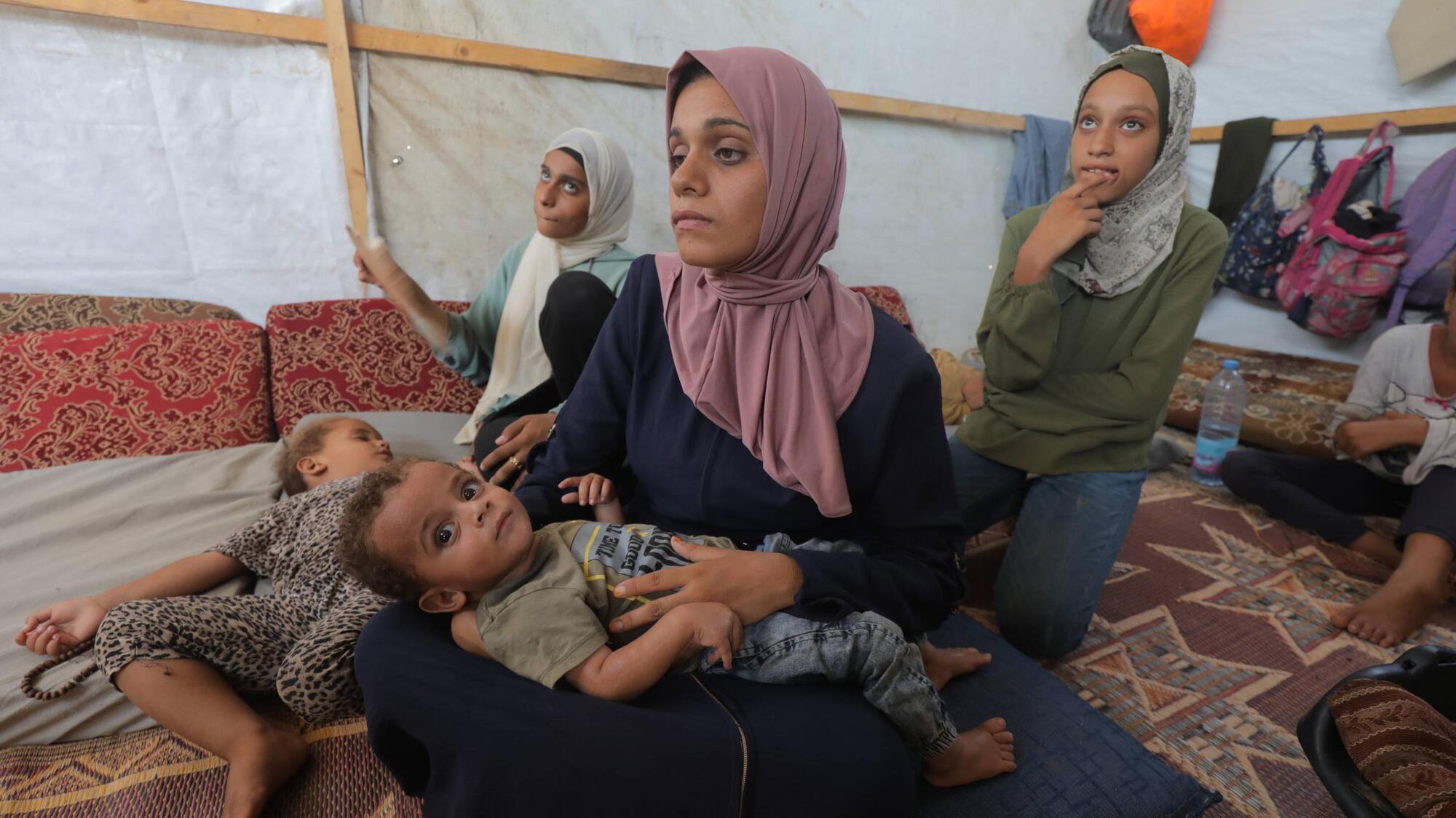
Abdul Rahman Abu al-Jidyen, 11 months, is suffering from polio, after fleeing with his family to Deir Al Balah, Gaza.
As predicted, cases have started to emerge and, mercifully, internationally-backed polio pauses have commenced to allow the distribution of critically-needed vaccines.
Without one, the WHO and partner organisations warn that children in Gaza will continue to become paralysed and polio will spread to the broader region and beyond.

Health officials have stressed that it is not a regional threat, but a global one, should it continue to spread.
In Ireland, polio vaccination figures for children aged under one year are way below 90% to 95%.
The HSE reports immunisation uptake rates in infants for the first quarter of 2024 at 86.4% — no improvement on the same figure for Q4 2023.
Some areas are worse than others. The vaccination rate in CHO7, which covers Dublin South City, Dublin South West, Dublin West, and Kildare/West Wicklow, is 82.3%. West Cork has 82% coverage, with Sligo/Leitrim at 81.4% and Dublin North 82.2%.
What does this mean? If poliovirus is found circulating in wastewater, as happened in London and New York in 2022, one in seven infants will be vulnerable to lifelong implications from a highly-contagious infection that is complicated by risk of death and lifelong disability.
The prevailing belief among most healthcare professionals is that polio is a disease from the past. Vaccines developed by Salk in 1955 (inactivated polio vaccine, IPV) and by Sabin in 1959 (oral polio vaccine, OPV) provide strong protection against polio disease. However, IPV does not provide gut mucosal immunity and so transmission of poliovirus from infected individuals vaccinated with IPV is still possible.
While OPV provides strong mucosal immunity, it carries a risk of the virus reverting to a more virulent form, leading to prolonged virus circulation and potential genetic reversion in areas with low polio vaccine coverage.
Since the introduction of vaccines, polio has become rare and its incidence has reduced by more than 99%.
However, poliovirus is still circulating and both wild-type and vaccine-derived polio cases occur every year.
Despite progress, the virus remains endemic in Afghanistan and Pakistan, with occasional outbreaks of vaccine-derived poliovirus (VDPV) in other areas with low vaccination rates.
A report in in June outlined that while major outbreaks of circulating VDPV type 1 (cVDPV1) and 2 (cVDPV2) are generally confined to sub-Saharan Africa in recent years, cases of VDPV are also seen in Europe.
Two unvaccinated children were paralysed in Israel in 2023. Environmental virus surveillance was reported in Israel, Ukraine, and Tajikistan. It was also reported in 2022 in New York and London — places known for having optimal sanitation and public health infrastructure.
Polio causes irreversible paralysis in less than one in 200 people infected, so cases of paralysis suggest that the virus is circulating more widely.
The WHO listed a new oral polio vaccine for emergency use in 2020. This vaccine contained weakened poliovirus.
Researchers used knowledge of the virus’s genome to create mutations that keep the virus from mutating to the more virulent form that can infect the nervous system. This is a significant step forward in the ability to manage outbreaks of cVDPV2, the most prevalent form of the virus, currently seen in Palestine.

In Ireland, the arrival of more than 100,000 Ukrainians since 2022 further heightens the need for comprehensive vaccine coverage in the national population.
Before the Ukraine war, vaccination rates in Ukraine were among the lowest in Europe — 20% of children were not vaccinated against measles and 13% were not vaccinated against polio. In 2021, an outbreak of vaccine-associated paralytic poliovirus was confirmed in more than 20 children, two of whom suffered acute flaccid paralysis. A mass-vaccination campaign in early 2022 was abruptly curtailed by the Russia-Ukraine war.
The reality of modern times is that competing health priorities, geopolitical barriers, civil conflicts, and the risk of future pandemics — compounded by cost-of-living crises — all challenge the ability of governments to prioritise the maintenance of uniform vaccine coverage for the global eradication of all circulating types of polioviruses.
It is not just refugees who have low vaccination rates. National vaccination rates in Ireland are way below the WHO-recommended 95% coverage required to prevent outbreaks of diseases in vulnerable unvaccinated populations.
Considering recent events in London, New York, Jerusalem, Ukraine, and now Gaza, vaccination against polio must be prioritised for refugees in congregated settings in Ireland, and all Irish children, to prevent the emergence of a highly transmissible infection with lifelong implications that is almost entirely preventable.
- Dr Catherine Conlon is a public health doctor in Cork and former director of human health and nutrition, Safefood.