Emma O'Kelly: RTÉ plan will break up, not reform the broadcaster
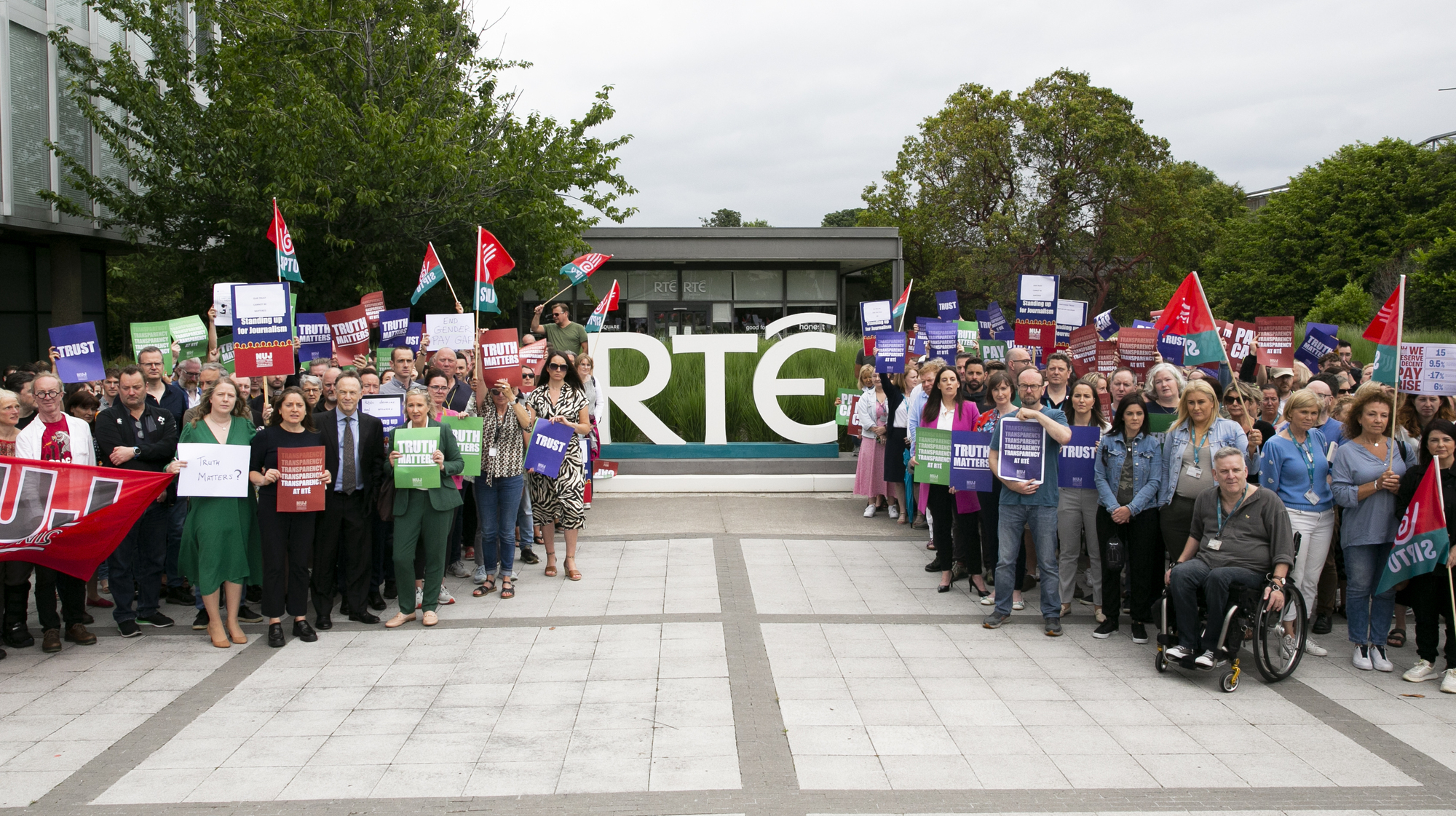
When staff protested a year ago, some feared the crisis would be used to break up RTÉ. Picture: Gareth Chaney
It was a year to the day yesterday (June 27) that staff in RTÉ first came out en masse on the Donnybrook campus and at regional offices around the country to stand together and express our dismay and anger at the revelations of the previous days.
Addressing my colleagues that day, I said that we, the staff, wanted the crisis that was unfolding to be of benefit to public service broadcasting here. I said the crisis needed to be the beginning of something new, of deep and profound reform that would give the Irish public what they deserved — a proper and fit-for-purpose broadcasting organisation.
But behind those words, I and many colleagues feared the worst. We feared that the crisis would be used to break up RTÉ, to slash jobs at the broadcaster, and outsource production to commercial companies in the for-profit sector.
That fear was confirmed last November with the publication of an outline statement of strategy for the future. RTÉ announced that one in five jobs would go, as significant sections of production were outsourced.
This week, with the publication of the full strategy for the next five years, staff learned more: The intention is to outsource production of the and as well as other programmes in both TV and radio.
The details are sketchy but at a meeting with staff on Tuesday, director general Kevin Bakhurst posed a question and answered it.

He said RTÉ was not moving to a model that would see all productions currently made by RTÉ staff go to the private sector. He said news and current affairs, sport, and “a few other genres” would continue to be made in-house. The implication seemed clear; everything else is up for grabs.
What is not clear, however, is the rationale.
We — and I mean RTÉ staff and the public — are told again and again that RTÉ needs to be smaller. Why? The crises that erupted and engulfed RTÉ last summer had nothing whatsoever to do with the number of people employed. They were about wanton profligacy and a lack of governance at the top.
The need to restore public trust in RTÉ was cited this week as another reason for the new strategy. But it was trust in RTÉ senior management that was destroyed by the revelations of last summer, not trust in RTÉ staff and not trust in its programming.
Outsourcing production to the commercial sector does nothing to restore that loss of trust, in fact it seems a perverse response. The programme that was at the centre of many of the revelations around secret payments and commercial deals, RTÉ’s flagship is now to be driven even further into the arms of commercial interests.
There were euphemisms used this week. We were told this was not outsourcing but simply moving programmes ‘off-site’, into independent studios. We were told that the RTÉ workers left behind could take redundancies and follow those programmes into the private sector, or choose to stay in RTÉ when their jobs are gone, to ‘retrain’.
RTÉ and the Government have said that there will be no compulsory redundancies but what do you do if your job is gone? One trade union official remarked that it seemed “compulsory by stealth”.
At last Tuesday’s meeting, RTÉ staff attempted to join the dots. They asked questions to try to get clarity. They expressed grave misgivings, for their jobs, and for what these plans might mean for public service broadcasting into the future.

RTÉ is home to a vast repository of programme-making skills and knowledge, including the highest editorial standards, built up and passed on over generations. Those who work in the station, even if only for a few years, imbibe these skills and standards and often carry them with them out into the private sector. Ireland’s independent sector is hugely reliant on a strong, vibrant, and reputable RTÉ.
What if this is dissipated? Once it is gone it is gone.
Staff are also struggling to find an economic rationale for outsourcing.
One speaker at Tuesday’s meeting spoke of a new cost that will come into the frame if production is outsourced — profit. “You are going to make someone very rich,” he told Mr Bakhurst.
Mr Bakhurst spoke of cost efficiency and the need “to produce in an enhanced way”, but one worker said: “I’m not sure there is anyone else that can do as well as we can do it and at the speed that we do it”.
RTÉ staff were told that there was public support for the plan, that it followed “widespread consultation”. But fewer than 3,000 members of the public responded to the online RTÉ questionnaire. They were asked to agree or disagree with leading statements such as “RTÉ should become a smaller organisation in pursuit of longer-term financial stability”.
Another rationale given for the plan to shrink RTÉ by outsourcing production is that this is the trend internationally. The example of the UK was used in Tuesday’s meeting. But the dangerous polarisation of media in the UK and elsewhere should surely serve as a warning to us, not an example.
Staff at RTÉ know there are massive challenges. We fully support a strong focus on digital services. That is where our future lies. We are fully behind the idea of moving more of what RTÉ does out beyond Dublin, to other parts of the country. We want the organisation we work for to better reflect Irish society in all its diversity and complexity, and we want our content to be where Irish audiences will access it.
But the plan announced this week is not the deep and profound reform that we called for last year. It is the breaking-up of RTÉ, and that could have profound and damaging consequences.
- Emma O'Kelly is the joint chair of RTÉ's Trade Union Group.