EU's new tariffs on Chinese electric vehicles will drive up prices
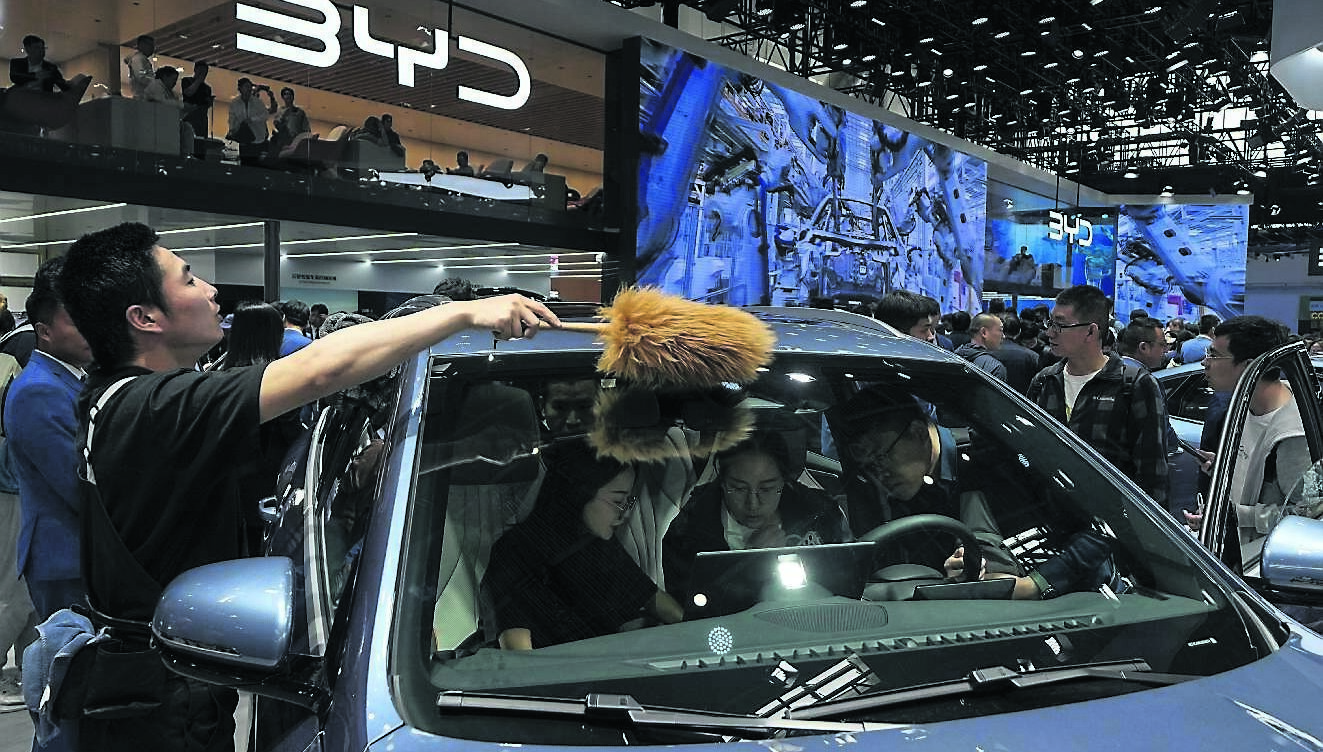
A BYD Song Pro DM-i electric vehicle car on display in Beijing: The EU is imposing levies on Chinese EVs in proportion to the amount of government subsidy each manufacturer receives. Picture: AP Photo/Andy Wong
On June 12, the European Union announced new provisional levies on Chinese electric-vehicle imports (EVs), based on how much state support manufacturers receive.
The tariffs follow a months-long investigation in to China's use of financial subsidies, and they will be imposed on top of the 10% tariff that the EU already has in place.
They are 'provisional' because they might be revised downward, if Chinese producers offer evidence that the support they receive is less than estimated.
Separately, if the EU can reach an agreement with China to reduce the volume of Chinese EV imports, the tariffs may not be implemented.
The tariffs reflect the EU's upper-bound estimate of the total subsidy per vehicle that Chinese producers receive from all levels of government throughout their supply chains.
The investigators sent requests for co-operation to all Chinese EV producers, and selected three from among those who complied: BYD, Geely, and SAIC.
They then pored over those companies’ records and interviewed company insiders and industry experts.
Concluding that the rates of subsidies are 17.4% at BYD, 20% at Geely, and 38.1% at SAIC, the investigators set tariffs on each company accordingly.
All other EV producers who co-operated with investigators will face a tariff of 21% (the weighted average of the three), while producers who have not co-operated will be subject to a 38.1% tariff.
The EU's findings provide insight into the true nature of the United States's 100% 'anti-subsidy' tariff on Chinese EVs. The US tariff, announced last month, is so much higher than any reasonable estimate of Chinese subsidies that its protectionist intent is obvious.
Even before Joe Biden's administration imposed the 100% levy on Chinese EVs, US tariffs on Chinese imports — erected under Donald Trump, but carried over by Biden — were already at levels similar to the infamous US Smoot-Hawley tariffs of the 1930s.
In 2020, a World Trade Organisation panel ruled that these tariffs are inconsistent with US legal obligations at the WTO. But both the Trump and Biden administrations have chosen to ignore WTO rules.
Most governments have said nothing publicly about the US policy, partly because the tariffs have raised the relative competitiveness of their own products in the same market, by reducing Chinese producers’ competitiveness.
Following the Trump tariffs, direct US imports from China declined precipitously, while imports from Mexico, India, Vietnam, and many other countries increased.
Some commentators seem to believe that since China’s cost advantage is so large, a 30% tariff is not enough to curtail Chinese EV exports. But this assumption is mistaken for two reasons.
Firstly, because different markets have different standards, particularly for safety, auto producers often adjust car designs, and this reduces the number of sales per model in a given market. Secondly, any model needs to reach a threshold of sales volume to be profitable. Thus, any tariff that can reduce the expected quantity of sales could remove the incentive for exporting to that market altogether.
Some Chinese EV producers might consider locating production in the US, which could be good for US job creation and tax revenues. But since the US government review of inbound foreign investment is perceived to be anti-China, many Chinese firms may simply give up on the US market entirely.
The primary victims of the US tariffs (besides Chinese exporters and US consumers) are producers from smaller countries that now face an elevated risk of larger countries imposing protectionist measures with seeming impunity.
As EVs are an important tool in the world’s transition to a net-zero economy, some subsidies are better than none. A globally efficient subsidy rate for EV production and consumption is higher in the absence of a sufficiently high global carbon tax. The EU and US probably prefer tariffs on foreign goods to subsidies on domestic EV production, because both are already burdened by high levels of debt.
The new tariffs will harm Chinese EV manufacturers’ prospects, in terms of profits and jobs. But they are also bad for European and US households, because they will raise prices (domestic producers will face less competitive pressure) and delay the transition from highly polluting traditional automobiles.
By shutting Chinese EVs out of the US and EU markets, the tariffs may drive an increase in Chinese exports to elsewhere. That will benefit consumers in those countries, and ease their transition to cleaner transportation. Among countries with small domestic auto industries, such as Australia and New Zealand, there are no obvious losers. But for countries with a sizable auto industry, there will be even greater competitive pressure, and these governments may feel compelled to imitate the US and the EU.
The world would have been much better off if major powers had negotiated a common pro-climate subsidy scheme for EVs, and a common tax on carbon emissions. Instead, we may get a self-destructive race to the bottom.
CONNECT WITH US TODAY



Be the first to know the latest news and updates