EU should stop ‘westsplaining’ and listen to its eastern members – they saw the Ukraine war coming
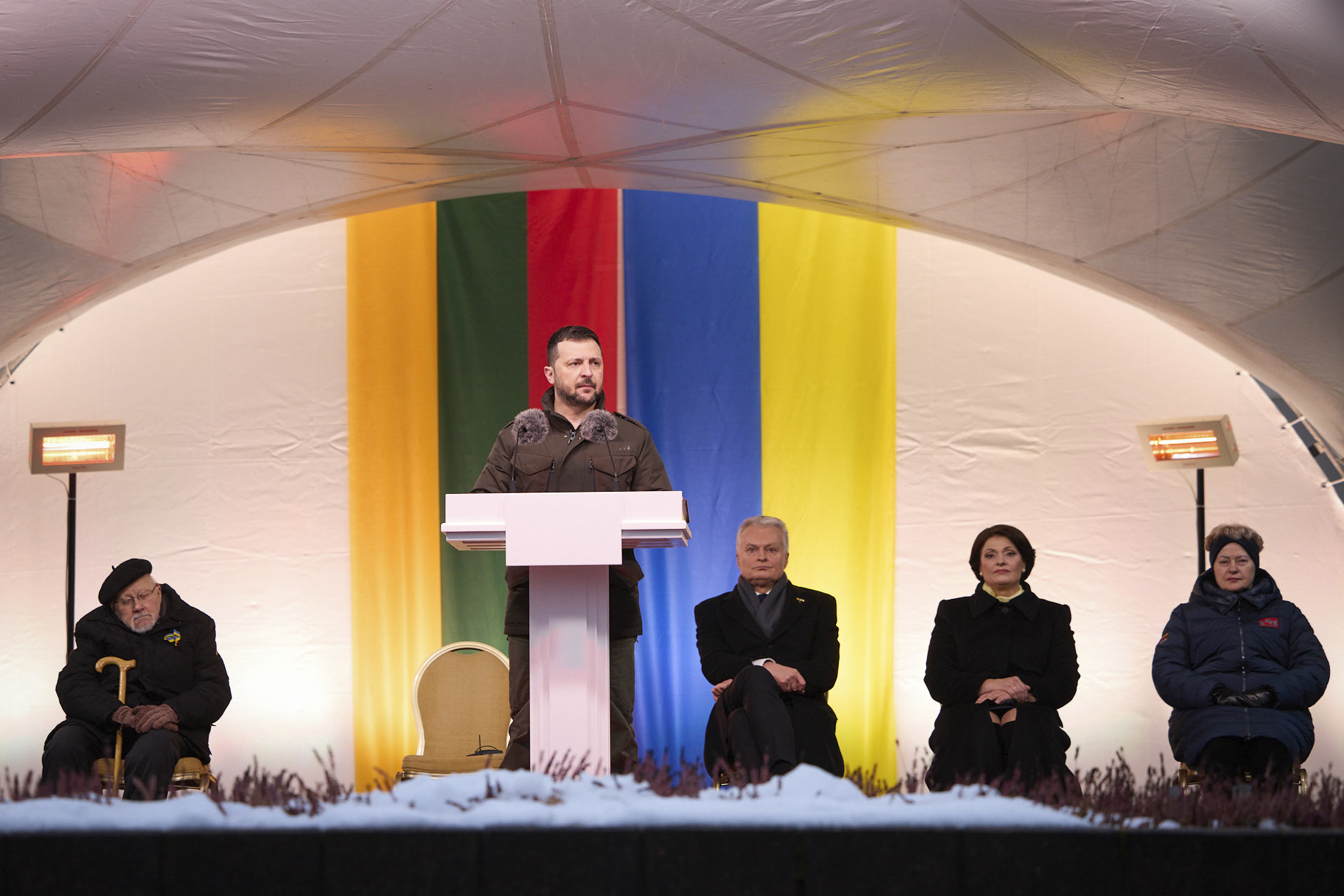
Ukrainian President Volodymyr Zelenskyy (standing) addresses people as (from left to right) Vytautas Landsbergis, first head of the Lithuania state, Lithuania's President Gitanas Nauseda, first lady Diana Nepaite and former Lithuanian President Dalia Grybauskaite sit behind him, in Vilnius, Lithuania, in January 2024. Photo: Ukrainian Presidential Press Office via AP
It’s rare for the words of Lithuanian government officials to make the top of the news outside the country. Lithuania’s views aren’t even a top priority among its allies. But perhaps it’s time that changed.
Following February’s Munich security conference, Lithuanian foreign minister Gabrielius Landsbergis warned: "We don’t lack capacity, we lack the political will and urgency necessary to support Ukraine and maintain our collective security.
During the Munich conference I was asked why I am so gloomy. Well, somebody has to tell it like it is, so here’s how it is: Things are not going well. 🧵 pic.twitter.com/NPu3y9SnP3
— Gabrielius Landsbergis🇱🇹 (@GLandsbergis) February 18, 2024
"Russia, on the other hand, has the will to destroy Ukraine and re-establish the Russian Empire. When will we start using our capacity to deter this?
Lithuania is a small country of just three million people, so perhaps we wouldn’t expect it to lead Europe’s response to Russian aggression.
However, all else being equal, and given its geographical proximity and vivid memory of the Soviet occupation, it would seem like common sense to give greater weight to the views of Lithuania and its neighbours than other nations. So why doesn’t this happen?
Vytautas Landsbergis, who was formerly the first president of the country’s parliament after independence from the USSR, predicted this war as long ago as 2008.
Interviewed by a European news website about the “situation in Georgia”, he bluntly responded:
This view stood in stark contrast to what the EU foreign ministers agreed upon at the time when they expressed “grave concern” over the war. They criticised Russia’s disproportionate response but pressed Georgia to sign the six-point ceasefire agreement, which basically allowed Russian “security forces” to implement “additional security measures”.
The ceasefire agreement led to the Russian occupation of 20% of Georgia’s territory, which continues to this day.
In 2014, when Russia occupied Crimea, other EU states agreed on certain sanctions but continued all the while to build their energy partnerships with the aggressor. Lithuania instead built its own liquefied natural gas terminal, named “independence”, which allowed it to break from its dependence on Russian gas.
In 2015, when EU countries were cautious to name the Russian Federation as an aggressor in the Luhansk and Donetsk regions of Ukraine, the Lithuanian ambassador to the UN clearly stated: “Russia is a direct party to this conflict and bears the primary responsibility for the conflict that is tearing into Ukraine’s flesh.”
By 2022, Russia had launched a full-scale attack against Ukraine. Words of support came from every direction but concrete support was less forthcoming. During the first days of the war, Germany refused to send weapons to Ukraine and even prevented Estonia from sending its old howitzer artillery weapons by withholding approval.
Lithuania, meanwhile, along with Latvia, Estonia and Poland, were sounding the alarm about the threat the situation posed to the rest of the region and called for Europe to support Ukraine “with every means available”. For many in the region, Europe should commit unambiguously to helping Ukraine win the war.
Until recently, even French president Emmanuel Macron was suggesting that Ukraine should compromise on some of its sovereignty to accommodate Putin’s demands. Such comments were coldly received in Baltic and eastern European states.
When Macron changed his strategy to say that he did not rule out sending troops to Ukraine, he faced a backlash from several European capitals. However, he found an ally in Lithuania.
This historical perspective highlights the stark difference of opinion between countries like Lithuania, Latvia, Estonia, Poland and the Czech Republic as compared to western European countries such as France or Germany. This suggests that “westplaining” still prevails in the EU.
Eastern European candidates have never been chosen for crucial roles like the Nato secretary general, for example. In fact, they are even briefed against, including by former European Commission vice president Frans Timmermans and at least one Commission official off the record.
Western Europe still does not view eastern Europe and the Baltics as equal partners. As a result, the EU — dominated by the West — still doesn’t truly perceive Russia as a direct threat to European security.
In a positive sign of recognition, EU Commission president Ursula Von der Leyen mentioned in her annual state of the union address in 2022: “We should have listened to the voices inside our union — in Poland, in the Baltics, and all across central and eastern Europe.”
This fleeting moment of acknowledgement should form the basis of a much more meaningful debate about who makes the decision in the EU and on what basis.
- Viktoriia Lapa is a lecturer at the Institute for European Policymaking at Bocconi University. This article featured on The Conversation, a news analysis and comment website written by academic experts.