Mick Clifford: Hard truths of the 1922 Bandon Valley massacre 
TG4 documentary provides a sharp-edged shovel with which to dig into a shamefulepisode of Ireland’s history that has long been kept buried, writes Mick Clifford
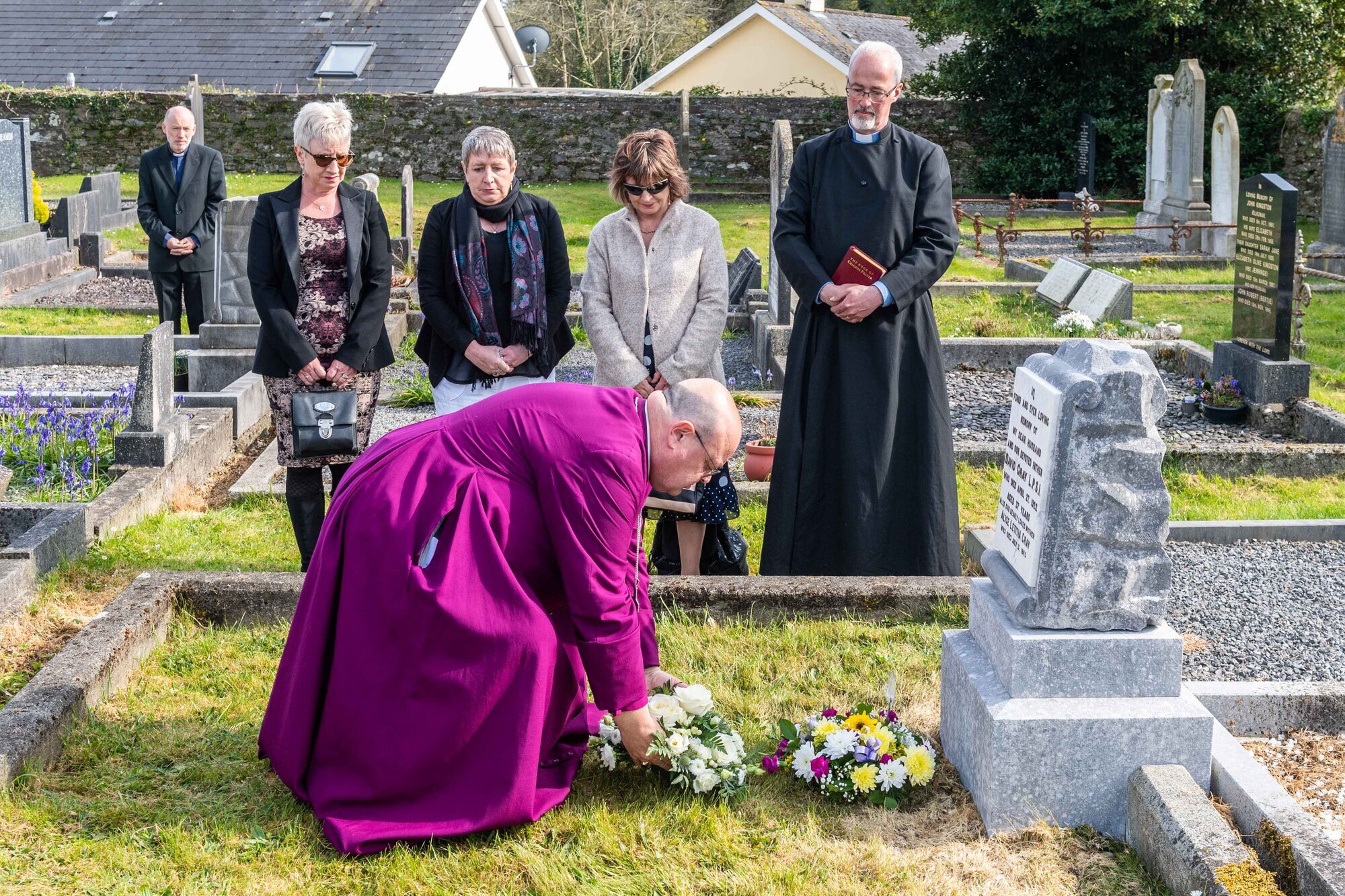
On the 100th anniversary of the Bandon Valley massacre, Bishop of Cork, Cloyne and Ross, Dr Paul Colton, lays a wreath on the grave of victim David Gray in Dunmanway. Picture: Andy Gibson.

On the 100th anniversary of the Bandon Valley massacre, Bishop of Cork, Cloyne and Ross, Dr Paul Colton, lays a wreath on the grave of victim David Gray in Dunmanway. Picture: Andy Gibson.

The centenary commemorations of the revolutionary period have been relatively sedate, tiptoeing around any lingering controversies that might reopen old wounds. This has particularly been the case in anything to do with events following the signing of the Anglo-Irish Treaty in December 1921.

Prior to the treaty, the movement for independence was as one. Afterwards came the split, not just in personnel of the day but narratives that were to endure for decades.

On Wednesday, TG4 airs a programme that ventures where others have feared to tread. Former RTÉ reporter Jerry O’Callaghan has made a film about the murder of 13 Protestants in West Cork in the lacuna between the end of the War of Independence and the beginning of the Civil War.

Marú in Iarthar Chorcaí (‘Murder in West Cork’) examines a brutal three-day period in which men varying in age from 16 to early 80s were shot dead, mostly in their homes, in the Dunmanway and Bandon Valley areas.

There is no question but these killings had nothing to do with the War of Independence. They occurred in April 1922, nearly a year after the ceasefire with the British, at a time when the leading figures of the revolution were seeking to prevent the new state falling into civil war.

These were murders, plain and simple — most likely acts of revenge. 

What has haunted the work of some historians in the last century is whether the murders could be classed as sectarian and what that, in turn, says about the nature of the revolution at that period.

O’Callaghan, a reporter of serious repute, whose father and uncle were both active in the IRA at the time, examines these issues and asks further questions, particularly the contemporary one as to whether there were differences between the violence of the revolutionary period and that of the later violence perpetrated by the Provisional IRA.

The savagery had its origins in a visit by Cmdt Michael O’Neill of the local IRA brigade to the home of Thomas and Samuel Hornibrook at Ballygroman in the early hours of April 26, 1922.

Why O’Neill and three other men showed up at the house at that time has not been established, but they were reported to be intent on taking a car belonging to the Hornibrooks. What ensued was that a relative of the Hornibrooks, Herbert Woods, shot O’Neill dead. The three Protestants were later seen being walked through Dunmanway, apparently under arrest by IRA personnel. They were shot dead soon afterwards.

Over the following three days, 10 other Protestants local to the area were also murdered.

Some had been under suspicion during the War of Independence of being informers, but that conflict had ended. Any suggestion that they were shot as informers is erroneous. One of the victims had a learning disability, another a physical disability. The youngest, Gerard McKinley, was just 16.

There is little doubt but that the murders were acts of revenge. What has divided historians since is whether these acts were sectarian and possibly reflective of a sectarian element in the conflicts at the time.

UCC’s John Borgonovo tells the programme that “one theory is they [the IRA] were trying to instil fear in the community”.

Cork-born poet Theo Dorgan says that while the three were “shot as Protestants”, it was “not because of their
religion but their loyalties”.

“It was a sectarian event, but that doesn’t mean that it was a sectarian war.”

One figure who looms large over the Bandon Valley massacre and other aspects of the time in West Cork is the late Canadian historian Peter Hart.

Mr Hart died at a young age in 2010, but one of the last interviews he ever gave was to Mr O’Callaghan, which
features in Wednesday night’s programme.

Hart’s work was highly controversial, as he challenged a few sacred cows about the revolutionary period. 

O’Callaghan delves into one of these, which concerned the famous Kilmichael ambush in which Tom Barry’s flying column killed 18 auxiliaries in a gun battle in November 1920.

Barry always maintained that there had been a false surrender which resulted in some of the Auxies opening fire and killing one of his men. Following this, he ordered his men to keep firing until all the enemy were dead. Mr Hart challenged this, and suggested that Barry had simply killed the prisoners who had surrendered.

This was sacrilege in an Ireland weened on tales of brave, virtuous boys who had beaten the odds and the enemy in battle while maintaining the highest standards of humanity. The reality was, in all likelihood, far different.

In a short space of time, the two sides in the Civil War showed just how brutal they could be when required. However, the evidence on which Hart based his reappraisal of Barry was shaky, and that is explored in the programme.

Hart’s broader thesis was that the War of Independence was, to some extent, a sectarian conflict, not dissimilar to those seen around the world at various junctures throughout the 20th century. As such, the Bandon Valley massacre was his Exhibit A.

This is disputed by various historians in Marú in Iarthar Chorcaí who posit that while Hart played a role in slaying some sacred cows, his general thesis does not stand up to scrutiny.

“He was articulating a myth held dearly in unionist opinion that southern Protestants had been massacred and driven out,” says historian John Regan, and many of his colleagues agree.

Another theme of those analysing Hart’s work is that it was greatly influenced by the contemporary violence in the late 20th century in the North.

O’Callaghan brings his camera north and explores this thorny issue, one that of late has received much airing from people who revel in the idea that there was no difference between the two conflicts. Danny Morrison, formerly Sinn Féin’s spokesman when the Provos were killing for a united Ireland, sees major parallels.

“Not only have they sanitised, they have also glamorised the IRA [of the 1920s],” he says. “They were fighting the same struggle and for the same outcome — British rule in Ireland.”

Diarmuid Ferriter advises caution, pointing out that context is required to properly make such comparisons.

The programme provides a sharp-edged shovel to dig into a past that has long been buried. Hart certainly tried to lend his effort to unearthing truths that dared not speak their name, but his compass and methods have been questioned and, in some respects, found wanting.

Jerry O’Callaghan doesn’t shy away from hard truths and asks questions that remain as awkward today as they were a century ago.

  • ‘Marú in Iarthar Chorcaí’ (Murder in West Cork) airs on Wednesday at 9.30pm, on TG4

More in this section

Revoiced

Newsletter

Had a busy week? Sign up for some of the best reads from the week gone by. Selected just for you.

Cookie Policy Privacy Policy Brand Safety FAQ Help Contact Us Terms and Conditions

© Examiner Echo Group Limited