Irish culture needs public service broadcasting to survive
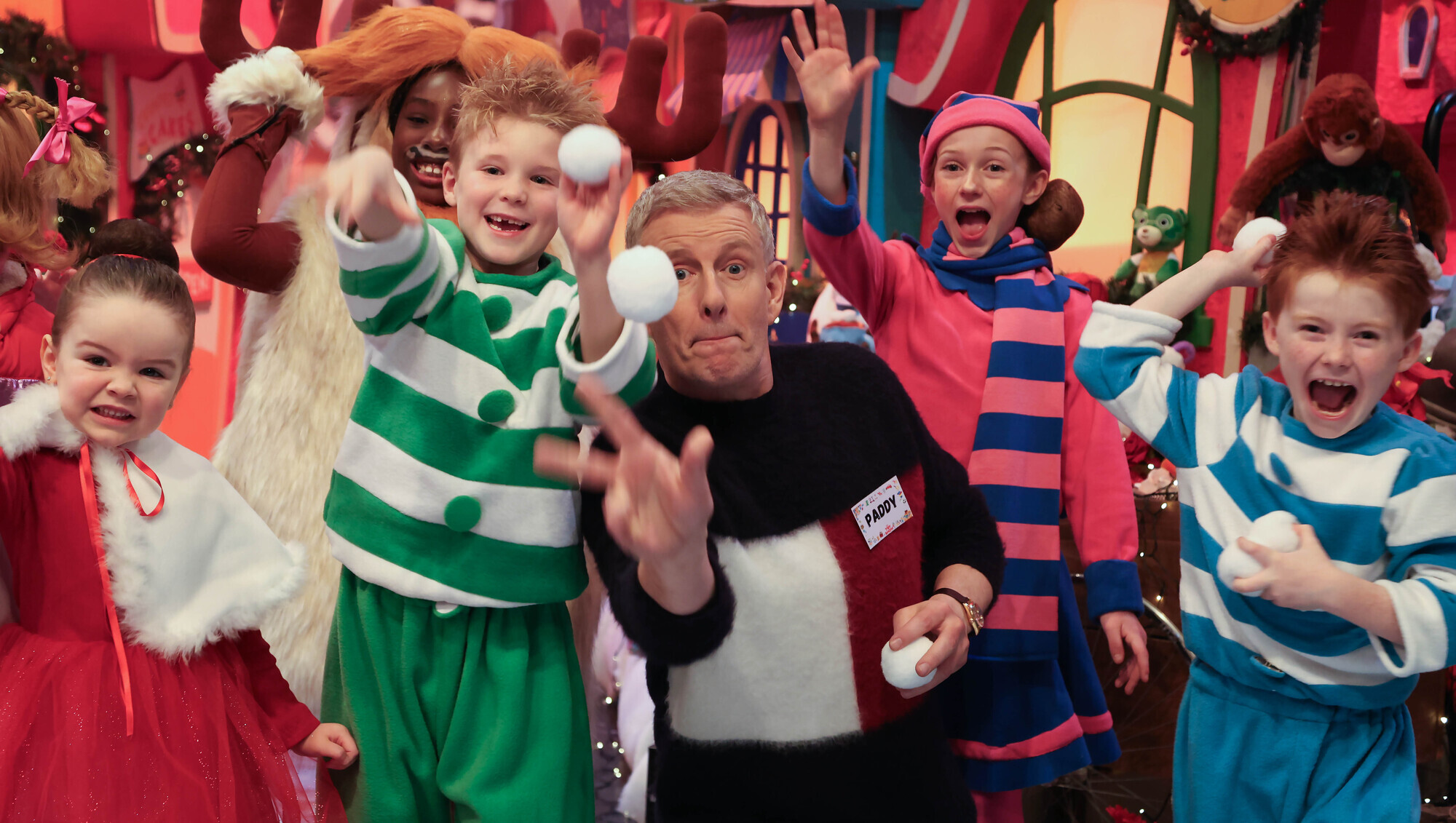
Late Late Toy Show host, Patrick Kielty with (from right to left) Paddy Geraghty (9) from Navan; Douglas Reid (11) from Carlow; Louis Hanna (7) from Dublin; Joanna Ujadughele (11) from Carlow and Bonnie Fagan (4) from Navan. Weakening RTÉ by reducing its capacity, outsourcing its core functions, or forcing it to survive as a mostly commercial operator does not modernise public service media. It dismantles it. Picture Colin Keegan, Collins, Dublin
RTÉ’s appearance before the Oireachtas today will raise familiar questions about governance and funding. But the most important question continues to be pushed aside: what is the vision for a public media institution that can meet the real and pressing needs facing our country?
In many ways, the fundamental things we need from a public media institution remain straightforward: a trusted source of national information, a space for Irish culture to thrive, and an institution capable of supporting democratic norms and the diverse needs of different groups in our society.

The rationale for a public media institution equipped to meet these needs has intensified rather than diminished. We live in an age of increasing insecurity and geopolitical tension.
In this context, it is notable many national and local media outlets are operated by companies outside the Irish state. Internationally, billionaires aligned to Donald Trump are buying up media and social media. Meanwhile, the digital platforms that have hijacked our attention show little regard for the safety of children or people’s wellbeing.

Culturally, we are a small nation in a vast English-language sphere and, while Irish creativity punches far above its weight, it is reckless to imagine that our culture and heritage matter to corporations like Disney or Netflix that now dominate the global entertainment market.
Policymakers and RTÉ management should be explaining how our public media institution will serve the country in this volatile context. Instead, the discussion keeps defaulting to cuts.
To put it starkly, we are now trapped in a cycle of “rationalising”, to use the minister’s word, the only media institution with a mandate to serve the entire Irish public at a time when the international media system, that includes social media, is creating grave problems for democratic stability, mental health and social cohesion.
A functioning public media institution is not a luxury. It is part of the basic infrastructure that supports a democratic society. Recognising that does not mean overlooking RTÉ’s shortcomings, minimising the contributions of other media, abandoning value-for-money oversight, or pretending that consumption habits have not changed.
Weakening RTÉ by reducing its capacity, outsourcing its core functions, or forcing it to survive as a mostly commercial operator does not modernise public service media. It dismantles it.
Those who argue for shrinking RTÉ often claim that it is no longer relevant. Undeniably, audiences have fragmented and younger people consume information and entertainment through very different channels.
But public service media are not judged by how much of the market they capture. They are judged by whether they remain available to all, whether they provide trusted information, and whether they serve groups and needs that commercial markets overlook.
Libraries and public parks do not lose their value because footfall declines. Their purpose is to exist for the public good. RTÉ’s purpose is the same.
The real challenge for RTÉ is therefore not relevance, but responsiveness. Research from Oxford shows that younger audiences value public service media when they encounter it. The problem for RTÉ is visibility and meet young people where they are.
That requires investment in new formats, new platforms and new forms of storytelling rather than deeper rounds of cuts. It requires a clear public service strategy for the digital era, not a continual paring back of the very capabilities needed to deliver it.
At the heart of those capabilities is in-house production. A public service broadcaster that cannot make programmes is not a public service broadcaster at all.
In-house teams do more than generate content. They preserve editorial independence, develop talent, build institutional expertise and ensure cultural continuity.
They make it possible for RTÉ to produce work that serves the public interest even when it is not commercially lucrative.
Outsourcing has an important place in Ireland’s media ecosystem, but a public institution reliant almost entirely on external production cannot reliably fulfil its public mandate.
Nowhere is this clearer than in the case of children’s media. Irish children spend much of their online lives in environments shaped by commercial incentives, data harvesting and content that varies wildly in quality.
A public media institution exists to counter those pressures, not surrender to them. Services like RTÉ Jr are designed to enrich children’s lives rather than monetise them, yet children’s programming has repeatedly been cut as RTÉ struggles to stretch limited resources.
All in-house production for young people was closed in 2016, a sad demise for a unit that delivered incredibly imaginative entertainment and characters that still resonate with audiences today.
The closure of RTÉ Jr Radio is another striking example of how reductions in capacity fall hardest on those with the least voice in public debate. If RTÉ cannot sustain its ability to make safe, high-quality Irish content for children, one of its most important public service responsibilities is already being eroded.
These realities sit uneasily beside the language of modernisation that now accompanies RTÉ’s cost-cutting.
We are told that resources must be “redirected” to meet digital audiences, particularly younger ones, yet the evidence of how this will be achieved is remarkably thin.
The recent review by the regulator and its independent consultants found no concrete plan for serving digital audiences and described RTÉ’s strategy as broad, generalised and lacking in operational detail.
In other words, the organisation is being asked to do more with less while offering little clarity about what that “more” is supposed to look like.
Cuts of this scale are not a digital strategy. They make a digital strategy harder to deliver.
Ireland is now sleepwalking into the destruction of its public media institution. Policymakers and vested interests claim that we no longer need RTÉ because all media can deliver public-interest content and because independent production companies can provide high-quality programming.
These arguments collapse two very different things into one: occasional public-interest output from private actors, and the existence of a public service institution with a democratic mandate to serve the entire population. One cannot replace the other.
Those who advocate reducing RTÉ’s capacity should be compelled to explain how Ireland is meant to safeguard its democratic life without a functioning public media institution.
They should also be required to confront the evidence that contradicts their own assumptions. Flawed beliefs about public funding, market dynamics and the nature of public service media are impeding the debate we urgently need.
More than 50 media academics from across Irish higher education institutions have now supported a statement prepared by the DCU Institute for Media, Democracy and Society calling for an evidence-based debate grounded in the country’s democratic and social needs.
That is the discussion Ireland should be having: not how to shrink RTÉ, but how to build a resilient, modern public media institution capable of serving the public good in one of the most challenging information environments our democracy has ever faced.
- Dr Eileen Culloty is an associate professor at DCU School of Communications and deputy director of the DCU Institute for Media, Democracy and Society