Our national treasures are a version of us, writ large
We cherish the example of people like the late poet, Seamus Heaney, and of the boxer, Katie Taylor, and of U2, because they show us what we can become. Our national treasures show us who we are.
This day last week, I went to Dublin to see the newly-opened Seamus Heaney exhibition. I wasnât sure what to expect.
Would I like it? Would it be too stuffy? Would the man who wrote the line, âA four-foot box, a foot for every year,â have been transformed into this god-like intellect, who was no longer accessible to me?
It was 10am when I arrived. It was lunchtime when I left. There were family photos, personal letters, private diary entries, Christmas cards, his writing desk, WB Yeatsâ lamp (which Heaney had bought) and a screen showing news reports from the day he died.
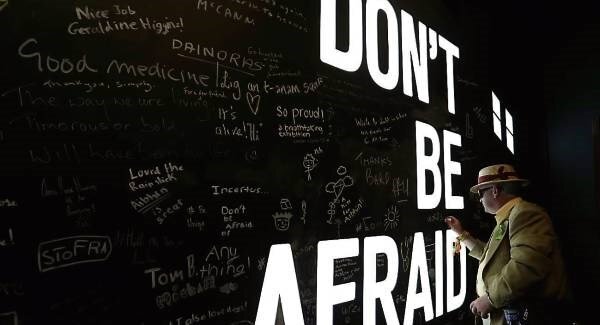
His final words, âNoli timereâ, or âDonât be afraidâ, were lit up on a big chalkboard at the exit.
Visitors left messages.
âThe nation is a man down,â read one, in reference to a newspaper letter from the time of the poetâs death.
Two women stood there reading the chalk-scribbled messages and used tissues to wipe their tears, which they had also used as they walked through the exhibition.
What was it about Heaney? Why did his work and words resonate so deeply with so many of us? Was it the accessibility of his language or something more?
He taught in Harvard. He taught in Oxford. He won the Nobel Prize in Literature. The Guardian described him as âthe greatest poet of our ageâ.
We were happy to have him representing Ireland, representing us, on the international stage.
But what is âusâ? He wrote, not with criticism, but with kindness.

Empathy ran deep in his poems. He held a sincere appreciation for nature â forests, our coastlines, the bog, animals, too. He wrote about his âsudden meltdowns of hapless affectionâ for his dog, Carlo.
People, relationships, were everything to him, like his poem about a beloved aunt: âWhile all the others were away at Mass/I was all hers, as we peeled potatoes.â
Heaney, too, had a pronounced social conscience. However, his sharp sense of injustice aside, Heaney was an optimist.
âBut then, once in a lifetime, the longed-for tidal wave of justice can rise up, and hope and history rhyme,â is now one of his most cited lines, quoted by both Joe Biden and Bill Clinton.
This national treasure of ours expressed kindness, lived with empathy, cared deeply about injustice, loved people, and erred on the side of hope, when pessimism was a surer bet.
With these characteristics, did he express the best version of Irishness, the ideal or purest version of ourselves? Was it his embodiment of these national traits that made us love him?
I got thinking about other national treasures. What was it about them that made us want to give them that special status? I consulted with some friends.
Maybe the following names would make your list; maybe not.
There was Olympic gold medallist, Katie Taylor. People liked her unwavering discipline on her path to international success. They liked how she wasnât brash. They liked her grace in defeat, too.
There was the 1990 Irish soccer team at the Italian World Cup and George Hamiltonâs voice in accompaniment.
Here we were, in a penalty shoot-out, with a teatime press conference paused by Taoiseach Charlie Haughey, and the Six One news carrying live shots of the game, as it was also being broadcast on RTĂ2.
âThe nation holds its breath,â said George, as the countryâs hopes rode high.
Alas, we did not succeed, but it was a moment in time, when, as a country, we hoped beyond hope and took our place among the nations of this world.
There was Father Ted, too. Not Dermot Morgan or Ardal OâHanlon or Pauline McLynn, individually, but the collective wit of its writers and cast.
They took on the Catholic Church, through the undefeated tool of humour, as Ireland was just beginning to take up its mantel as a modern European nation.
Here we were, with the ability to laugh at ourselves, and it being broadcast on a British station.
Marian Keyes was mentioned, too. Just like many of the other national treasures, she embodied humour and kindness, but not at the expense of honesty and insightfulness.
Take your pick of the following three, depending on your county of origin, but Brian OâDriscoll, Paul OâConnell, and Ronan OâGara are considered national treasures. Why?
For the same reasons as many of the others: success as the result of disciplined effort, grace in defeat and retirement, and humility.
Again, not as individuals, but U2, as a whole, for their unashamed ambition, for breaking America, and for lasting the test of time.
And Saoirse Ronan, our 24-year-old, three-time Oscar-nominated actor, for ânot losing the run of herselfâ, as she walks red carpets, hosts primetime American TV shows, graces the cover of Vogue, and wins Golden Globes.
Itâs been said that begrudgery is a uniquely Irish word, that we like to knock off the heads of tall poppies, or delight when they fall off themselves.
But why, then, have so many of the people we consider national treasures gone on to achieve international fame and success?
Not only do our national treasures show who we really are, they show us, too, that weâre more Buddhist than begrudger.
At the end of the day, the joy we get from relishing in the success of others (mudita) is far stronger than the pleasure we derive from celebrating their misfortune (schadenfreude).
Much like the collective, and often shared characteristics of our national treasures, our response to them shows us who we really are, and what we aspire to be.