Apple just the start of Irish battle over tax

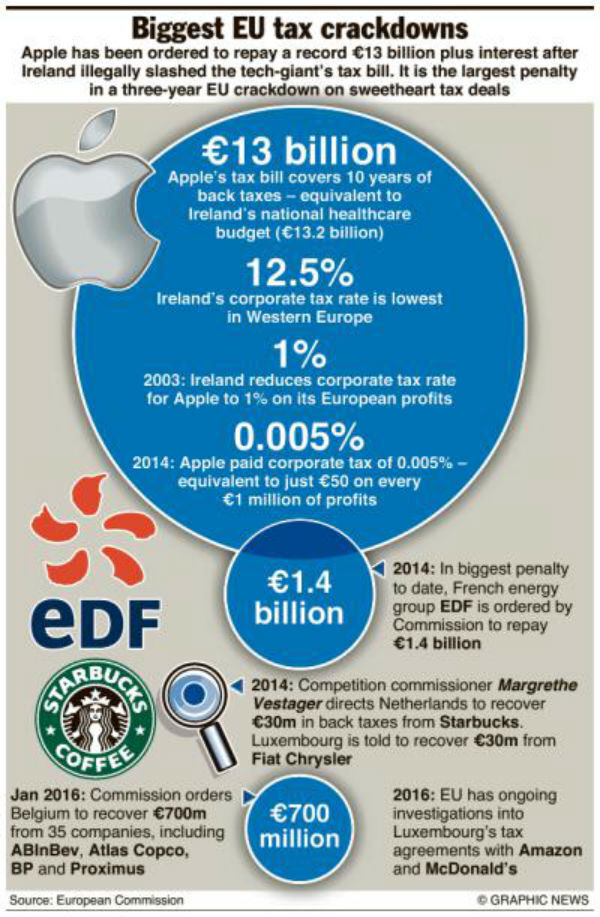
But the minority Government, in launching its robust defence against the commission, is also taking on huge political risk at home. It faces explaining to a potentially sceptical electorate why it wants to turn its back on a huge bounty of as much as €13bn in back taxes from one of the largest and richest multinationals in the world.
Apple may in the next few years employ as many as 6,000 people in Cork. It has shown its further commitment in plans to build a huge data centre in Athenry in Co Galway.
With over $230bn (€205bn) in cash, Apple is also one of the few companies in the world that will not blink in facing a tax demand from Revenue of up to €13bn in the next few months.
Proof of that came yesterday when Apple shares just about flickered. The stock fell by less than 1%, barely registering on a company valued at almost $572bn.
But the audacity of the Government’s commitment to fight the commission — pledging to lock up €13bn over many years in an account at the NTMA while it appeals the decision through European courts — shows there is a lot more going on than first meets the eye.
In fact, its fight has everything to do with ring-fencing the 12.5% corporation tax rate from a new threat from an emboldened commission.
Ireland has initiated a big fight with the commission but not necessarily with the part of the Brussels machine that yesterday handed down the order to Dublin to collect the tax from Apple.
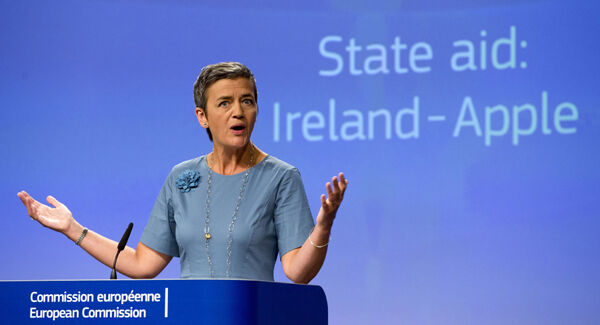
Competition supremo Margrethe Vestager over a year ago also ruled that the Netherlands with its dealings with Starbucks, and Luxembourg in its dealings with Fiat had broken state aid rules.
Both those states, which plan to appeal, offer significant tax incentives to lure incoming investments. Unlike Ireland, however, they rely a lot less on offering companies one of the lowest headline rates in Europe.
A more substantial threat facing Ireland remains firmly with a much more dangerous part of the commission — its economics, financial affairs, tax and customs directorate, led by Pierre Moscovici.
Appointed in late 2014, Mr Moscovici was sent a “mission statement”, detailing what was expected of him in his new job by commission head Jean-Claude Juncker.
Included in Mr Moscovici’s job spec was a direction to conclude negotiations with member states on plans for a financial transaction tax, as well as for a common consolidated corporate tax base, or CCCTB. Ireland had already turned its back on the financial tax and has long faced down the threat of the new pan-EU corporate tax regime.
EU officials have for some time worked on plans to share out the corporate tax spoils by agreeing on common ways to redistribute corporate taxes between member states, but firmly based on the where companies generate their sales or profits, and not on the location of tax residency.
Company profits would be split on the basis of the countries where the company generates most sales, or employs most staff, and not where their European head offices were located.
Many people believe 12.5% CCCTB would spell disaster for the decades-old 12.5% corporate headline tax rate here. The proposals were frozen when Europe was struck by the eurozone debt crisis. But Mr Juncker and Mr Moscovici — who now heads a more powerful job than any Brussels tax commissioner has held before him — are expected to push ahead with the plan.
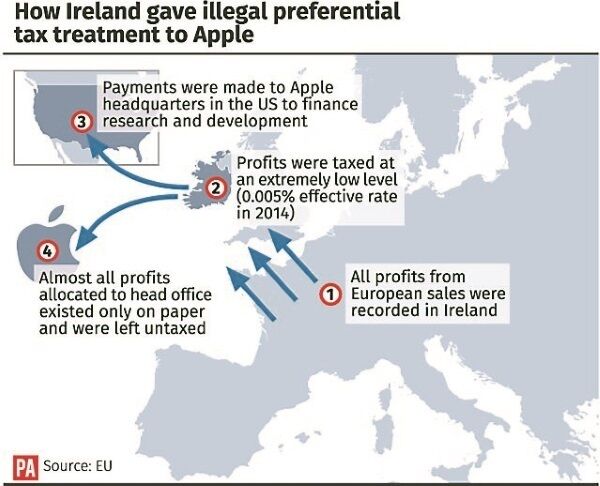
In tax strategy documents released last month, the Department of Finance said the commission was expected “to relaunch” its CCTB plan later this year.
“This proposal is expected to follow the two-step approach of seeking agreement of a common tax base before identifying how consolidation could work,” the department said, but noting that unanimity is required across the EU before any such plan can be put in place.
The Government says the commission, with its state-aid ruling, is straying into new areas in its bid to grab more control over tax sovereignty of member states.
Yesterday, the Department of Finance said it was “simply untrue” the Revenue had struck any sort of sweetheart deal with Apple.
Officials said the Government had “lots of concerns” about the direction the commission was taking and that changes to Irish corporate law in 2014 should have assuaged any concerns.
But with new CCCTB corporate tax plan looming, it is likely that the Apple case will be only the start of Ireland’s tax battles with the commission.
CONNECT WITH US TODAY



Be the first to know the latest news and updates