Mick Clifford: Michael Fingleton never faced a full reckoning for the banking crash
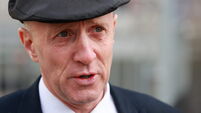
Michael Fingleton told the banking inquiry in 2015 that he didn’t “regret any decision I took'. File photo: RollingNews.ie
The front page could have been read as an incitement to commit extreme violence.
It was the morning of March 30, 2010, and looking out from the cover of the tabloid were Michael Fingleton and Seán FitzPatrick. Beneath the two faces was the headline: “They Deserve To Be Shot”.
On that day, it was revealed that Anglo Irish Bank had produced losses of €12.7bn. This was at a time when great swathes of society were finding it difficult to keep body and soul together because of swingeing cutbacks and a tanking economy.
The chief culprits identified as delivering the country to this station were the former bankers, FitzPatrick of Anglo Irish, and Fingleton of Irish Nationwide Building Society.
Later that day, the honchos in made it plain that it wasn’t intended that the headline be taken literally. But it had been an expression of the inchoate anger permeating society at a time of living, for many, on the edge of want.
Read More
The pair of bankers had become public enemies number one and two. FitzPatrick died in 2021 at the age of 73. Michael Fingleton died last Sunday, two days after Nama, the vehicle deployed to clean the national chaos created by these men and others, was officially wound up.
He was 88 and had suffered a severe stroke eight years ago. His last years must have been painful for him and his loved ones, but his illness also meant that he never had to answer fully for how he had recklessly contributed to the banking crash in 2008.
It cost €5.4bn to bail out the Irish Nationwide, money that was badly needed at the time in the most disadvantaged enclaves in the State, where unemployment and ravaged services were bearing the brunt of the economic crisis.
In 2008, when the wheels began to come off, Fingleton was estimated to be worth €75m, an extraordinary sum for a person who was nominally an employee of a mutual society.
On a pound-for-pound basis, the building society was the costliest of the banks that had to be bailed out. In 2011, it was rolled into Irish Anglo to create what was a new zombie bank.

How had a small mutual society, designed to provide mortgages to first-time buyers, morphed into an entity that at the time of the crash had loans out for over €8bn, four-fifths of which were going to developers rather than new home owners?
It also emerged in the wash that in the last year before the crash, Fingleton had received a bonus of €1m from the society. This performance-related payment came at a time when his recklessness was being exposed in loan books on a weekly basis.
He pledged to pay it back but never did. And above and beyond all that, he had no regrets. He told the banking inquiry in 2015 that he didn’t “regret any decision I took”.
“What I do regret is that, at the time, the society had a commercial loan book that was, at the time, too large, and, as a consequence of the crash, was deemed to have significant losses within that book,” he said.
It was a nonsensical answer.
Quite obviously, the reason the society had a loan book that was, as he quaintly put it, “too large”, was because he threw out loans to all comers with precious little reference even to his own board or fellow executives.
The trajectory of Michael Fingleton’s career in some ways mirrors the "growing up" of Ireland in the late 20th century and beyond.
From Tubbercurry in Sligo, where his father was stationed as a garda, his first calling appeared to be from God rather than Mammon.
After school, he attended All Hallows College in Drumcondra in pursuit of the priesthood. At the time, this wasn’t an unusual choice of career as up to 500 young men were being recruited each year.
He quit before finishing his training, but he retained a sense of vocation by joining the aid agency Concern and working for a period in Biafra in Africa.
In 1971, he joined the Irish Nationwide. At the time, it had five employees and a loan book of €2.5m.
Thereafter, he applied both his business acumen and charm to raise the roof on the place skywards towards being a fully fledged bank in mutual society clothing.
He was known for his gladhanding of politicians and developers. A frequent visitor to the members' bar in Leinster House, he was also part of the evolving developer set, which worked hard and partied harder.
His kindred spirit, Seán FitzPatrick, summed up, in 2005, the self-image that these chancers, disguised as developers and bankers, had of themselves.
“We had ideas, and we had balls,” FitzPatrick told a gathering. “We worked the scene and maximised the moment, the world watched in astonishment.”
Before too long, the world’s astonishment turned to horror and anger, and FitzPatrick, Fingleton, and their pals, looked not like buccaneering entrepreneurs but five-star chancers.
Another group that he courted assiduously was the media.
It was well known in journalist circles in the 1990s and 2000s that if you had any trouble acquiring a mortgage, Fingleton was worth a visit.
This was particularly the case for freelance journalists who usually failed to meet the criteria for lending with other institutions.
There would be no sweetheart rate. If anything, Fingleton was known to charge a premium to those who might be a risk. But merely getting access to the mortgage market was an achievement in itself.
The writer Colm Toibín, who began his working life as a journalist, used to recall that in 2009, when Fingleton was a persona non grata, they were both in a city centre hotel, and Toibín went up to shake his hand.
“He gave me my first mortgage ... when I wasn’t the most solvent person in Ireland,” Toibín recalled. “I always thought he was a chancer and I always liked him.”
Fingerton, or Fingers as he was known, was the ultimate gladhandler, whether dealing with a lowly reporter or millionaire developer. Among the latter, he was rarely far from the centre of big social gatherings.
At the height of the boom, Fingleton was one of a select group invited to celebrate the wedding of developer Seán Dunne to gossip columnist Gayle Killilea.
The nuptials took place over a two-week cruise aboard the Christina O, a palatial yacht on which its original owner, Aristotle Onassis, held his wedding to Jackie Kennedy. Later, Dunne was declared bankrupt, kicking off a process in which he remains entangled to this day.
And why wouldn’t the "masters of the universe" have held Fingers close and dear? He was doling out loans to them with the complete absence of any due diligence or risk assessment.
Internally, the society, which by the early 2000s was a bank in all but name, was his complete fiefdom. A fly-on-the-wall view of the internal workings of Irish Nationwide was provided by one of its employees in a short-lived court action in 2007.
Brian Fitzgibbon, a rising star at the institution, went to the High Court to prevent an attempt to suspend and discipline him.
He claimed that he was being wrongly blamed for loans to two crooked solicitors, one of whom, Michael Lynn, is currently serving a prison term.
Fitzgibbon claimed he was being made a scapegoat and that Fingleton oversaw all loans with precious little recourse to the rules.

Fitzgibbon was a member of the Irish Nationwide's credit committee, which was supposed to assess applications for loans in excess of €1m.
Yet, he claimed, the committee only existed “simply to satisfy the requirements of the financial regulator”.
He also said he was aware of a “significant number of high-value loans which were personally approved by Fingleton without any recourse to compliance with the normal procedures”.
Pretty quickly, once these affidavits were lodged with the court, the Irish Nationwide rushed to sort things out, and Fitzgibbon was reinstated by order of the High Court. In time, Fitzgibbon’s allegations would be borne out through various investigations.
Contrary to the most basic governance practices in any organisation, Fingleton was running a financial institution like a personal fiefdom.
This was echoed at an Employment Appeals Tribunal hearing in 2011, when a former executive, Olivia Greene, said that Fingleton ran the institution like a personal bank.
There were different lending rules for different sets of borrowers.
There was one set of criteria for the general public, “and a different set for people in certain social circles”, which included members of the government, media, and close friends.
Fingleton was obviously a talented banker who had the various attributes that were traditionally required to prosper in money lending.
At a different time, under a different government, he simply wouldn’t have been in a position to give full voice to his reckless instincts.
His story, in that respect, is not complete without reference to a system that served as an enabler to the likes of him.
Light touch regulation was the official term for a system that amounted to “stand back, and let ‘em at it.”
Instead of holding a stick over bankers, lest they let greed get the better of their prudential instincts, the regulation amounted to a few friendly chats and the deployment of the three monkeys pledged to see, hear, nor speak any evil about banking practices.
The deference shown to the banks was no secret. In 2005, the labelled Ireland “the wild west of European finance.”
A report into regulation, conducted later by the governor of the Central Bank, found that it was “excessively deferential and accommodating” to the banks.
There was “an unwillingness to take on board the real risk of a looming problem and act with sufficient decision and force to head it off”.
It should also be noted that this light-touch regime was endorsed by a government which had its eye on the bottom line of a booming economy and ears studiously turned away from the rumble of distant thunder.
Had a regulator attempted to come down heavy, they may well have found the government at odds with anything that might interfere with the inflating bubble.
Such a milieu represented an open prairie for somebody like Fingleton.
His institution was effectively wound up in opprobrium, and he was cast in the role of nation wrecker.
In public, he affected the pose of a man without regrets who was a victim of circumstance, the media, and the perennial instinct of the mob to identify a scapegoat.
But in private, he must surely have spent time in the mind’s review room, wondering where he should have modified his behaviour, at what points he should have told himself to cut it out.
The liquidator for the merged zombie bank, IRBC, sued him for negligence and mismanagement. The case dragged on for years, but in 2019, following his stroke, he was no longer in a position to give evidence.
His son informed the court that his father’s assets had been reduced to €25,000 in two bank accounts. The hearing concluded last year, with a ruling still due, although it is now unclear whether that will actually happen.
He departed without ever facing a proper reckoning, or an acceptance that he had got so much wrong at such a high cost to himself, society at large, and his family.
He didn’t set out to hurt anybody, to commit any crime, to follow a career trajectory where he would ultimately be identified with a culture of recklessness and greed.
But his talents, his timing, and his hubris all combined to set him on a path where his name will forever be synonymous with the worst excesses at a time of dangerous illusory wealth.