How Jeb Bush was swallowed by his past
At a Jeb Bush staff meeting in the conference room of a Phoenix hotel in May, a text message popped into the phone of his senior adviser and long-time confidante Sally Bradshaw that sent aides scrambling for the television: “He said it.”
It had been four days since Bush and his team rehearsed how to extinguish the political firestorm he’d ignited by saying, astonishingly, that he would have agreed with then-president George W Bush to invade Iraq in 2003 even if — and this was the killer — he’d known the intelligence was faulty.
Bush took days to spit out the prepared answer as he wrestled with himself over an issue that touched on two of the biggest stumbling blocks in his quest for the Republican presidential nomination, ones that were obvious from the beginning: Critiques of his family and the stagecraft of modern political campaigns.
When Bush finally reversed course on the Iraq question, on May 14, his aides alerted Bradshaw as Bush awkwardly installed a mea culpa at the end of his stump speech, struggling to speak in complete sentences as a confused crowd traded glances.
“If we’re all supposed to answer hypothetical questions — knowing what we know now, what would you have done? — I would not have engaged, I would not have gone into Iraq,” Bush said, before trailing off in an avalanche of qualifications.
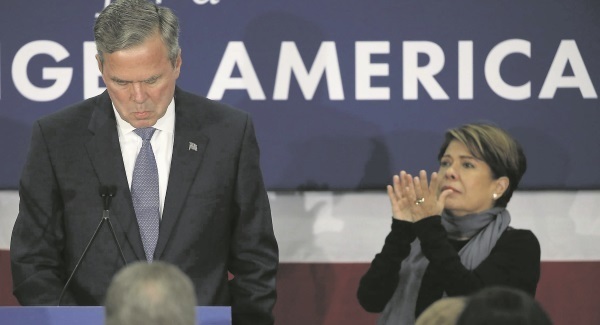
The moment, in retrospect, crystallised how hard it would be for Bush to win. On Saturday he ended his bid to become the Republican nominee, bringing to a close the modern era of GOP politics and — at least for a generation — ending the reign of a remarkable political dynasty.
One problem with Bush’s campaign, of course, is that the rules by which the dynasty had always operated did not apply in this season of the angry outsider. Bush’s record of accomplishment as Florida’s governor — not to mention his vast war chest — were relegated to mere footnotes as the race progressed. It was as though his very personality was reduced to two words by Donald Trump — “low energy” — and voters shook their heads, realised that Trump had put his finger on it, and agreed. Bush never recovered.
To blame Trump is to forgive Bush. The other problem was Jeb himself.
From the beginning, there was a dreamy, philosophical air to his effort. As he mulled his decision to enter the race, he focused on his interior thought processes, speaking of the need to be able to campaign “joyfully”.
By the end, he seemed to be observing himself from a remove. “I feel like I’m in some sort of play,” Bush said in his penultimate town hall on Friday. “We’re all part of a narrative.”
He wanted to sell himself as a thoughtful conciliator, an effective administrator, an adult. Most of the signs in the Republican Party were pointing in the opposite direction.
Bush viewed himself as a persuader, but the party’s agitated base longed for a validator. He spoke about showing his heart to voters. Conservatives wanted to see his fists.
The irony of the whole effort was that Bush had used his fists. He had bloodied his knuckles in just the kind of political street fighting that so many Republicans now are seeking.

As Florida governor, he survived a multimillion-dollar campaign launched by teachers and state-employee unions to unseat him. As governor, he had relished twisting arms and knocking heads in his own party to drive through landmark school-choice legislation.
But from the beginning of this campaign, the younger Bush struggled to get his message out. One problem was that, as Bush stumbled through the summer and autumn, Right to Rise held its fire, sitting on its enormous haul. It was only in late October that the super-Pac began pouring money in earnest in early-state markets and failed to move the needle. When the votes and dollars were tabulated, the numbers were gaudy. The Bush organisation spent over $5,000 (€4,500) per vote in Iowa, where he finished sixth, and New Hampshire, where he finished fourth, according to a Washington Post analysis.
In a normal year, buoyed by his vast financial advantage and establishment support, Bush may have been able to survive his early stumbles and steep learning curve as a candidate. But it was not a normal year, because one of his adversaries was not a normal candidate.
Bush memorably laughed at the mention of Trump during an interview on Fox News the day the New York businessman announced his campaign, a day after Bush’s own formal launch.
But the dismissiveness — which Bush immediately apologised for with a sly grin on his face — ignored potential red flags. Trump, who had flirted for years with running, was leading or near the top of several Republican primary polls four years earlier.
Almost out of the gate, Trump had tagged Bush — who, as a governor, had rebuffed Trump’s attempt to build casinos in Florida — with the “low-energy” label.

Bush, for the record, is not low energy. At that point, he was out-hustling almost everyone on the campaign trail. He was raising money almost every time he sat down for a meal, impressing donors with his executive prowess.
But it was a memorable phrase, capturing something about how Bush physically carried himself (he often slouched his shoulders, appearing to make his 6ft 4in frame smaller), his thoughtfulness, his lack of overt aggression.
When Bush fought back, his voice rising, you could feel him willing himself to confront the bully — which only reinforced the original insult.
Trump wasn’t the only beneficiary of Bush’s struggles. Another was his former Florida protégé and young man in a hurry Marco Rubio.
Many in Bushworld believed that, once they announced their huge fundraising haul, Rubio, blocked from his obvious sources of money in Florida, would wait his turn in another year. But Rubio, with his generational message, Hispanic background, and immense ambition, interpreted the situation differently, setting off a psychodrama as rich as the Bush’s with Trump, though often more veiled.

Rubio bided his time. But with Bush weakened by Trump’s attacks, Rubio saw an opening. On October 28 in Boulder, Colorado, he took it. That was the night of the third Republican presidential debate, where Bush needed a strong performance. Instead, he appeared overmatched on stage as Rubio stole Bush’s knife — an attack on Rubio’s truancy in the Senate, one that obviously was going to come — and turned it on his former mentor.
In the final days of the campaign, in the week before the South Carolina primary, Bush doubled down on family, which was after all, the foundation of his campaign.
But the Bush dynasty was also its biggest weakness. After more than a year, voters were still asking Bush at town halls how he’d be different from his brother and father.
He seemed to sense the futility. “If you’re not going to vote for me,” Bush said. “I hope you’ll pray for my family at least.”