Planners question several aspects of Ringaskiddy incinerator plan
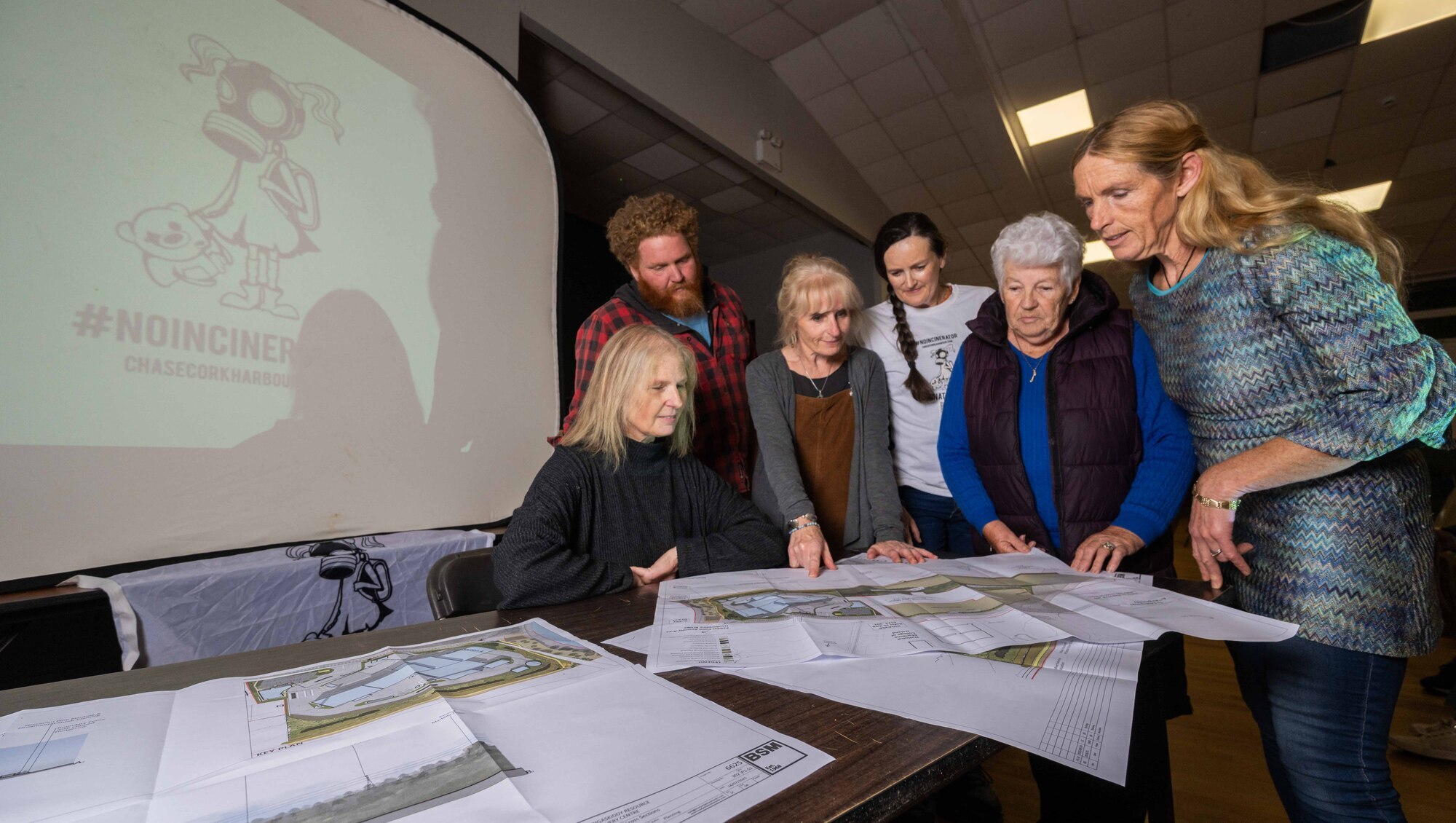
Members of Cork Harbour Alliance for a Safe Environment, including Linda Fitzpatrick, Denis Cronin, Mary O’Leary, Sue Walsh, Gertie O’Driscoll, and Marcia Dalton, reviewing plans for the incinerator last year. File picture: Joleen Cronin
Planners have requested further information on a proposal to build an incinerator in Cork Harbour almost 25 years after planning permission for it was first sought.
Indaver Ireland now has until August 31 to submit new information on its proposed incinerator in Ringaskiddy to An Coimisiún Pleanála.
The request follows 991 submissions received during the public consultation period that closed on November, 17, 2025, which included submissions from many organisations and individuals concerned about bringing a waste incinerator to the coastal area.
Following validation by An Coimisiún Pleanála of these submissions, Indaver submitted a 390-page response on March 18. However, the planning board has identified multiple areas that it said require further clarification.
These include a detailed assessment of how Indaver will monitor and manage the destruction of PFAS, otherwise known as 'forever chemicals', at the site. PFAS are chemicals that have been linked to certain cancers and other health problems.
The European Commission’s Joint Research Centre indicates that temperatures of 1,100–1,200°C are needed to destroy PFAS, but this is significantly higher than Indaver’s proposed operating band of 850–1000°C, campaign group Cork Harbour Alliance for a Safe Environment (Chase) said.
Read More
The planning board has also called for an R1 value, which measures energy efficiency in a waste incinerator so that it can be evaluated if the facility qualifies as an energy recovery operation — whether or how efficiently it can burn waste and transform that into energy.
An assessment of the impact that disposal of the plant’s bottom ash could have on Ireland’s landfill capacity has also been requested.
The proposed incinerator’s air quality and stack (chimney) has been questioned. Although Indaver’s own modelling identifies a good engineering practice stack height of 114.25m, their proposed stack is 70m, Chase has claimed.
An Coimisiún Pleanála has requested that Indaver address what this shortfall means for building downwash (where emissions can be pulled back down towards ground level) and the resulting pollution concentrations at nearby homes and other sensitive locations.
Updated noise baseline surveys using current datasets have also been requested.
Chase, a local group which has campaigned against the incinerator for many years, said that the planning board had “identified significant areas of real shortcoming” in Indaver's application.
“In plain English, Indaver is being asked to explain how it will make safe chemicals its incinerator can’t reliably operate at a high enough heat to destroy, what a stack 44m short of good engineering practice will mean for nearby homes, to update a 10-year-old application with current data and methodology to meet current and future standards across a number of areas, and to prove with calculations instead of reassurances, that this proposed project is not a simple disposal option,” a spokesperson said.
Indaver has proposed to build a waste-to-energy facility for the treatment of up to 240,000 tonnes per annum of residual, household, commercial and industrial non hazardous and hazardous waste in Cork Harbour.
This waste is currently landfilled or exported, the company said. Of the 240,000 tonnes of waste, up to 24,000 tonnes per annum of suitable hazardous waste would be treated at the facility, Indaver said.
CONNECT WITH US TODAY



Be the first to know the latest news and updates