Surreal situation as US sends help to destroy US weaponry
IRAQI security forces lost 2,300 Humvee armoured vehicles when Islamic State overran the northern city of Mosul in June 2014, prime minister Haider al-Abadi said on Sunday.
Coupled with previous losses of US weapons, the conclusion is simple: The US is effectively supplying Islamic State with tools of war the militant group cannot otherwise hope to acquire from its patrons.
In addition to the Humvees, Iraqi forces previously abandoned significant types and numbers of heavy weapons to Islamic State. For example, losses to Islamic State include at least 40 M1A1 main battle tanks, as well as small arms and ammunition, including 74,000 machine guns, and as many as 52 M198 howitzer mobile gun systems.
“We lost a lot of weapons,” Abadi admitted.
To help replenish Iraq’s motor pool, the US state department last year approved a sale to Iraq of 1,000 Humvees, along with their armour upgrades, machine guns, and grenade launchers.
The US previously donated 250 mine-resistant armoured personnel carriers (MRAPs) to Iraq, plus unaccountable amounts of material left behind when American forces departed in 2011. The US is currently in the process of moving to Iraq 175 M1A1 Abrams main battle tanks, 55,000 rounds of main tank-gun ammunition, $600m (€537m) in howitzers and trucks, $700m worth of Hellfire missiles, and 2,000 AT-4 rockets.
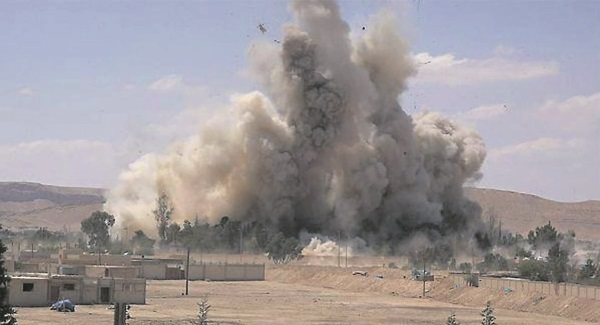
The Hellfires and AT-4s, anti-tank weapons, are presumably going to be used to help destroy the US armour in the hands of Islamic State. The US is also conducting air strikes to destroy weapons seized by Islamic State.
It’s a surreal state of affairs in which American weaponry is being sent into Iraq to destroy American weaponry previously sent into Iraq. If a new sequel to Catch-22 were to be written, this would be the plot line.
The US also continues to spend money on training the Iraqi military. Some 3,000 American soldiers are in Iraq preparing Iraqi soldiers to perhaps someday fight Islamic State; many of the Americans are conducting the training on former military bases abandoned by the US following Gulf War 2.0.
In addition, some $1.2bn in training funds for Iraq were tucked into an omnibus spending bill that US Congress passed earlier this year. This is in spite of the sad reality that from 2003 to 2011, the US spent $25bn training Iraqi security forces.
The return on these training investments? The Iraqi army had 30,000 soldiers in Mosul, who ran away in the face of about 1,000 Islamic State fighters. The same thing happened just a few weeks ago in Ramadi, where 10,000 Iraqi soldiers, collapsing faster than a cardboard box in the rain, fled ahead of only 400 Islamic State fighters. The Iraqis left behind more weapons.
In an interview with me a year ago, Chris Coyne, professor of economics at the Mercatus Centre at George Mason University, predicted this exact scenario well before the US sent troops back into Iraq: “The United States government provided significant amounts of military hardware to the Iraqi government with the intention that it would be used for good. However, during the Islamic State offensive, many of the Iraqis turned and ran, leaving behind the United States-supplied hardware. This weapons windfall may further alter the dynamics in Syria.
“Now the United States government wants to provide more military supplies to the Iraqi government to combat Islamic State. But I haven’t heard many people recognising, let alone discussing, the potential negative unintended consequences of doing so.
“How do we know the weapons and supplies will be used as desired? Why should we have any confidence that supplying more military hardware to a country with a dysfunctional and ineffective government will lead to a good outcome either in Iraq or in the broader region?”
The impact of all these heavy weapons falling into Islamic State hands is significant for American foreign policy goals in the Middle East. A report prepared for the UN’s Security Council warns that Islamic State possesses sufficient reserves of small arms, ammunition, and vehicles to wage its war in Syria and Iraq for two more years.
And that presumes the US won’t be losing more tools of war to Islamic State, thanks to the Iraqi army.
IS possesses sufficient reserves of small arms, ammunition, and vehicles to wage its war in Syria and Iraq for two more years