West Ham’s goal against Arsenal was correctly disallowed. The rest is just noise
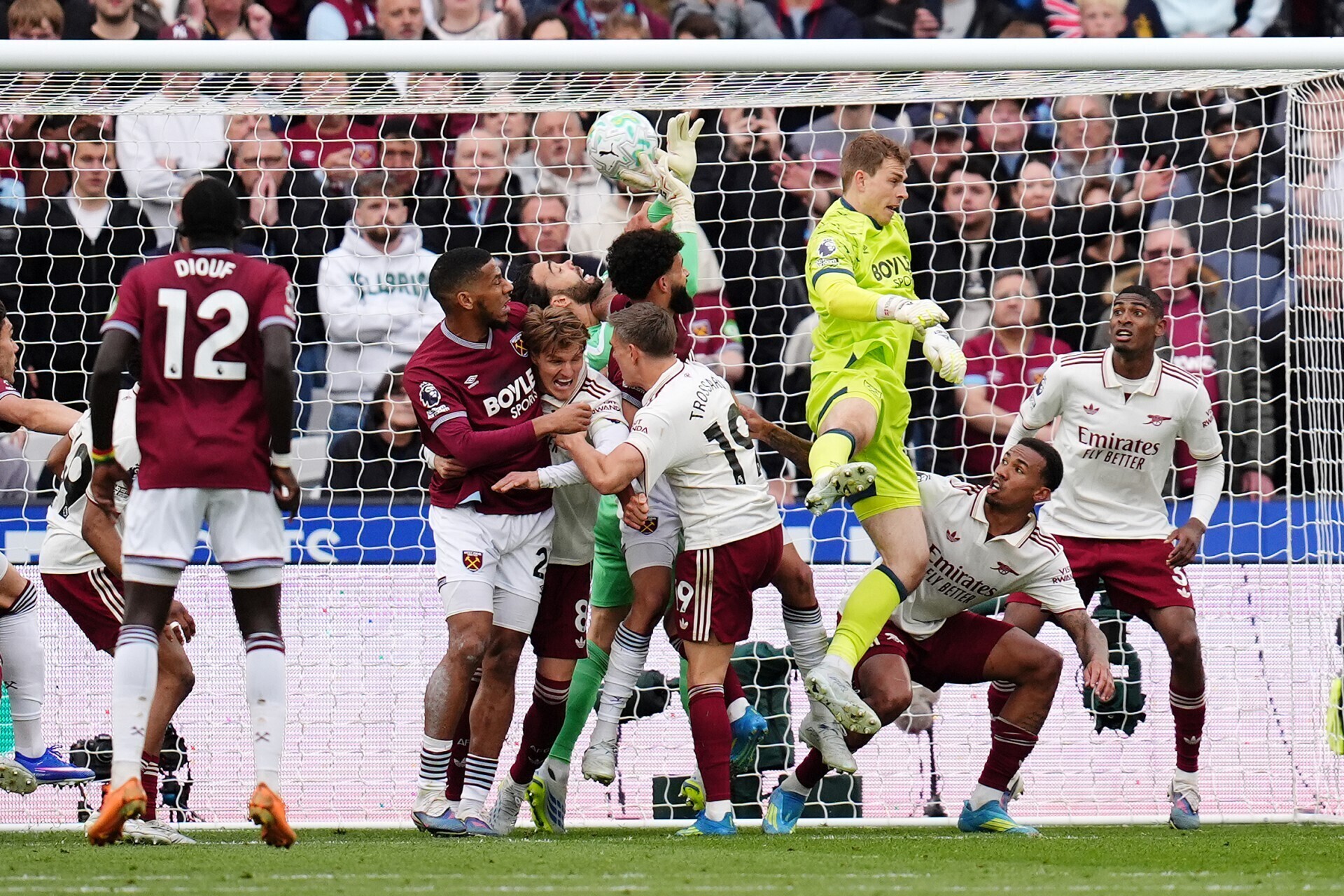
Arsenal goalkeeper David Raya (centre left) is fouled by West Ham United's Pablo Felipe in the build up to Callum Wilson disallowed goal during the Premier League match at London Stadium, London. Picture: John Walton/PA Wire.
A corner. A melee. Bodies everywhere. Blocks and tugs, pulls and shoves. A VAR decision. Fury. Empty noise. A title perhaps decided; a significant impact on the relegation battle. Shouting. Confused pundits ranting. Social media figures rallying to the side they were always going to take. Welcome to modern soccer.
After what looked like an injury-time equaliser for West Ham was ruled out on Sunday, Arsenal now need only to beat Burnley and Crystal Palace to be sure of their first Premier League title in 22 years. In the relegation scrap, West Ham are a point behind Tottenham, who played at home to Leeds, now safe, on Monday evening. But the big issue is a VAR decision. Of course it is: this is 2025-26.
Let’s begin with the basic point. Arsenal goalkeeper David Raya was fouled, if not by Pablo then certainly by Jean-Clair Todibo, who pulled his shirt. West Ham (and Manchester City by extension) could feel aggrieved had the potential equaliser been ruled out for the way Pablo’s arm stretched across Raya’s neck, which looked far worse in a still or slowed down image than it did it real time, where it became apparent that Pablo was bracing himself as Leandro Trossard barrelled into him, and Raya had run into him. But the Todibo pull is clear, and referees love shirt-pulls because they are definitive. A shirt was pulled: it was a foul, and so the goal was rightly disallowed.
And so we come to the other issues. Haven’t Arsenal got away with worse this season, most notably their goals against Manchester United in the opening weekend and against Aston Villa at the end of December? To which the answer is possibly, but it’s really not the job of Sunday’s referee, Chris Kavanagh, or VAR official, Darren England, to consider that. Their job is simply to consider the incident in question and make the best call they can: that one team got the benefit of a tight decision in the past, whether five minutes ago or five months ago, should make no difference.
What about all the other fouls going on simultaneously in the box? Why penalise that one? Because that’s the one that had an obvious impact on whether the goal was scored or not. There is a far bigger debate to be had on how soccer polices the box during set plays, where blocking, obstruction and holding are widespread. The way Declan Rice wrestled Konstantinos Mavropanos, for instance, cannot be allowed. But to complain about a player being penalised for tugging a goalkeeper’s shirt as he was about to try to catch a ball seems wilfully obtuse. What’s the alternative to picking on the incident with the most material impact? To see which happened first? VAR is intrusive and slow enough without endless analysis of a dozen different potential offences, trying to work out whether grappling incident A began a millisecond before pushing incident B.
And to those who complain that it took so long, well, that’s VAR. If soccer is going to have it – and that it was introduced without proper trialling or any real discussion of the likely consequences, and has been enormously damaging to the match-going experience is surely obvious to even its most committed proponents – there has to be an acceptance that some decisions will take several minutes. The disruption to the flow of the game and the loss of spontaneity were always probable drawbacks but, once the game has been stopped, it makes even less sense to place officials under additional pressure to meet some arbitrary time limit. Better to get it right after six minutes than be guessing after three; although it may be that the best course of action turns out to be not delaying the game at all and just accepting the decision of the on-field official.
And then there’s the debate – of which, yes, this piece is part. At least some of the reaction when Callum Wilson’s shot had crossed the line was weariness at the thought of the endless discourse it would provoke. That sense of fatigue has already been thoroughly justified. All VAR has done is make the debate around refereeing more tendentious, more furious, because the explanation that officials simply hadn’t seen an incident no longer holds. Now there are endless debates about what the precise wording of the law actually means, squabbling about what “clear and obvious” entails, allied with accusations of bias and conspiracy, none of it helped by a culture that encourages actual journalists to abandon even any attempt at objectivity. Noise, argument, anger … all of it is engagement, driving the mills of the social media content machine.
But beyond the fury, and beyond the ever greater doubts about VAR, one fact remains: Kavanagh and England got the decision correct. Raya was fouled. The goal was correctly ruled out.
Guardian
CONNECT WITH US TODAY



Be the first to know the latest news and updates